How Cloud Backend Supports Long-Term Mobile App Growth In 2026
In 2026, mobile applications will no longer be built only for launch. They are designed to evolve and adapt to changing user expectations…
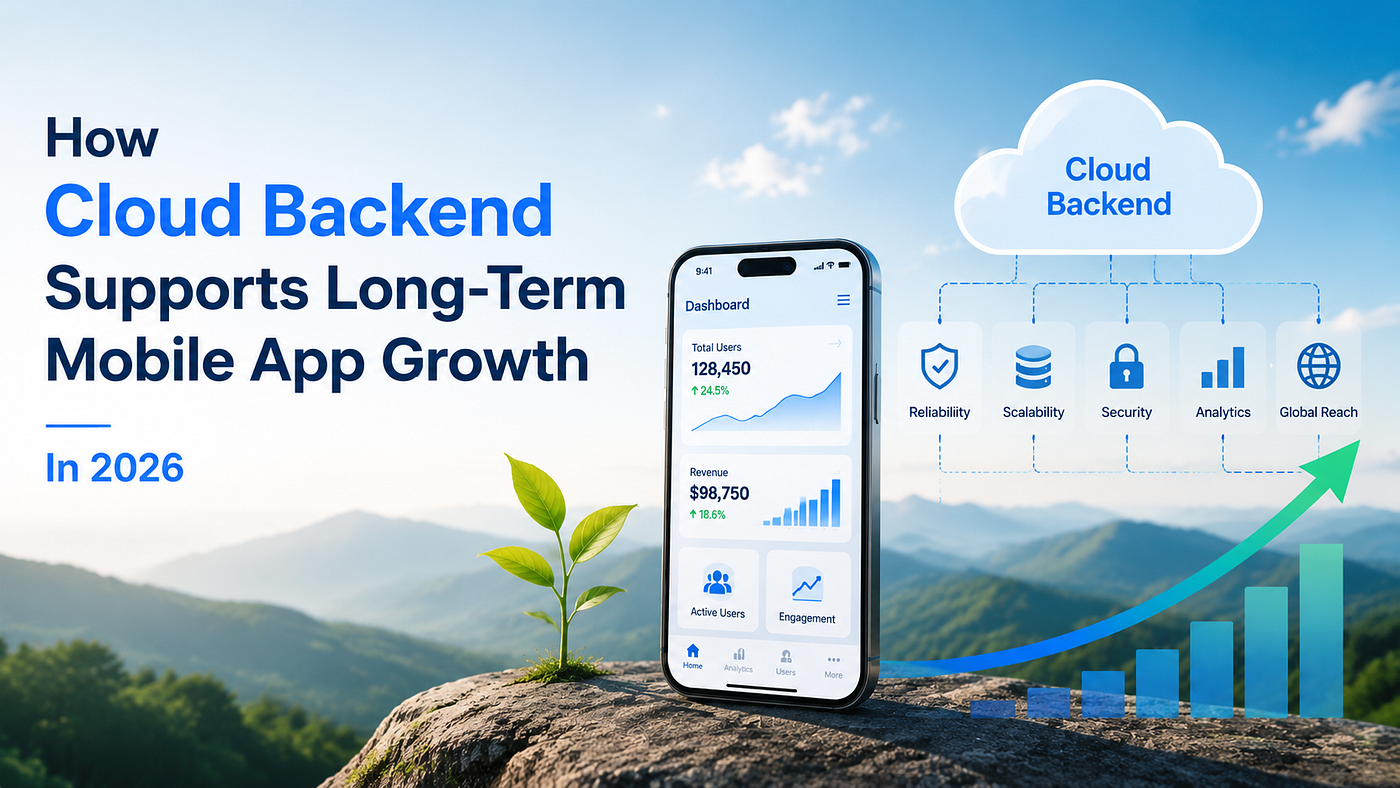
How Cloud Backend Supports Long-Term Mobile App Growth In 2026
In 2026, mobile applications will no longer be built only for launch. They are designed to evolve and adapt to changing user expectations over time. This shift makes backend architecture a central part of product strategy, which is why many companies invest in cloud-based backend development solutions. Cleveroad, a custom software development company delivering web and mobile systems since 2011, treats the cloud backend as a foundation for sustainable product growth and consistent performance.
In this article, you’ll learn how cloud backend supports long-term scalability and how businesses can use it to maintain stable growth.
Why Backend Architecture Defines Product Longevity
A mobile app’s success depends not only on its interface but also on how well it handles growth over time. Backend systems process user data and ensure consistent functionality.
If the backend cannot scale, the entire product becomes unstable under increased demand. Performance issues and system failures often originate from limited infrastructure.
Cloud backend changes this dynamic by allowing systems to expand without major restructuring. It creates an environment where growth is planned from the start rather than addressed after problems appear.
How Cloud Backend Enables Continuous Scaling
Scaling isn’t just about handling additional users. It is similarly about providing new services and supporting more data usage. A micro-cloud-based backend can also allow for applications to automatically scale resources based on your requirements. If user activity increases, then the appropriate additional computing and storage can be provided without your intervention.
These added capabilities also enable you to develop your product in phases, with limited redesign of the backend and its capabilities.
Thus, for companies with long-term development plans, in highly evolving applications, and with high uncertainty regarding future requirements, this type of approach can reduce overall technical risk and provide greater capability flexibility for application evolution, as well as the ability to support continuous feature and function releases.
Managing Product Updates With Cloud Infrastructure
To keep mobile applications up to date and relevant, they must be updated regularly. The ability to deliver timely updates to applications is influenced by the application’s backend architecture.
With a cloud backend solution, the server-side of an application is separate from the mobile application. This separation allows developers to update application features without requiring users to download an app update.
The cloud backend also dramatically simplifies the testing of any new feature(s) as it allows developers to deploy these features on the cloud and then use user feedback to adjust them accordingly.
Teams with structured development processes, such as Cleveroad, often rely on this flexibility to maintain consistent product improvement without disrupting user experience.
Supporting Data Growth And Complexity
As applications grow, so does the amount of data they handle. This includes user information and media content.
The cloud backend provides storage systems that scale up as demand increases. It also supports different data types, including structured and unstructured formats.
Efficient, secure data management is critical for applications that rely on analytics or personalized experiences.
As data volume grows, performance will decline without scalable storage and processing. Cloud solutions prevent this by distributing workloads across many systems.
Integration Capabilities In Cloud-Based Systems
Mobile applications today typically do not run alone but instead use third-party providers and integrate with external communities. By providing applications with standardized APIs and flexibility for connecting various services, cloud backends help facilitate reaching out to other systems (integration). Connecting your app to third-party systems makes it easier for developers to implement new tools or expand their app’s feature set without having to rebuild the underlying core of their app from scratch.
For companies that use several digital services, this ability reduces the time spent on application development and increases consistency across their systems.
Risk Management And System Stability
Constant, reliable performance can be maintained through proactive risk management. Backend system problems can create uncertainty regarding both customer trust and business operations.
The cloud back-end provides additional mitigating strategies by distributing computing and incorporating redundancy into the architecture. This means that the failure of one component does not impact the operation of other components.
Monitoring tools monitor the health of back-end systems, and alerts and automated responses enable quick reactions by appropriate personnel to address potential backend problems before they affect end users.
The process of integrating these management tactics is typically handled by skilled development teams like those of Cleveroad while developing backend architectures for sound business operation.
Planning Cloud Backend For Sustainable Growth
Adopting a cloud backend is not only a technical decision. It requires alignment with business goals and product strategy.
Start by identifying expected growth patterns. This includes user acquisition and data requirements.
Design backend systems with flexibility in mind. Modular architecture allows easier adaptation to new needs.
Implement performance-monitoring and cost-control measures early. This helps maintain efficiency as the system scales.
By planning these aspects from the beginning, companies can avoid costly restructuring later.
Conclusion
In 2026, the cloud backend will play a critical role in supporting long-term mobile app growth. It allows systems to scale and remain stable as user demand increases.
However, its effectiveness depends on thoughtful architecture and continuous optimization. Businesses need to consider scalability and integration capabilities when designing backend systems.
Cleveroad helps companies build cloud-based backend solutions that support sustainable development and reliable performance throughout the product lifecycle.
To better understand how cloud backend contributes to mobile app success and explore practical implementation insights, read Cleveroad’s article about the benefits of cloud backend.
Frequently Asked Questions
Why is cloud backend important for long-term app growth?
It allows applications to scale resources, handle increasing data volumes, and support new features without rebuilding the system.
How does the cloud backend handle increasing data volume?
It uses scalable storage and distributed processing to maintain performance as data grows.
Can the cloud backend support multiple integrations?
Yes, it enables connections with external services through APIs, making integrations more flexible.
What is the main risk when scaling without a cloud backend?
Limited infrastructure can lead to performance issues, system failures, and difficulty in adding new features.
메타데이터
- post_id
- 4ac85d4cd981
- slug
- how-cloud-backend-supports-long-term-mobile-app-growth-in-2026-4ac85d4cd981
- url
- https://medium.com/@Cleveroad/how-cloud-backend-supports-long-term-mobile-app-growth-in-2026-4ac85d4cd981
- canonical_url
- https://medium.com/@Cleveroad/how-cloud-backend-supports-long-term-mobile-app-growth-in-2026-4ac85d4cd981
- author_url
- https://medium.com/@Cleveroad
- status
- ok
- fetched_at
- 2026-07-13 06:23:13