Best trigonometry study resources
If you are unable to Pass your Exams, Quizzes, Tests or Unable to Handle Homework Assignments or full course online, Get paid help from…
Best trigonometry study resources
If you are unable to Pass your Exams, Quizzes, Tests or Unable to Handle Homework Assignments or full course online, Get paid help from Online Helpers at Hiraedu! Contact Details for HiraEdu Helper: WEBSITE: hiraedu. com WhatsApp: +12136359834 Email: info@hiraedu. com Call: +12136359834
Quick Answer
The best answer to ‘Best trigonometry study resources’ depends on the learner’s goal. A student who needs homework support should start with clear lessons and worked examples. A student preparing for a test should add official practice and timed review. A teacher needs resources that are easy to assign and assess. A college student often needs textbooks, lecture notes, calculators, and discussion forums. In most cases, the strongest setup combines one lesson source, one practice source, one checking tool, and one place to ask questions.
Why This Guide Matters
This guide focuses on a specific area of mathematics and shows how to learn it with websites, books, videos, practice problems, and checking tools. The best subject study plan starts with definitions, moves to worked examples, then builds fluency with mixed practice. Students should not only memorize formulas. They should learn when a formula applies, why it works, and how to check the result.
Math is one of the easiest subjects to practice badly. A student can watch ten videos and still be unable to solve a problem alone. A parent can buy a tutoring package without knowing whether the tutor is fixing the real gaps. A teacher can assign many worksheets without building understanding. This guide helps avoid those problems by showing how to choose resources for explanation, practice, feedback, and long-term skill growth.
The websites and tools in this article are not ranked only by popularity. They are judged by usefulness, clarity, reliability, practice depth, cost, level coverage, and how well they help a learner move from confusion to independent problem solving. Some resources are best for beginners. Some are best for advanced learners. Some are best used only after a student tries the problem by hand.
What Makes a Math Resource Good?
A good math resource explains the idea before asking for speed. It uses examples that show the steps, gives practice that starts easy and becomes harder, and provides feedback when the student makes a mistake. It also helps students see patterns across problems instead of memorizing one trick for one worksheet.
A weak math resource gives an answer without teaching the method. It may look helpful because it finishes homework fast, but it does not prepare the student for quizzes, tests, or new problems. The best resources build independence. They make students ask, ‘Why does this step work?’ and ‘How would I solve a similar problem tomorrow?’
When comparing math websites, apps, tutors, and courses, use four questions: Does it match my level? Does it explain clearly? Does it give enough practice? Does it help me check understanding without simply copying answers? If the answer is yes, the resource is probably worth trying.
Best Resource Stack for Most Learners
For a balanced math study system, choose one main lesson source, one textbook or written reference, one practice source, one graphing or checking tool, and one support option. For example, a high school algebra student might use Khan Academy for lessons, OpenStax for written examples, IXL or DeltaMath for practice, Desmos for graph checks, and a tutor or teacher for confusing questions.
For a college calculus student, the stack might be Paul’s Online Math Notes, OpenStax Calculus, MIT OpenCourseWare, Wolfram Alpha, and a weekly study group. For a teacher, the stack might be NRICH for rich tasks, DeltaMath for practice, Desmos for visualization, OpenStax for references, and GeoGebra for geometry or graph demonstrations.
Do not collect too many resources at once. Resource overload is real. Students often spend more time searching than studying. Pick a small stack, use it for two weeks, measure progress, and adjust only when needed.
Detailed Reviews of Recommended Math Resources
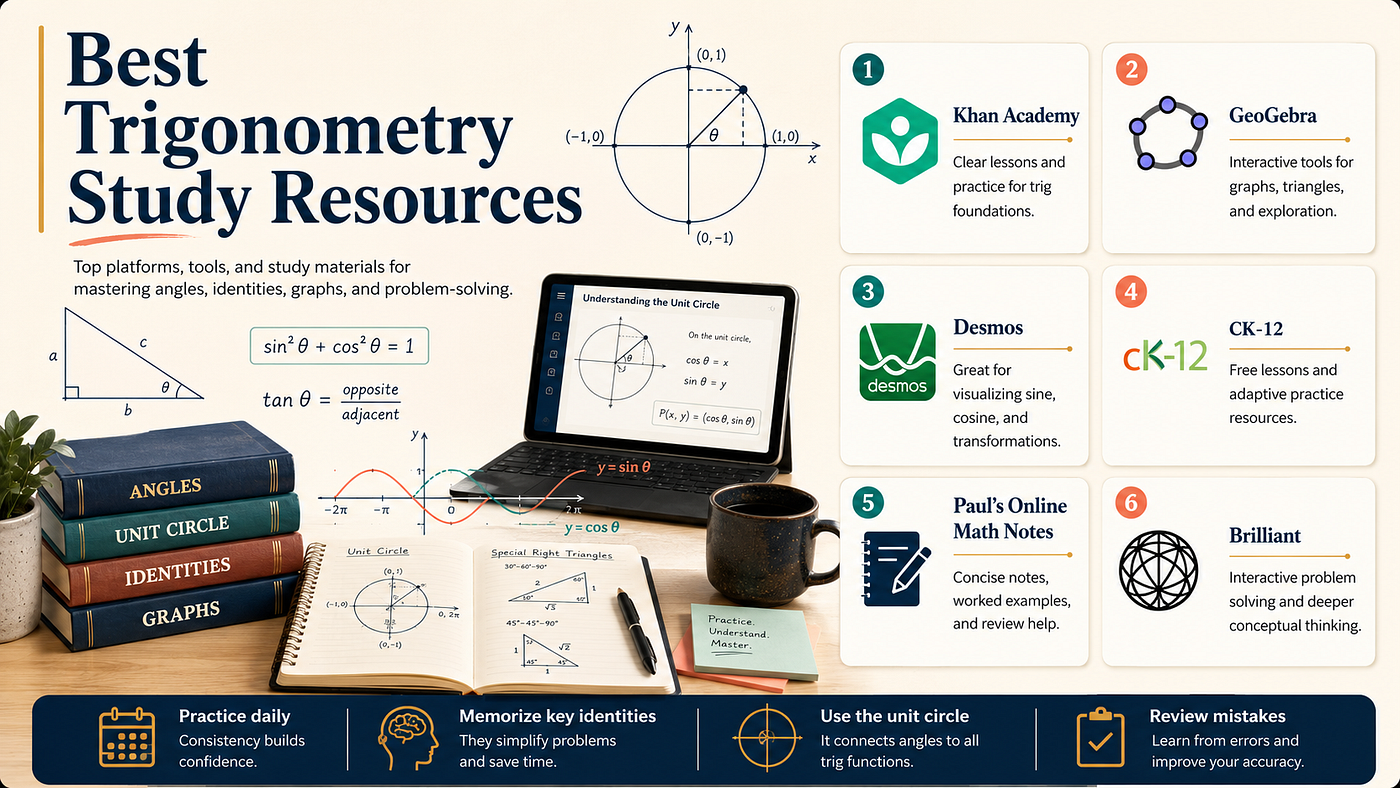
Khan Academy: Khan Academy is one of the safest first stops for learners because it combines short lessons, practice problems, skill checks, and progress tracking. It is especially useful when a student needs to rebuild foundations before moving into harder topics. A good way to use it is to watch one lesson, solve the practice set without looking at hints, then write down every mistake in an error log. The strength of Khan Academy is sequence: students can move from arithmetic to algebra to calculus without guessing what to learn next. Best for: K-12 math, algebra, geometry, trigonometry, calculus readiness, statistics, and SAT math practice. Website: https://www.khanacademy.org/math
OpenStax: OpenStax is a strong choice when a student or teacher needs a complete free textbook. The books are organized like standard college texts, so they work well for structured self-study and classroom support. A useful routine is to read the section summary first, study the examples, cover the solution, redo the example, and then solve odd or selected practice problems. OpenStax pairs well with Khan Academy for video support and with Desmos or GeoGebra for visual checking. Best for: College algebra, precalculus, calculus, statistics, and teacher-friendly textbook support. Website: https://openstax.org/subjects/math
Desmos: Desmos is one of the best free tools for seeing what an equation actually does. It helps students connect algebra to graphs, which is important for linear equations, quadratics, trigonometry, calculus, and statistics. Use Desmos after you try a problem by hand. Graph the function, check the intercepts, test your answer visually, and ask whether the picture makes sense. Teachers can also use it to demonstrate patterns with sliders and interactive activities. Best for: Graphing equations, functions, transformations, inequalities, sliders, and quick visual checks. Website: https://www.desmos.com/calculator
GeoGebra: GeoGebra is excellent for students who learn better by moving objects and seeing relationships change. It is more than a graphing calculator; it also supports geometry constructions, 3D graphing, and classroom activities. A geometry student can use GeoGebra to construct triangles, circles, transformations, and angle relationships. A calculus student can use it to visualize tangent lines, slopes, and areas. The best use is exploration after learning the rule, not replacing the rule. Best for: Geometry, algebra, graphing, 3D graphs, dynamic constructions, statistics, and probability visualization. Website: https://www.geogebra.org/
Paul’s Online Math Notes: Paul’s Online Math Notes is a classic resource for calculus and differential equations because the explanations are direct, detailed, and example-heavy. It is especially helpful when a student says, ‘I understand the idea, but I do not know how to start problems.’ The notes include worked examples and many practice problems. Use it by reading one section, copying the worked example by hand, and then solving a similar problem without looking. For calculus homework, this site is often easier to follow than a dense textbook. Best for: Algebra review, Calculus I, Calculus II, Calculus III, and differential equations. Website: https://tutorial.math.lamar.edu/
Symbolab: Symbolab is useful when students need steps rather than only final answers. It is especially helpful for algebra, calculus, trig identities, integrals, and matrix operations. The safest way to use it is to cover the solution after seeing the first step, try the next step yourself, and then compare. If you simply copy steps, your grade may improve for one assignment but your test performance will not. Use Symbolab to diagnose the point where your own work breaks down. Best for: Step-by-step algebra, calculus, trigonometry, linear algebra, and statistics support. Website: https://www.symbolab.com/solver/step-by-step
Wolfram Alpha: Wolfram Alpha is powerful for checking answers, exploring alternate forms, and working with advanced topics. It can solve equations, compute derivatives and integrals, evaluate matrices, and show graphs. Students should use it as a checker and explainer, not as a shortcut. First solve the problem on paper, then enter the expression to verify the answer. When a result is different, compare each algebra step carefully. That turns a solver into a learning tool. Best for: Checking advanced math, algebra, calculus, differential equations, linear algebra, and statistics. Website: https://www.wolframalpha.com/
Brilliant: Brilliant is strong for learners who want interactive problem solving instead of passive video watching. Its lessons push students to make choices and learn from feedback. This makes it useful for building intuition in algebra, geometry, calculus, probability, and logic. It is not a complete replacement for a textbook if you need lots of traditional homework practice, but it is excellent for understanding ideas that feel abstract. Best for: Conceptual math, problem solving, algebra, geometry, calculus, probability, statistics, logic, and data thinking. Website: https://brilliant.org/math/
IXL: IXL is useful for repeated practice because it breaks math into many small skills and gives adaptive questions. It works well for students who need to master fundamentals through repetition. The risk is treating practice as speed work only. Students should pause after missed questions, write down the skill name, and redo a similar problem slowly. Teachers and parents can use progress reports to see which skills need reteaching. Best for: Skill-by-skill K-12 math practice and targeted homework support. Website: https://www.ixl.com/math
Mathway: Mathway is a broad problem-solving tool that can handle many math areas. It is valuable for quick answer checks and topic identification. Students should be careful with it because fast answers can create the illusion of understanding. A better method is to write your own plan first, use Mathway to compare, then explain the solution aloud in simple words. If you cannot explain why a step works, review the concept before moving on. Best for: Algebra, graphing, calculus, statistics, finite math, linear algebra, chemistry, and physics problem checks. Website: https://www.mathway.com/
Resource Comparison Table


How to Use These Resources Without Wasting Time
Start every study session with a target. A target is not ‘study math.’ A target is ‘solve ten linear equation problems without mistakes,’ ‘learn the product rule,’ or ‘review probability tree diagrams.’ Clear targets make it easier to choose the right resource and stop when the goal is met.
Use the 20–40–20 rule. Spend about 20 percent of your session reviewing notes or watching a lesson, 40 percent solving problems without help, and 20 percent reviewing mistakes. The remaining time can be used for checking answers, asking questions, or making flashcards. This balance prevents passive studying.
If you use a solver or AI tool, do not start there. First read the problem, write what you know, choose a method, and try at least one step. Then use the tool to compare. The learning happens when you notice the difference between your step and the correct step.
Books and Written Study Materials
Books still matter in math because they give structure, definitions, examples, exercises, and review. A website can help with quick clarification, but a good book shows the full path through a subject. Students who rely only on short videos often miss definitions, notation, and proof details.
Choose a book by level. A middle school or high school student may need a school textbook, Khan Academy-style practice, and a workbook. A college student may need OpenStax, Schaum’s Outlines, or a professor’s recommended text. A contest student may need Art of Problem Solving books. A test-prep student should use official practice materials for the exam.
The best way to study from a math book is active. Read the definition, copy one example, cover the solution, redo it, and then solve similar exercises. Do not highlight entire pages. Highlighting feels productive, but solving problems builds skill.
OpenStax College Algebra 2e: A free textbook for algebra review, functions, equations, inequalities, systems, and modeling.
OpenStax Precalculus 2e: A useful bridge from algebra and trigonometry into calculus and college math.
OpenStax Calculus Volumes 1–3: Free college calculus books with examples and exercises for single-variable and multivariable calculus.
OpenStax Introductory Statistics: A clear entry point for descriptive statistics, probability, inference, and data analysis.
Schaum’s Outlines: Good for extra solved problems when a student needs more examples than a normal textbook gives.
Art of Problem Solving books: Strong books for students who want deeper problem solving and competition-style reasoning.
Gilbert Strang’s Linear Algebra resources: Excellent for college linear algebra, matrices, vector spaces, and applications.
A current school textbook or exam-board book: Best when preparing for A Level, IB, SAT, GRE, GMAT, AP, or a specific class syllabus.
Topic-Specific Study Advice
Trigonometry becomes easier when students connect three views: triangle ratios, unit circle coordinates, and graphs of sine, cosine, and tangent. Do not study these as separate facts. They are different views of the same relationships.
The unit circle should be practiced until common angles feel familiar. Students should also graph trig functions with Desmos and change amplitude, period, phase shift, and vertical shift.
For identities, do not memorize every transformation. Learn the core identities, then practice rewriting one side of an equation into the other. Always look for common factors, reciprocal identities, Pythagorean identities, and angle formulas.
Additional Resource Directory
MIT OpenCourseWare: This resource can also support the topic ‘Best trigonometry study resources’ when used with a clear goal. MIT OpenCourseWare is best for serious learners who want university-level notes, syllabi, lectures, assignments, and exams. It is not always as gentle as a beginner course, but it gives motivated students access to rigorous material. For college math help, start with one course page, download the syllabus, and follow the weekly order. Do not jump straight into problem sets unless you have watched or read the supporting lecture material. MIT OCW is especially strong for calculus, linear algebra, probability, and proof-based subjects. It is best used for College math, calculus, linear algebra, differential equations, discrete math, probability, and advanced study. Before adding it to your study plan, decide whether you need lessons, practice, visual tools, answers, discussion, or a formal course.
Photomath: This resource can also support the topic ‘Best trigonometry study resources’ when used with a clear goal. Photomath is popular because students can scan a problem and see step-by-step explanations. It can be helpful when a student is stuck and cannot even identify the topic. The key is to use the explanation as a tutor, not as an answer copier. After reading the solution, close the app and redo the problem from a blank page. If you cannot redo it, you have not learned it yet. It is best used for Homework checking, basic through advanced school math, and step-by-step visual explanations. Before adding it to your study plan, decide whether you need lessons, practice, visual tools, answers, discussion, or a formal course.
Mathos.ai: This resource can also support the topic ‘Best trigonometry study resources’ when used with a clear goal. Mathos.ai is an AI math helper designed to solve math problems and explain steps. Like any AI tool, it should be used carefully. It can help students generate a first explanation, ask follow-up questions, and check the logic of a solution, but students should verify important work with a textbook, teacher, or trusted calculator. The best use is conversational: ask why a step is valid, request a simpler explanation, and then solve a new similar problem without AI help. It is best used for AI-assisted problem explanation, image/PDF homework help, calculator tools, and guided math tutoring support. Before adding it to your study plan, decide whether you need lessons, practice, visual tools, answers, discussion, or a formal course.
DeltaMath: This resource can also support the topic ‘Best trigonometry study resources’ when used with a clear goal. DeltaMath is especially helpful for teachers who want controllable practice sets, instant feedback, and student progress data. Students can benefit from the clear problem types and repeated practice. The best use is targeted: choose one standard, assign a reasonable number of problems, and require students to correct mistakes in writing. DeltaMath is not just a homework tool; it can also support warm-ups, review days, and skill recovery. It is best used for Middle school, high school, and AP math practice assigned by teachers. Before adding it to your study plan, decide whether you need lessons, practice, visual tools, answers, discussion, or a formal course.
Art of Problem Solving: This resource can also support the topic ‘Best trigonometry study resources’ when used with a clear goal. Art of Problem Solving is best for students who want challenging math beyond routine school practice. It offers books, classes, videos, forums, and problem archives. AoPS is not always the easiest starting point for a struggling student, but it is excellent for motivated learners who enjoy hard problems. The biggest lesson from AoPS is that math is not only about formulas; it is about strategy, creativity, and explaining why an answer must be true. It is best used for Competition math, problem solving, AMC, AIME, olympiad-style reasoning, and advanced students. Before adding it to your study plan, decide whether you need lessons, practice, visual tools, answers, discussion, or a formal course.
NRICH: This resource can also support the topic ‘Best trigonometry study resources’ when used with a clear goal. NRICH provides free problem-solving tasks for teachers, students, and parents. It is valuable because it helps learners think, discuss, test ideas, and explain patterns. Use NRICH when students need deeper reasoning rather than another worksheet of similar problems. Teachers can choose a task, let students explore in pairs, and then discuss strategies as a class. It is especially useful for building curiosity and mathematical confidence. It is best used for Teacher activities, rich tasks, reasoning, classroom discussion, and students ages 3 to 18. Before adding it to your study plan, decide whether you need lessons, practice, visual tools, answers, discussion, or a formal course.
Math Stack Exchange: This resource can also support the topic ‘Best trigonometry study resources’ when used with a clear goal. Math Stack Exchange is a strong place to read explanations and ask thoughtful questions. It works best when a student shows effort, writes the problem clearly, and explains where they are stuck. It is not meant for dumping homework without work. Before asking, search the site, try the problem, and include your attempt. Reading good answers can also teach mathematical writing and proof style. It is best used for Detailed math discussions, proof help, advanced questions, and concept clarification. Before adding it to your study plan, decide whether you need lessons, practice, visual tools, answers, discussion, or a formal course.
Coursera: This resource can also support the topic ‘Best trigonometry study resources’ when used with a clear goal. Coursera can help learners who want a course format with videos, assignments, and certificates. Many courses are offered by universities, and some can be audited or started free depending on the course. Because options change, students should check the current course page, prerequisites, dates, and cost. Coursera works best for adults, college students, and motivated high school students who want guided learning without attending a local class. It is best used for Structured math, calculus, data, statistics, and university-backed online courses. Before adding it to your study plan, decide whether you need lessons, practice, visual tools, answers, discussion, or a formal course.
edX: This resource can also support the topic ‘Best trigonometry study resources’ when used with a clear goal. edX offers math courses from universities and educational organizations. It is useful for learners who want structured content and, in many cases, optional paid certificates. Before enrolling, check the workload, prerequisites, and whether the free audit option gives enough access for your goals. edX can be especially useful for calculus, data analysis, and applied mathematics, but students should still build a practice routine outside the videos. It is best used for College-style math, calculus, statistics, data, and professional certificates. Before adding it to your study plan, decide whether you need lessons, practice, visual tools, answers, discussion, or a formal course.
College Board and Khan Academy SAT Math: This resource can also support the topic ‘Best trigonometry study resources’ when used with a clear goal. For SAT math, official practice matters. College Board provides digital SAT practice through Bluebook, and Khan Academy offers official Digital SAT prep. Students should take a diagnostic test, review missed question types, and drill the underlying math skills. The best SAT math prep combines official practice with topic review in algebra, advanced math, problem solving, data analysis, geometry, and trigonometry. It is best used for Digital SAT math practice, Bluebook tests, and official SAT preparation. Before adding it to your study plan, decide whether you need lessons, practice, visual tools, answers, discussion, or a formal course.
ETS GRE Quantitative Reasoning: This resource can also support the topic ‘Best trigonometry study resources’ when used with a clear goal. Students preparing for GRE Quant should begin with ETS because it shows the official question types and tested concepts. GRE math is not advanced calculus, but it requires careful reasoning, algebra, arithmetic, geometry, data interpretation, and probability. Use official questions to learn timing and wording. Use Khan Academy, OpenStax, and targeted practice to repair weak topics between official practice sets. It is best used for GRE Quant practice, official sample questions, and test-maker explanations. Before adding it to your study plan, decide whether you need lessons, practice, visual tools, answers, discussion, or a formal course.
GMAC GMAT Quantitative Reasoning: This resource can also support the topic ‘Best trigonometry study resources’ when used with a clear goal. For GMAT Quant, official questions from GMAC are important because GMAT problems reward reasoning and efficiency, not just calculation. Students should practice number properties, algebra, rates, ratios, word problems, and problem-solving strategy. A good plan is to learn the concept, solve untimed practice, then move to timed official sets. Review every missed problem and write the fastest valid method. It is best used for GMAT Quantitative Reasoning practice and official GMAC question style. Before adding it to your study plan, decide whether you need lessons, practice, visual tools, answers, discussion, or a formal course.
If you are unable to Pass your Exams, Quizzes, Tests or Unable to Handle Homework Assignments or full course online, Get paid help from Online Helpers at Hiraedu! Contact Details for HiraEdu Helper: WEBSITE: hiraedu. com WhatsApp: +12136359834 Email: info@hiraedu. com Call: +12136359834
How to Build Your Own Practice Test
A practice test does not have to be complicated. Choose 20 to 30 problems from the topics you need most. Include easy, medium, and hard questions. Mix problem types so you are forced to choose methods, not simply repeat the last example. If you are preparing for an official exam, use official practice whenever possible. If you are preparing for a class, use your textbook review, teacher study guide, old quizzes, and homework corrections.
Set a timer, but do not rush your first attempt. The first goal is accuracy. After the test, mark every problem as correct, wrong, or uncertain. The uncertain category is important because students often get lucky on some answers. A lucky correct answer still needs review. For each missed or uncertain problem, write the topic, the reason for the mistake, and the correct method.
After reviewing, create a smaller retry test with only the topics you missed. This is where progress happens. Many students take full practice tests but never repair weak areas. A smarter plan is full test, review, targeted drills, retry set, and then another mixed test. This cycle works for homework, classroom exams, SAT math, GRE Quant, GMAT Quant, A Level maths, IB math, and college courses.
Do not count a practice test as finished until you can redo missed problems without looking. The final score matters less than the lessons you take from the test. A low practice score can be useful if it shows exactly what to fix next. A high score can be misleading if you do not understand why your answers are right.
Free, Low-Cost, and Paid Study Options
Free options are often enough for motivated learners. Khan Academy, OpenStax, MIT OpenCourseWare, Paul’s Online Math Notes, Desmos, GeoGebra, NRICH, and Math Stack Exchange can cover a large amount of math learning at no cost. Free resources work best when the student has a clear plan and can stay consistent without external deadlines.
Low-cost options can help when a student needs more structure. Workbooks, used textbooks, affordable online courses, app subscriptions, or short tutoring packages can fill specific gaps. Before paying, try the free trial, sample lesson, or preview. Make sure the resource matches the student’s level. A resource that is too easy wastes time, and a resource that is too hard creates discouragement.
Paid tutoring or courses make sense when the student needs accountability, expert feedback, or fast improvement before an important exam. A paid resource should provide more than content. It should provide diagnosis, a plan, practice, feedback, and measurable progress. If a course only shows videos that can be found elsewhere, it may not be worth the price.
The best budget plan is layered. Start free, add low-cost materials if needed, and pay for tutoring or a course only when you know the exact problem you are trying to solve. For example, do not hire a tutor for ‘math.’ Hire a tutor to repair quadratic equations, prepare for the SAT math module, improve calculus integration, or build proof-writing skills.
Study Plans by Learner Type
Middle school students should focus on number sense, fractions, decimals, ratios, percent, negative numbers, equations, graphs, and word problems. Short daily practice works better than long weekly sessions. Parents should ask students to explain their thinking instead of only checking whether the answer is correct.
High school students should build a stronger notebook system. Algebra, geometry, trigonometry, statistics, and precalculus all connect. Students preparing for SAT, ACT, AP, IB, A Level, or college placement should use official practice and keep track of weak topics. A graphing tool is helpful, but students still need hand skills.
College students should read definitions carefully and attend to notation. College math often becomes harder because the language becomes more precise. Students should use office hours, tutoring centers, textbooks, online notes, and discussion forums early. Waiting until the week before an exam usually leads to panic rather than learning.
Adult learners should begin with a realistic schedule. Returning to math after a long break is normal. Start with diagnostic review, rebuild foundations, and connect every topic to a goal such as work, a degree, a test, or personal growth. Consistency matters more than speed.
How to Measure Progress
Progress in math should be measured in several ways. Score improvement matters, but so do accuracy, independence, speed, confidence, and explanation quality. A student is improving when they can solve problems with fewer hints, explain steps more clearly, and notice errors before checking the answer.
Use a weekly progress sheet. Write the topics studied, number of problems attempted, number correct, common mistakes, and next steps. This simple record prevents vague studying. It also helps parents, tutors, and teachers see whether the current approach is working.
Measure old mistakes again. Every week, choose five problems you missed before and try them cold. If you can solve them now, the review worked. If you miss them again, the topic needs a new explanation or more practice. Repeated mistakes are not failure. They are signals.
For long-term learning, use mixed review. Students often master a topic on the day they study it but forget it later. Mixed review brings back older topics and forces flexible thinking. This is especially important for cumulative exams, standardized tests, and college math courses.
Safety, Accuracy, and Academic Integrity
Online math resources should be used honestly. If a teacher says no outside tools, follow that rule. If tools are allowed, show your own reasoning and cite support when required. Learning math is not only about arriving at an answer; it is about building a mind that can solve new problems.
Check important answers with more than one source when possible. Solvers, calculators, and AI tools can disagree because of input errors, domain restrictions, rounding, or missing assumptions. If an answer affects a grade, scholarship, job test, or professional task, verify it carefully.
Protect privacy when using online platforms. Students should avoid posting personal information, school login details, teacher materials that are not meant to be shared, or live exam questions. When asking questions in forums, rewrite the problem in your own words and show your attempt.
Teachers and parents should teach tool literacy. Students need to know when calculators are helpful, when mental math is better, when a graph confirms an answer, and when AI output needs checking. Tool literacy is now part of math literacy.
Practice Questions and How to Review Them
Practice is the center of math learning. Reading explanations is useful, but solving problems is where skill is built. A good practice set has easy questions for accuracy, medium questions for method choice, and a few hard questions for transfer. After practice, the student should review mistakes slowly instead of simply checking the score.
Sample Question 1: Solve 3x + 7 = 22. Answer: x = 5. Review lesson: subtract 7 from both sides, then divide by 3. This simple equation checks whether a student understands inverse operations.
Sample Question 2: A line has slope 2 and passes through (1, 5). Find its equation. Answer: y = 2x + 3. Review lesson: use y = mx + b, substitute x = 1 and y = 5, then solve for b.
Sample Question 3: If f(x) = x² — 4x, find f(6). Answer: 12. Review lesson: replace x with 6 carefully: 36–24 = 12. Function questions often punish students who rush substitution.
Sample Question 4: A bag has 3 red marbles and 5 blue marbles. What is the probability of choosing a red marble? Answer: 3/8. Review lesson: probability is favorable outcomes divided by total outcomes when outcomes are equally likely.
Sample Question 5: Find the derivative of x³. Answer: 3x². Review lesson: the power rule says d/dx of x^n is n*x^(n-1). Also check whether your course requires proof, application, or only computation.
Four-Week Study Plan
Week 1: Diagnose and rebuild basics. Choose one topic and take a short diagnostic set. Do not worry about the score. Sort mistakes into content gaps, careless errors, reading errors, and timing errors. Review foundational lessons and solve easier practice until the method feels stable.
Week 2: Learn and practice core skills. Work through lessons in order. After each lesson, solve practice problems without help. Use graphing tools and calculators only after you have tried the work. Start an error log and review it at the end of the week.
Week 3: Mix topics and increase difficulty. Math tests and real homework rarely announce the method. Start using mixed sets that require choosing the right strategy. Add one longer session for challenge problems or application problems. Meet with a tutor, teacher, or study group if the same mistake keeps repeating.
Week 4: Review, test, and adjust. Take a practice test, mock quiz, or timed problem set. Review every missed problem. Make a final list of weak topics and spend the last few days repairing those gaps. Keep the plan simple: learn, practice, review, repeat.
Daily Study Routine
A daily math routine does not need to be long. Thirty focused minutes can be powerful. Spend five minutes reviewing old mistakes, ten minutes learning or reviewing one concept, ten minutes solving problems, and five minutes writing what you learned. This routine is better than a two-hour session of distracted video watching.
Use a notebook even when studying online. Write definitions, formulas, steps, and mistakes by hand. When you make an error, do not erase it immediately. Mark it, correct it, and write the reason. Over time, the notebook becomes a personalized study guide.
End every session with a confidence check. Can you solve a similar problem without looking? Can you explain the method to a younger student? Can you say when the method does not apply? If not, review one more example before moving on.
Common Mistakes to Avoid
Mistake 1: Watching too many videos without solving problems. Videos are useful, but they do not build fluency by themselves. Always pair video learning with practice.
Mistake 2: Copying solver steps without understanding them. This may finish homework, but it creates weak test performance. Use solvers to learn, not to escape learning.
Mistake 3: Skipping prerequisite skills. If algebra is weak, calculus will feel much harder. If fractions are weak, probability and rational expressions will be frustrating. Repair gaps early.
Mistake 4: Using too many resources. Pick a small set and stay consistent. One good lesson source used well is better than ten tabs opened at once.
Mistake 5: Ignoring mistakes. Mistakes are the most useful data in math study. Review them, label them, and retry similar problems until the pattern changes.
For Parents and Adult Learners
Parents should look for progress, not only completed homework. Ask the student to explain one problem from the assignment. If the student can explain the steps and the reason behind them, learning is happening. If the student only says ‘the app showed me,’ more active practice is needed.
Adult learners should not feel embarrassed about reviewing basics. Many adults return to math after years away. Start with placement-style review, build a steady routine, and use free resources before paying for a course. Confidence returns when small skills become reliable again.
Whether the learner is a child, teen, or adult, the same rule applies: math improves through clear explanation, deliberate practice, feedback, and review. There is no magic resource, but a good system can make improvement predictable.
Frequently Asked Questions
Q: What is the best free math help website?
A: For most learners, Khan Academy is the best free starting point because it has lessons, practice, and progress tracking. For college learners, MIT OpenCourseWare, OpenStax, and Paul’s Online Math Notes are also excellent.
Q: Are math solver apps good for homework?
A: They can be helpful if used for checking and learning steps. They are harmful if students copy answers without understanding. Always try the problem first and redo it without the app.
Q: How do I know if I need a math tutor?
A: You may need a tutor if you keep making the same mistakes, do not understand class explanations, are preparing for an important test, or feel too anxious to study alone. A good tutor should diagnose gaps and teach study habits.
Q: What is the best way to study math online?
A: Use one lesson source, one written reference, one practice source, and one checking tool. Study actively by solving problems, reviewing mistakes, and explaining steps in your own words.
Q: Can AI solve math problems correctly?
A: AI tools can be useful, but they can make mistakes or skip important details. Use AI for explanation and practice support, then verify important answers with a trusted source.
Q: What should teachers use for online math practice?
A: Teachers can use tools such as DeltaMath, IXL, Khan Academy, Desmos, GeoGebra, OpenStax, and NRICH depending on the goal. Choose tools that support feedback and reasoning.
Q: How many math problems should I practice each day?
A: Quality matters more than quantity. A focused set of 10 to 20 problems with careful review can be better than 50 rushed problems. Always review errors.
Q: What is the best resource for calculus?
A: Paul’s Online Math Notes, OpenStax Calculus, Khan Academy, MIT OpenCourseWare, Desmos, GeoGebra, Symbolab, and Wolfram Alpha can work together well.
Q: What is the best resource for exam math?
A: Use official practice for the exam first. For SAT math, use College Board and Khan Academy. For GRE Quant, use ETS. For GMAT Quant, use GMAC official practice. Then use general resources to fix weak topics.
Q: How can I improve math confidence?
A: Start with problems you can solve, then increase difficulty slowly. Keep an error log, celebrate accuracy, ask better questions, and practice regularly. Confidence grows from repeated successful effort.
Final Checklist
Choose one main learning source, one practice source, one checking tool, and one support option.
Take a short diagnostic before buying a course or tutor package.
Use official resources for SAT, GRE, GMAT, A Level, IB, or other exam preparation.
Keep an error log and review it every week.
Use AI and solvers for learning support, not answer copying.
Build a routine that includes explanation, practice, review, and mixed problems.
Ask for help early when the same mistake keeps appearing.
References and Source Websites
ETS GRE Quantitative Reasoning
GMAT Official Quantitative Practice
Pearson Edexcel A Level Mathematics
Cambridge International AS & A Level Mathematics
International Baccalaureate Mathematics
If you are unable to Pass your Exams, Quizzes, Tests or Unable to Handle Homework Assignments or full course online, Get paid help from Online Helpers at Hiraedu! Contact Details for HiraEdu Helper: WEBSITE: hiraedu. com WhatsApp: +12136359834 Email: info@hiraedu. com Call: +12136359834
메타데이터
- post_id
- 4ecaa6d79630
- slug
- best-trigonometry-study-resources-4ecaa6d79630
- url
- https://medium.com/@runcushal/best-trigonometry-study-resources-4ecaa6d79630
- canonical_url
- https://medium.com/@runcushal/best-trigonometry-study-resources-4ecaa6d79630
- author_url
- https://medium.com/@runcushal
- status
- ok
- fetched_at
- 2026-08-20 02:18:54