Stage Micrometers Explained — A Practical Guide to Microscope Calibration for Accurate Measurements
Understanding the Instrument
Stage Micrometers Explained — A Practical Guide to Microscope Calibration for Accurate Measurements
What Is a Stage Micrometer and Why Does It Matter in the Lab
Understanding the Instrument
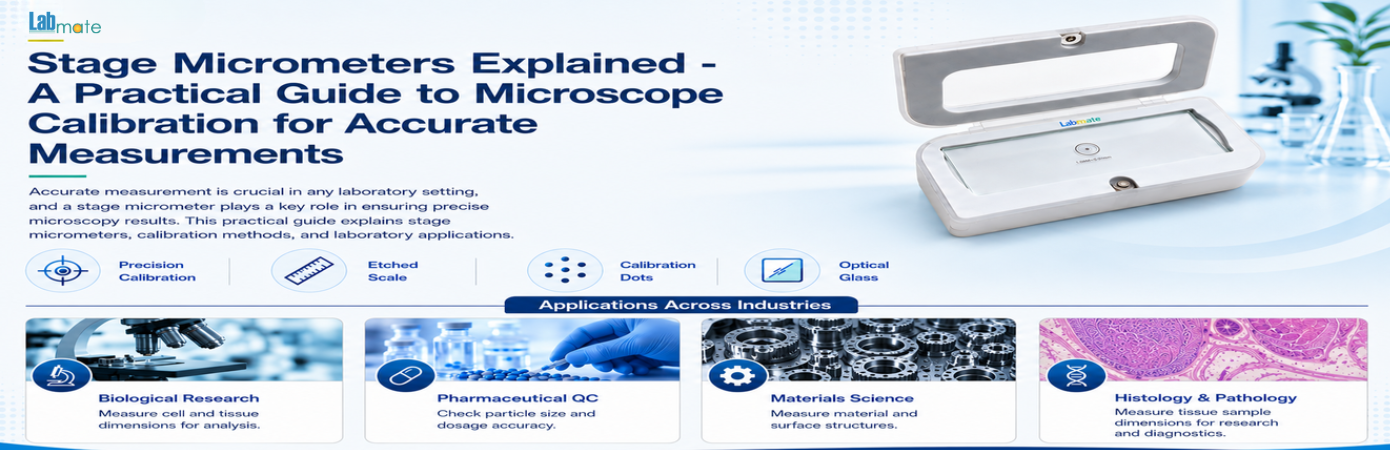
A Stage Micrometer is a microscope calibration tool that consists of a precisely ruled scale on an optical glass slide. It provides a known, accurate reference that allows laboratory professionals to determine the actual size of microscopic objects viewed through a microscope. The etched scale on the glass slide base serves as a traceable standard against which the microscope’s measurement system is verified and adjusted.
Division Values and Measuring Range
Stage Micrometers are available in different specifications depending on the application. Depending on the model, divisions may be 0.01 mm or 0.1 mm, with measuring ranges of 1 mm or 10 mm. Some models also feature calibration dots in sizes of 0.01 mm, 0.05 mm, 0.1 mm, 1 mm, 5 mm, and 10 mm, which are used to check optical distortion, focus precision, and image quality across different magnification levels.
Why Calibration Cannot Be Skipped
Without a properly calibrated microscope, measurements can vary depending on the objective lens used, the eyepiece reticle, or the optical setup. A Stage Micrometer calibration process aligns the microscope’s measurement scale with a known standard, ensuring that results are accurate and reproducible across experiments, instruments, and operators. This is particularly important in pharmaceutical quality control, biological research, forensic microscopy, and materials science, where measurement consistency directly affects the outcome.
How to Use a Stage Micrometer
Place the Stage Micrometer onto the microscope stage as you would a regular sample slide. Focus using the objective lens, beginning at low magnification before moving higher. Align the eyepiece reticle over the micrometer scale, then calculate the value of each reticle division by comparing it to the known distance on the Stage Micrometer. Record the calibration values for each objective lens to maintain consistency in future measurements.
Tips for Accurate Results
Clean the optical glass slide with a soft, lint-free cloth before each use. Avoid touching the etched scale directly to prevent scratches or contamination from skin oils. Store the Stage Micrometer in a protective case when not in use, and recalibrate the microscope after servicing, moving the instrument, or changing optical components.
Conclusion
A Stage Micrometer is a straightforward but essential instrument for any laboratory that depends on quantitative microscopy. Proper use and periodic calibration ensure that measurement data remains traceable, reproducible, and fit for scientific reporting.
For more information, click here or contact us at
Email: info@labmate.com
메타데이터
- post_id
- 4fd2397c92a0
- slug
- stage-micrometers-explained-a-practical-guide-to-microscope-calibration-for-accurate-measurements-4fd2397c92a0
- url
- https://medium.com/@eleza.labmate/stage-micrometers-explained-a-practical-guide-to-microscope-calibration-for-accurate-measurements-4fd2397c92a0
- canonical_url
- https://medium.com/@eleza.labmate/stage-micrometers-explained-a-practical-guide-to-microscope-calibration-for-accurate-measurements-4fd2397c92a0
- author_url
- https://medium.com/@eleza.labmate
- status
- ok
- fetched_at
- 2026-08-31 11:46:57

