SQL Injection Deep Dive: From Beginner to Full Exploitation
The login page looked ordinary.
SQL Injection Deep Dive: From Beginner to Full Exploitation
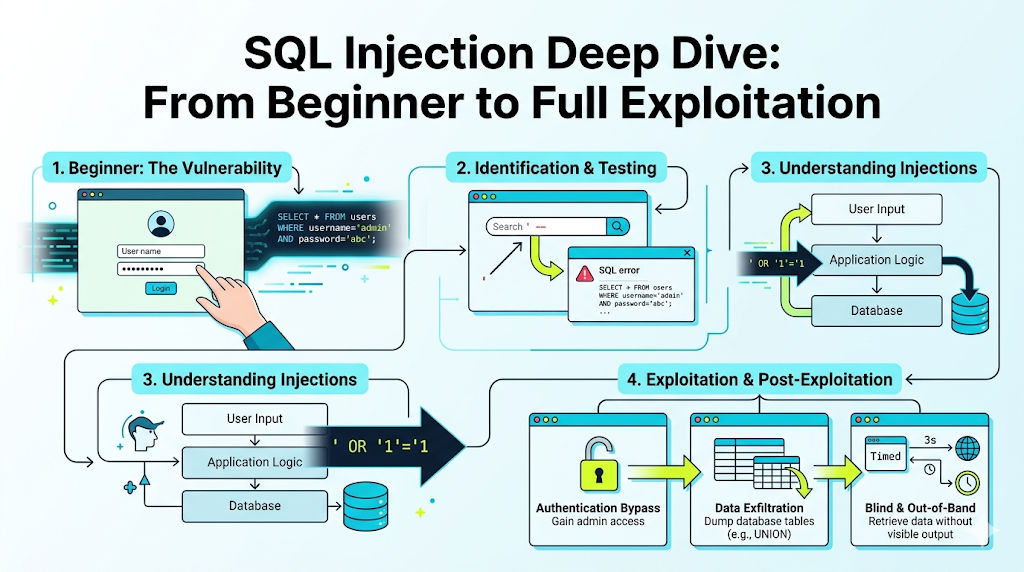
The login page looked ordinary.
Two fields.
Username. Password.
Nothing special.
A beginner hacker opened Burp Suite, intercepted the request, and typed:
' OR '1'='1
He pressed Enter.
And suddenly…
He was inside the admin panel.
No password.
No brute force.
No malware.
Just one line of input.
“The database didn’t get hacked because it was weak. It got hacked because the application trusted user input.”
Most beginners think hacking is a complicated web of zeroes, ones, and green cascading text. But the reality is far more practical. Many of the most devastating real-world breaches begin with a single, poorly written SQL query.
By the end of this deep dive, you won’t just know what SQL Injection is. You will understand it deeply, see exactly how attackers exploit databases in the wild, dissect massive real-world breaches, and, most importantly, learn how defenders permanently neutralize this iconic threat.
1. What is SQL Injection? (The Foundation)
SQL Injection (SQLi) is a critical vulnerability that occurs when user-supplied input is directly included in a database query without proper sanitization or parameterization.
The Core Idea:
The attacker is not attacking the database directly. They are manipulating the application’s logic and trust assumptions. By submitting crafted input, the attacker tricks the backend into executing unintended database commands.
2. How Databases Work
To break a system, you must first understand how it works. A database is essentially a structured digital filing cabinet. Information is organized into Tables, which consist of Rows (individual records) and Columns (specific attributes).
Example users Table:

Databases communicate using Structured Query Language (SQL).
Basic Query:
SQL
SELECT * FROM users;Using a WHERE Clause (Filtering):
SQL
SELECT * FROM users WHERE username='admin';The Important Insight: Modern applications constantly build dynamic SQL queries on the fly using the data you type into forms. That is exactly where vulnerabilities are born.

3. Login Authentication Logic (Where SQLi Begins)
Let’s look under the hood of a typical, vulnerable login system. When you submit your credentials, the backend generates a query that looks something like this:
SQL
SELECT * FROM users
WHERE username='admin'
AND password='1234';
Step-by-Step Logic:
- The user enters their credentials.
- The backend dynamically concatenates the input into the SQL string.
- The database checks if a record exists matching both the username and the password. If a row is returned, login is successful.
4. Your First SQL Injection (The Famous Payload)
What happens if an attacker enters ' OR '1'='1 into the username field and leaves the password blank?
The Resulting Query:
SQL
SELECT * FROM users
WHERE username='' OR '1'='1'
AND password='';
Why It Works:
The database evaluates the logic. Because '1'='1' is always TRUE, the entire WHERE clause evaluates to TRUE, completely bypassing the password check.
- Normal Logic:
username = adminANDpassword = correct - Injected Logic:
FALSEORTRUE
The application logic breaks, returning the first record in the database (usually the admin), and logs the attacker in.
5. How Hackers Actually Discover SQLi
Attackers don’t just guess payloads blindly. They map the application’s behavior looking for specific signs of vulnerability.
Signs of Vulnerability:
- Error Messages: Seeing things like
SQL syntax error near... - Strange Responses: Blank pages, missing elements, or 500 Internal Server Errors.
- Delays: The server taking noticeably longer to respond.
Common Testing Characters:
- Single quote:
' - Double quote:
" - Comments:
--or#
Why Errors Matter: Errors are goldmines. They leak the database type (MySQL, PostgreSQL, MSSQL), query structure, and backend logic, giving the attacker a blueprint of the system.
6. Types of SQL Injection
SQLi isn’t just one attack; it is an entire category of exploitation.
6.1 Authentication Bypass SQLi
- Goal: Log in without a password.
- Example Payload:
admin' -- - Mechanics: The
--tells the database to treat the rest of the query (the password check) as a comment, effectively deleting it from the execution flow.

6.2 UNION-Based SQL Injection
- Goal: Extract data from completely different tables.
- Example:
UNION SELECT username, password FROM users - Mechanics: Uses the
UNIONoperator to combine the results of the original query with the results of a new, malicious query injected by the attacker. - Real Impact: Dumping entire databases, extracting employee emails, and leaking customer credentials.
6.3 Error-Based SQLi
- Goal: Force the database to generate an error containing sensitive data.
- Mechanics: Attackers craft payloads that intentionally break SQL math or logic, forcing the database to reveal table names or version numbers right on the web page.

6.4 Blind SQL Injection (The Advanced Standard)
Sometimes, an application is vulnerable, but it suppresses all error messages and doesn’t print any database output to the screen.
- Boolean-Based Blind: The attacker asks the database True/False questions (e.g., “Is the first letter of the admin password an ‘A’?”). They observe slight differences in the page response (e.g., a “Welcome” message appears only if True).
- Time-Based Blind: The attacker forces the database to pause.
SLEEP(5). If the web page takes exactly 5 seconds to load, the injection is confirmed.
6.5 Out-of-Band SQLi (Advanced)
Used when there is no visible output and time-based attacks are blocked. The attacker tricks the database server into making an external DNS or HTTP request to an attacker-controlled server, exfiltrating the data over the network.
7. Real-World SQL Injection Breaches
This isn’t just theory. SQLi has caused billions of dollars in damage.
- Sony Pictures: Injection flaws helped attackers compromise massive internal systems, leading to catastrophic data leaks.
- Yahoo Voices: A simple SQLi exposed a massive trove of unencrypted user credentials.
- Heartland Payment Systems: One of the largest payment breaches in history. Millions of credit cards were compromised via SQLi.
- TalkTalk Breach: A teenage attacker utilized automated SQLi tools to breach the telecom giant, causing immense financial and reputational ruin.
- Cisco Prime License Manager: SQLi vulnerabilities allowed remote attackers to gain unauthorized access and execute underlying database commands.
8. The Exploitation Process (Real Hacker Workflow)
When an attacker targets an application, they follow a systematic methodology.
- Step 1: Identify Input Fields: Login forms, search bars, URL parameters (
?id=1), and hidden API requests. - Step 2: Test Special Characters: Injecting
',", and--to intentionally break the syntax. - Step 3: Observe Behavior: Watching carefully for errors, time delays, or broken UI elements.
- Step 4: Enumerate the Database: Mapping out the architecture. Finding table names, column names, and the underlying database version.
- Step 5: Extract Sensitive Data: Pulling out credentials, session tokens, and personal identifiable information (PII).
9. Tools of the Trade
While manual testing is crucial for understanding, attackers use powerful tools to automate the process.
- Burp Suite: The industry standard for intercepting, modifying, and analyzing web requests on the fly.
- sqlmap: An aggressive, automated open-source tool that detects and exploits SQL injection flaws.
- Example command:
sqlmap -u [http://vulnerablesite.com?id=1](http://vulnerablesite.com?id=1) --dbs(Dumps the database names). - Wireshark: Used for deep-dive network traffic analysis during out-of-band data exfiltration.

10. Why SQL Injection Still Exists
SQLi has been on the OWASP Top 10 for decades. So why is it still happening? Because developers continue to concatenate strings and trust user input.
Example of Disastrous Code (PHP):
PHP
$query = "SELECT * FROM users WHERE username='" . $user . "'";This directly stitches whatever the user types into the fabric of the application’s command structure.
11. How to Prevent SQL Injection (For Defenders)
Defeating SQL injection is actually incredibly straightforward if modern secure coding practices are applied consistently.
Parameterized Queries (Prepared Statements)
This is the ultimate defense. Parameterization ensures that the database treats user input strictly as data, never as executable code.
SAFE Example (Python):
Python
cursor.execute(
  "SELECT * FROM users WHERE username=?",
  (username,)
)
✅ Input Validation
Always validate what the user submits. Enforce strict rules on length, type (integer vs. string), and format (e.g., ensuring an email field only accepts valid email structures).
✅ Least Privilege
A web application’s database account should only have the permissions it absolutely needs. The web application should never log into the database using a sa (system admin) or root account. It shouldn't have the power to drop tables or access unrelated databases.
✅ Web Application Firewall (WAF)
A WAF can act as a crucial defensive layer, identifying and blocking common malicious payloads (like UNION SELECT) before they ever reach the backend server.
✅ Error Handling
Never expose raw SQL errors or stack traces to the end user. Catch exceptions internally and serve generic, safe error pages.
12. The Hacker Mindset
To truly master web security, you have to change how you view an application.
Hackers don’t look at a web page; they look at the data flow. They ask:
- What input here actually reaches the database?
- Can I break the intended query logic?
- What trust assumptions did the developer make?
Important Insight: SQL Injection is not “magic.” It is simply manipulating the misplaced trust between the application layer and the database layer.
13. Hands-On Practice
Reading isn’t enough. You need muscle memory. Here is where you can legally and safely practice:
- DVWA (Damn Vulnerable Web App): Excellent for practicing basic and blind SQLi in a controlled local environment.
- PortSwigger Web Security Academy: Created by the makers of Burp Suite. Contains highly realistic, modern scenarios.
- OWASP Juice Shop: A modern, sophisticated vulnerable web application built on Node.js/Angular.
14. Common Beginner Mistakes
- Thinking only login forms are vulnerable: Any input — headers, cookies, search bars, API JSON bodies — can be vulnerable.
- Ignoring APIs: Modern applications often pass vulnerable parameters via REST or GraphQL APIs in the background.
- Using
sqlmapblindly: Running automated tools without understanding the underlying queries will cause you to miss complex, custom injections (and get you caught). - Forgetting blind SQLi exists: Just because there isn’t an error message on the screen doesn’t mean the system is secure.
15. Advanced Realities: Beyond the Database
SQL Injection isn’t just about stealing data. It can be a gateway to total infrastructure collapse.
Depending on the database permissions and architecture, SQLi can lead to:
- Remote Code Execution (RCE)
- Full Server Compromise
- Data Destruction (Dropping tables)
- Ransomware Deployment
Example: In Microsoft SQL Server, if the xp_cmdshell feature is enabled and the attacker has sufficient privileges, they can execute operating system commands directly from the SQL injection payload, turning a database flaw into a full server takeover.
16. Conclusion
“A database doesn’t care whether input comes from a user or an attacker. It only executes what it is told.”
SQL Injection remains one of the deadliest and most iconic vulnerabilities in the history of the internet. Memorizing a list of payloads will only get you so far. Understanding the underlying query logic, the flow of data, and the architecture of trust is what separates script kiddies from true security professionals.
Sanitize your inputs, parameterize your queries, and never trust the user.
17. Up Next…
Enjoyed this deep dive?
👉 Next Post: “Cross-Site Scripting (XSS): Turning Browsers into Attack Weapons”
We’ll be tearing down how attackers weaponize JavaScript to hijack sessions, steal cookies, and manipulate the DOM in real-time. Stay tuned.
메타데이터
- post_id
- 589580a9100c
- slug
- sql-injection-deep-dive-from-beginner-to-full-exploitation-589580a9100c
- url
- https://medium.com/@at.kishor.k/sql-injection-deep-dive-from-beginner-to-full-exploitation-589580a9100c
- canonical_url
- https://medium.com/@at.kishor.k/sql-injection-deep-dive-from-beginner-to-full-exploitation-589580a9100c
- author_url
- https://medium.com/@at.kishor.k
- status
- ok
- fetched_at
- 2026-06-09 15:37:30