The Employee Who Embezzled $2M Working From Home. Their Activity Data Was Screaming the Whole Time.
She was a model remote employee.
The Employee Who Embezzled $2M Working From Home. Their Activity Data Was Screaming the Whole Time.
She was a model remote employee.
Always online by 8:30. Green dot on Slack until 5. Deliverables landed on time. Her manager called her “self-motivated” in two consecutive performance reviews. HR had zero complaints on file.
Over 19 months, she moved $2.1 million from the company’s accounts into three shell entities she controlled. Nobody noticed until an external auditor flagged a pattern in vendor payments that didn’t match any approved supplier.
By then, she’d already resigned. Voluntarily. With a glowing reference letter.
The Story Everybody’s Telling Wrong
When cases like this surface, and they surface constantly, the reflexive response is always the same: this is what happens when you let people work from home.
That’s the wrong conclusion.
She didn’t steal because she was remote. She stole because nobody was looking at the right data. And remote work didn’t create that blind spot. It just removed the last thing that was accidentally covering for it, the ambient awareness of sitting ten feet from your coworker.
In an office, someone might have noticed she was staying late on days vendor payments processed. Someone might have overheard an odd phone call. Someone might have glanced at her screen while walking to the printer.
None of that is a security system. It’s coincidence dressed up as oversight. And when you move everyone home, the coincidence disappears but the oversight was never really there to begin with.
What the Data Was Doing
Here’s what makes this case interesting. If her company had been tracking activity patterns, not keystrokes, not screenshots every thirty seconds, just the shape of her workday, the anomalies were loud.
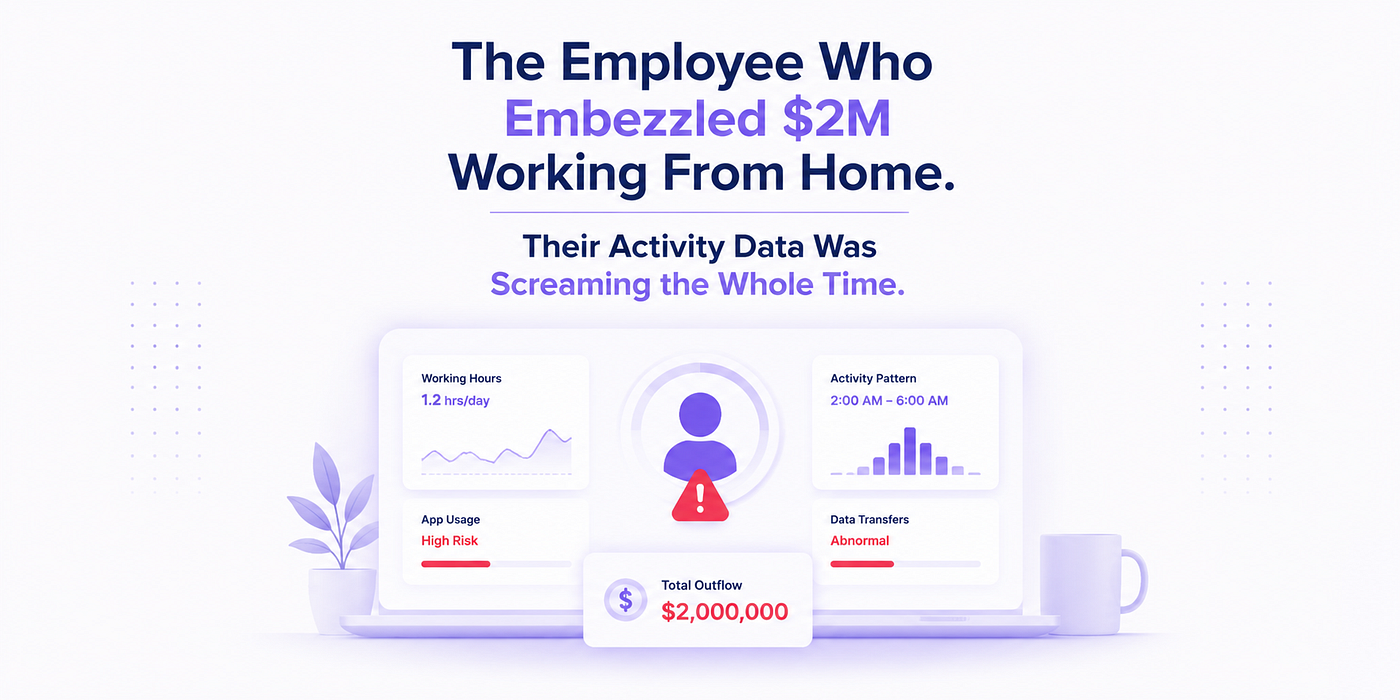
She logged into the financial system on weekends. Not once. Regularly. For a role that had zero weekend deliverables.
Her app usage shifted dramatically around month four. Before the fraud started, her top applications were Outlook, Excel, and the company’s project management tool. After month four, the financial ERP system jumped to her most-used app and stayed there. For a mid-level operations role, that’s not normal.
She started working in bursts. Long idle periods followed by 20-minute sessions of concentrated activity in the payment system. The pattern didn’t match any legitimate workflow. It matched someone who was waiting for the right moment and moving fast when she found it.
None of this required surveillance. No camera. No screen recording. Just a baseline of what normal activity looks like for that role and an alert when the pattern broke.
The system was screaming. But nobody had built the system to listen.
The $150,000 Problem
This isn’t a one-off story. The Association of Certified Fraud Examiners publishes a global fraud study every two years. The 2024 report found that the median occupational fraud loss is $150,000 per case. The median duration before detection: 12 months.
Twelve months. That means most fraud runs for a full year before anyone catches it. And the number one detection method isn’t audits. It isn’t monitoring software. It isn’t even management review.
It’s tips. Forty-three percent of fraud is caught because someone, a coworker, a vendor, a customer reports something that felt off.
That works when people share a physical space and pick up on body language, overheard conversations, and visible behavior. It works less well when everyone is a rectangular Zoom tile that switches off at 5 PM.
Remote work didn’t invent fraud. But it removed the informal tripwires that used to catch it early. Something has to replace those tripwires. And “trust your team”, while important — isn’t a fraud prevention strategy. It’s a sentence on a company values poster.
The Difference Between Watching and Seeing
The company in this story wasn’t anti-monitoring. They had badge access logs. They had VPN connection records. They even had a basic time-tracking tool.
But none of it was connected. None of it showed the pattern. You don’t catch fraud by checking if someone’s online. You catch it by noticing that someone’s workflow quietly changed shape and asking why.
That’s not surveillance. That’s structural awareness. The kind you used to get for free when everyone sat in the same room.
You don’t get it for free anymore.

**We360.ai* tracks activity patterns, app usage, and workflow anomalies across your entire team — giving you the structural awareness that remote work took away. Start your **7-day free trial* and see what your current tools are missing.
메타데이터
- post_id
- 5cea8ba81a3c
- slug
- the-employee-who-embezzled-2m-working-from-home-their-activity-data-was-screaming-the-whole-time-5cea8ba81a3c
- url
- https://medium.com/@we360ai/the-employee-who-embezzled-2m-working-from-home-their-activity-data-was-screaming-the-whole-time-5cea8ba81a3c
- canonical_url
- https://medium.com/@we360ai/the-employee-who-embezzled-2m-working-from-home-their-activity-data-was-screaming-the-whole-time-5cea8ba81a3c
- author_url
- https://medium.com/@we360ai
- status
- ok
- fetched_at
- 2026-06-14 11:28:49