AI Medical Chronology Services: Helping Attorneys Turn Complex Medical Records into Case-Ready…
For attorneys handling personal injury, medical malpractice, workers’ compensation, and mass tort cases, medical records are often the…
AI Medical Chronology Services: Helping Attorneys Turn Complex Medical Records into Case-Ready Insights
For attorneys handling personal injury, medical malpractice, workers’ compensation, and mass tort cases, medical records are often the foundation of the case. They reveal what happened, when it happened, how the injury progressed, what treatment was provided, and whether the medical evidence supports causation, damages, and long-term impact.
But there is one major challenge: medical records are rarely easy to review.
A single case may include hundreds or thousands of pages from hospitals, specialists, diagnostic centers, physical therapy clinics, pharmacies, and billing departments. Important facts are often buried across multiple records, repeated in different formats, or documented using complex clinical terminology. For attorneys and paralegal teams, manually reviewing these records can be time-consuming, costly, and prone to missed details.
This is where **AI Medical Chronology Services** are changing the way the medical-legal team works.
What Is Medical Chronology?
Medical chronology is a structured timeline for a patient’s medical events. It organizes medical records in date order and highlights key details such as:
- Date of treatment
- Provider or facility name
- Reason for visit
- Symptoms and complaints
- Diagnosis
- Treatment provided
- Diagnostic findings
- Medications
- Referrals
- Follow-up recommendations
- Relevant case issues such as causation, pre-existing conditions, gaps in treatment, and permanency
For attorneys, a well-prepared medical chronology is more than a summary. It is a litigation support tool that helps legal teams quickly understand the medical story behind a claim.
Why Attorneys Need Medical Chronology Services
Attorneys do not have time to search through unorganized medical records every time they need a case of fact. A clear chronology allows them to review the case faster, prepare demand letters, evaluate damages, identify strengths and weaknesses, and communicate more effectively with clients, experts, adjusters, and opposing counsel.
In personal injury cases, for example, medical chronology can show the progression from the accident date to emergency care, specialist visits, imaging results, therapy, surgery, impairment ratings, and future care recommendations. In medical malpractice cases, it can help identify missed diagnoses, delays in treatment, abnormal findings, and deviations in the timeline of care.
The stronger the medical timeline, the easier it becomes to build a strong legal narrative.
Manual Medical Chronology: The Traditional Approach
Traditionally, medical chronologies are prepared manually by paralegals, nurses, medical reviewers, or legal support teams. This method involves reading every page, extracting relevant information, organizing it chronologically, and preparing a report for attorney review.
Manual chronology reviews have some clear advantages. Human reviewers can understand legal context, identify subtle medical issues, and apply judgment to what should be included or excluded. Experienced reviewers can also recognize red flags that may not be obvious from a simple keyword search.
However, manual review also has limitations.
When records are large, repetitive, handwritten, or poorly organized, manual review can take significant time. Important details may be missed due to fatigue, volume, or inconsistent documentation. Turnaround times may also delay case evaluation, settlement preparation, or expert review.
For high-volume legal practices, manual-only chronology preparation can become expensive and difficult to scale.
AI-Driven Medical Chronology: A Modern Advantage
AI-driven medical chronology services use artificial intelligence to accelerate the medical record review process. AI tools can help extract key dates, identify providers, detect diagnoses, group related treatment events, summarize medical visits, and highlight potentially relevant findings.
For law firms, the benefit is speed and structure.
Instead of spending hours locating every treatment event manually, AI can quickly organize large volumes of records into a usable timeline. This allows legal teams to focus more on case strategy rather than administrative document review.
AI can also help identify patterns across records, such as:
- Treatment gaps
- Repeated complaints
- Imaging findings
- Surgical history
- Medication changes
- Prior injuries
- Follow-up recommendations
- Permanent restrictions
- Future care needs
When used properly, AI Medical Chronology Services can reduce review time, improve consistency, and help attorneys access important medical facts faster.
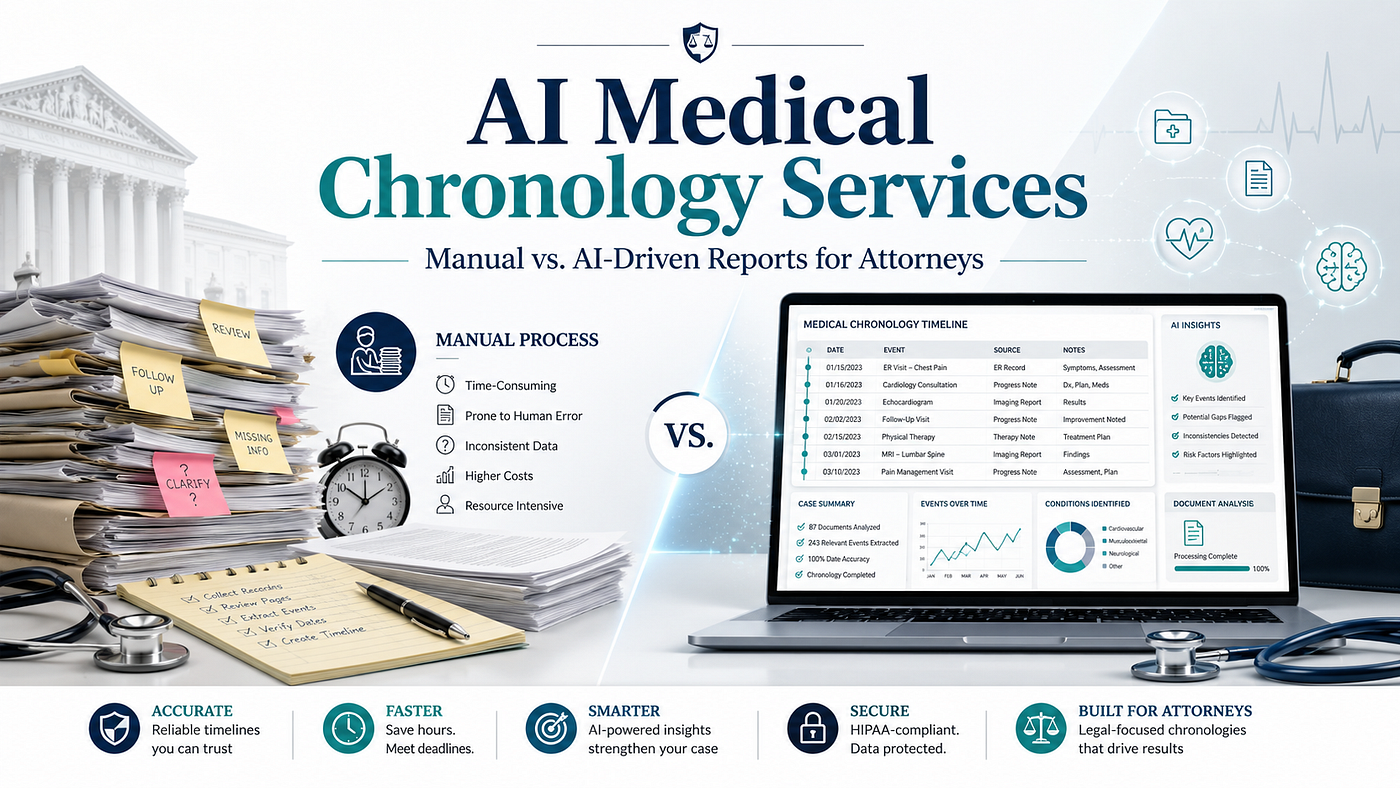
Manual vs. AI-Driven Medical Chronology Reports
Manual and AI-driven medical chronology reports serve the same purpose, but they differ in speed, scalability, consistency, and review process.
A manual medical chronology relies completely on human review. It can be highly detailed and context-aware, especially when handled by experienced medical-legal professionals. However, it may take longer to complete, especially for records with hundreds or thousands of pages.
An AI-driven medical chronology uses technology to assist with record sorting, information extraction, and timeline creation. This can significantly reduce turnaround time and improve efficiency. However, AI should not be used as a replacement for professional medical-legal review. The best results come from combining AI-powered processing with human quality control.
For attorneys, the ideal solution is not simply “AI instead of humans.” It is AI-assisted, human-reviewed medical chronology.
That combination delivers the speed of automation and the judgment of experienced reviewers.
Why Human Review Still Matters
Medical records are complex. A diagnosis may appear in one note but be ruled out later. A patient may report pain in different ways across multiple visits. A radiology report may contain findings that need clinical interpretation. A treatment gap may have a valid explanation. A prior injury may or may not be relevant to the current claim.
AI can organize and identify information quickly, but human expertise is essential to verify accuracy, remove irrelevant details, and ensure the final report supports the legal purpose of the case.
For this reason, attorneys should look for AI Medical Chronology Services that include professional review, quality checks, and medical-legal understanding.
Chronology should not simply be fast. It should be accurate, reliable, and case-ready.
How AI Medical Chronology Services Help Law Firms
AI Medical Chronology Services can support law firms in several practical ways.
First, they reduce the time spent reviewing large medical records. This is especially helpful during early case assessment, pre-litigation review, and demand preparation.
Second, they improve their organization. Attorneys can quickly see what happened, when it happened, and which providers were involved.
Third, they help identify key medical facts that affect case value. These may include objective findings, surgical recommendations, permanent restrictions, impairment ratings, and future treatment needs.
Fourth, they support better communication. A clear chronology helps attorneys explain the medical story to insurance adjusters, experts, mediators, and juries.
Finally, they allow legal teams to handle more cases without overwhelming internal staff.
What Attorneys Should Expect from a Quality AI Medical Chronology Report
A strong AI-assisted medical chronology should be clear, structured, and easy to use. It should not overload the attorney with unnecessary clinical text. Instead, it should highlight the most relevant facts in a format that supports legal review.
A quality report should include:
- Chronological treatment timeline
- Provider and facility details
- Clear summary of each encounter
- Key diagnoses and complaints
- Diagnostic test findings
- Treatment recommendations
- Surgical history, if applicable
- Medication and therapy details
- Notes on treatment gaps
- Prior medical history references
- Case-relevant observations
- Source reference details for easy verification
The report should help the attorney understand the case faster without losing access to the underlying medical evidence.
AI Does Not Replace Legal Judgment
AI can support attorneys, but it cannot replace legal judgment. Attorneys still decide case value, liability strategy, settlement position, expert requirements, and trial presentation.
The role of AI Medical Chronology Services is to make medical information easier to access, review, and use. It helps legal teams move from scattered records to structured insight.
For busy law firms, that difference matters.
The Future of Medical Chronology Is AI-Assisted and Human-Reviewed
The legal industry is moving toward faster, smarter, and more technology-enabled case preparation. Medical chronology is no exception.
Manual review will continue to be important, especially for complex cases. But AI-driven tools can reduce delays, improve consistency, and help attorneys focus on strategy instead of record sorting.
The future is not fully manual and not fully automated. The future is a hybrid model: AI-powered efficiency combined with professional medical-legal review.
For attorneys, this means faster reports, better organization, and more confidence when reviewing medical evidence.
Final Thoughts
Medical records tell the story of injury, treatment, recovery, and damages. But without proper organization, that story can remain hidden inside hundreds of pages of clinical documentation.
**AI Medical Chronology Services** help attorneys transform complex medical records into clear, accurate, and case-ready timelines. When supported by human review, these services offer the best of both worlds: speed, structure, accuracy, and legal usability.
For law firms handling injury-related claims, AI-driven medical chronology is no longer just a convenience. It is becoming a practical advantage in case preparation, demand drafting, expert review, and litigation strategy.
About Us:
Medical Insightz provides AI-powered medical record review and medical legal services trusted by attorneys, insurance professionals, and healthcare organizations across the United States.
By combining advanced artificial intelligence with clinical expertise, we deliver faster, accurate, and cost-effective medical record analysis. Our services include medical chronologies, narrative summaries, litigation support, payer services, healthcare provider support, and data analytics.
Website URL: **medicalinsightz.com LinkedIn: https://www.linkedin.com/company/medical-insightz**
메타데이터
- post_id
- 61128d3c4da8
- slug
- ai-medical-chronology-services-helping-attorneys-turn-complex-medical-records-into-case-ready-61128d3c4da8
- url
- https://medium.com/@contact_27001/ai-medical-chronology-services-helping-attorneys-turn-complex-medical-records-into-case-ready-61128d3c4da8
- canonical_url
- https://medium.com/@contact_27001/ai-medical-chronology-services-helping-attorneys-turn-complex-medical-records-into-case-ready-61128d3c4da8
- author_url
- https://medium.com/@contact_27001
- status
- ok
- fetched_at
- 2026-06-09 15:37:30






