Logistic Regression and Machine Learning in Python for Trading: End-to-End Case Studies and…
This article demonstrates how logistic regression can be applied in trading with Python to build interpretable machine learning models for…
Logistic Regression and Machine Learning in Python for Trading: End-to-End Case Studies and Applications
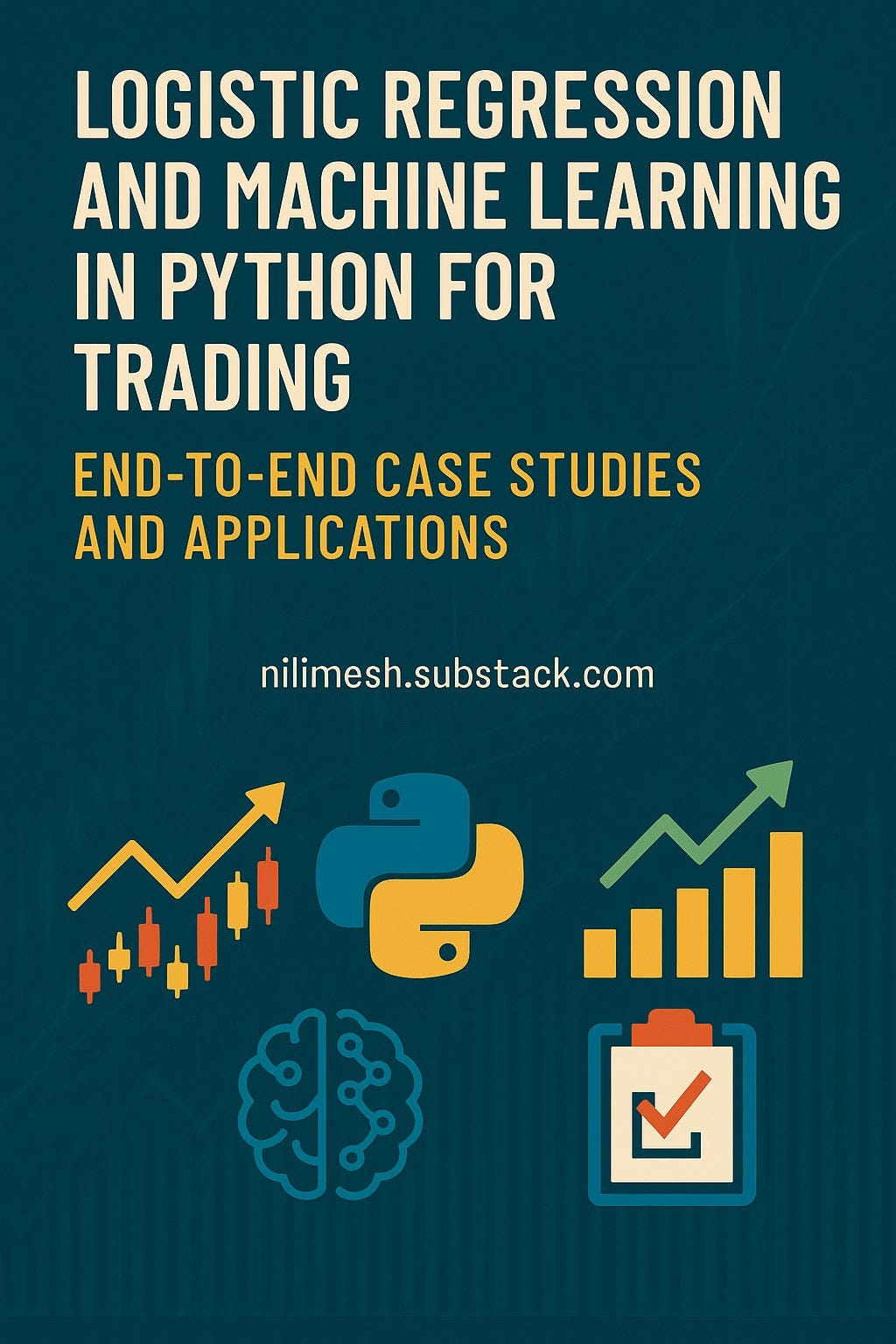
This article demonstrates how logistic regression can be applied in trading with Python to build interpretable machine learning models for predicting price direction, volatility regimes, and event-driven market movements.
Step-by-Step Outline
1. Introduction to Logistic Regression in Trading
- Explanation of logistic regression as a classification model for financial markets.
- Why it is useful for predicting binary outcomes such as “price goes up vs. down.”
- Advantages: interpretability, probability outputs, baseline for machine learning in trading.
2. Applications of Logistic Regression in Financial Trading
- Price Direction Prediction: using technical indicators to classify up or down movements.
- Volatility Regime Classification: identifying high vs. low volatility environments.
- Risk Management: estimating probability of hitting stop-loss levels.
- Event-Based Trading: predicting market reaction to earnings announcements or news.
3. Mathematical Foundation of Logistic Regression
- Logistic function for mapping predictors to probabilities.
- Coefficients interpreted as log-odds and odds ratios in the trading context.
- Estimation using maximum likelihood and extensions with L1/L2 regularization.
4. Setting Up the Python Environment
- Libraries for data handling (
pandas,numpy), modeling (scikit-learn), and visualization (matplotlib,seaborn). - Ensuring reproducibility with random seeds.
5. Preparing Financial Data for Logistic Regression
- Data preprocessing steps: generating features, splitting into train/test sets, and scaling.
- Importance of time-series awareness in trading datasets.
6. Building Logistic Regression Models in Python
- Using
LogisticRegressionfrom scikit-learn for classification. - Training on technical and fundamental features.
- Extracting coefficients for feature importance.
7. Model Evaluation and Diagnostics
- Confusion matrix, precision, recall, F1-score.
- ROC curve and AUC.
- Precision–Recall curves for imbalanced trading setups.
- Odds ratios to understand the effect of technical indicators.
8. Case Study 1: Predicting Price Direction with Technical Indicators
- Example workflow using moving averages, RSI, and momentum as predictors.
- Logistic regression for classifying up vs. down movements.
9. Case Study 2: Volatility Regime Classification
- Building a classifier to distinguish between high and low volatility periods.
- Applications in risk-adjusted position sizing.
10. Case Study 3: Event-Based Trading Strategy
- Predicting stock price reaction after earnings or economic news events.
- Evaluating classification accuracy and potential profitability.
11. Comparison with Other Machine Learning Models
- Benchmark logistic regression against Decision Trees and Random Forests.
- Discuss trade-offs between interpretability and predictive performance in trading.
12. Advantages and Limitations in Trading Applications
- Advantages: speed, interpretability, ease of use in backtesting.
- Limitations: linear log-odds assumption, inability to capture complex patterns.
- When to use logistic regression vs. more advanced models.
13. End-to-End Python Script
- A unified script covering preprocessing, logistic regression model building, diagnostics, and evaluation for all three case studies.
14. Conclusion
- Summary of how logistic regression fits into trading workflows.
- Emphasis on its role as a baseline model and as a tool for interpretable probability-based trading decisions.
Download the article:
메타데이터
- post_id
- 634611a73d5d
- slug
- logistic-regression-and-machine-learning-in-python-for-trading-end-to-end-case-studies-and-634611a73d5d
- url
- https://medium.com/@HalderNilimesh/logistic-regression-and-machine-learning-in-python-for-trading-end-to-end-case-studies-and-634611a73d5d
- canonical_url
- https://medium.com/@HalderNilimesh/logistic-regression-and-machine-learning-in-python-for-trading-end-to-end-case-studies-and-634611a73d5d
- author_url
- https://medium.com/@HalderNilimesh
- status
- ok
- fetched_at
- 2026-08-22 18:52:42