Sample Rate Selection for Different Human Sounds Classification
Human sounds classification — including speech, coughs, laughter, and accidental falls — is critical for healthcare and security. Sample…
Sample Rate Selection for Different Human Sounds Classification
Human sounds classification — including speech, coughs, laughter, and accidental falls — is critical for healthcare and security. Sample rate selection significantly impacts deep learning model accuracy and computational efficiency. This article analyzes the spectral characteristics of human vocalizations and environmental events, reviewing empirical evidence from speech recognition, cough detection, and acoustic fall detection. Our analysis reveals that while 16 kHz is a practical standard for most tasks, the optimal rate depends on specific application requirements. We provide evidence-based guidelines for practitioners, balancing spectral fidelity with the resource constraints of modern deployment.
Intro
Human sounds classification is vital for healthcare monitoring, human-computer interaction, and ambient assisted living. From detecting respiratory diseases via cough analysis to monitoring elderly individuals for accidental falls, deep learning models are increasingly prevalent. Preprocessing, specifically sample rate selection, influences model performance and deployment feasibility. Unlike general audio, human sounds have defined spectral characteristics that guide optimal selection. In this article, we synthesizes evidence across speech, cough, and acoustic event detection to provide clear recommendations.
Spectral Characteristics
Different human vocalizations occupy distinct frequency ranges:
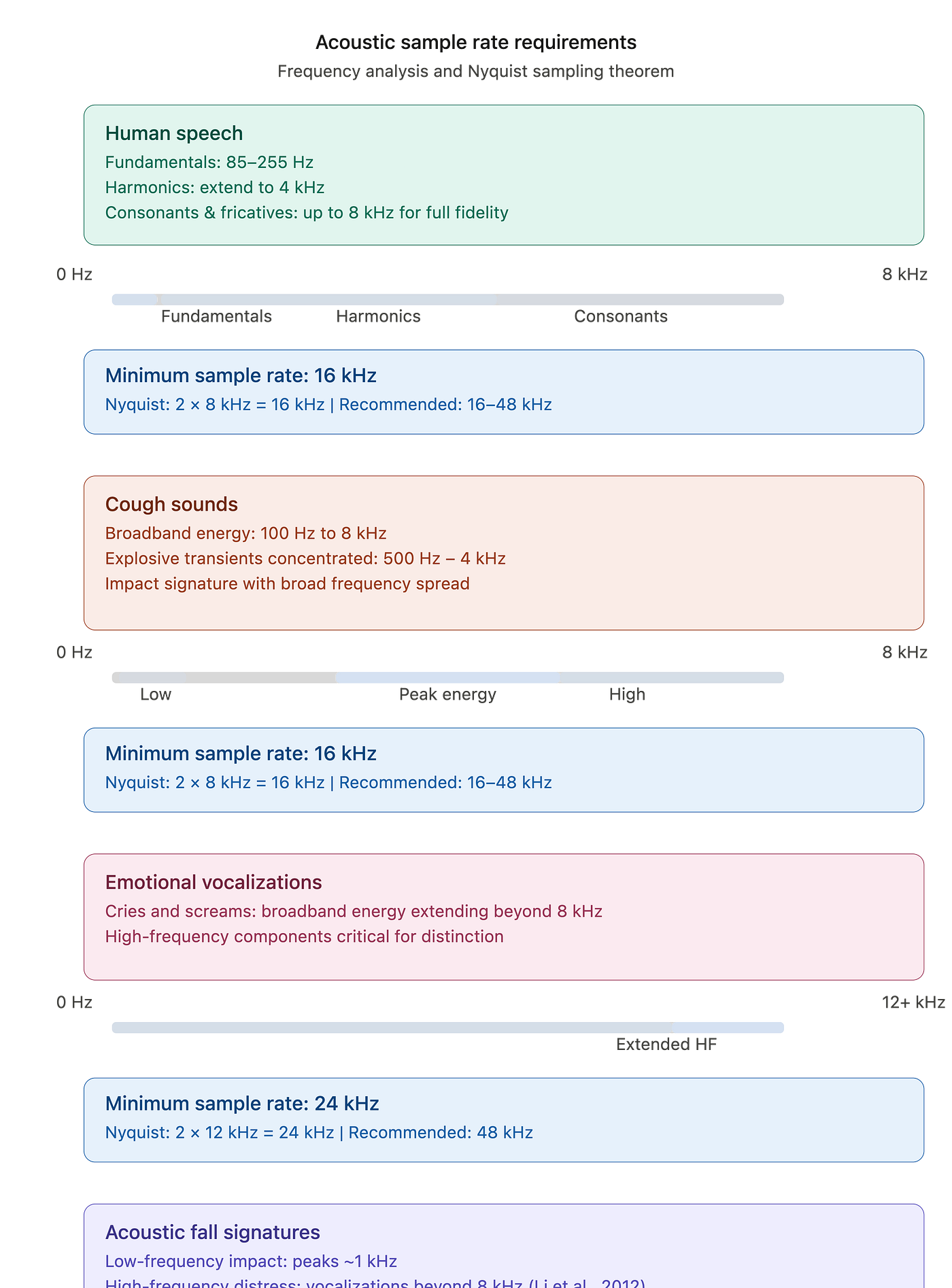
- Speech: Fundamental frequencies range from 85–255 Hz, with harmonics extending to 4 kHz. High-frequency consonants and fricatives require up to 8 kHz for full fidelity.
- Coughs: Broadband energy spans 100 Hz to 8 kHz. Explosive transients require higher sample rates to capture features concentrated between 500 Hz and 4 kHz.
- Emotional Vocalizations: Cries and screams often contain energy extending beyond 8 kHz.
- Acoustic Fall Signatures: Falls produce a composite profile: a low-frequency impact (peaking ~1 kHz) often followed by high-frequency distress vocalizations (Li et al., 2012).
Theoretical Foundations
The Nyquist theorem requires a sample rate at least twice the highest frequency of interest.
- 8 kHz (Narrow-band): Sufficient for basic speech but misses nuances for emotion or fall identification.
- 16 kHz (Wide-band): Captures frequencies to 8 kHz, covering essential speech and high-frequency harmonics for most human-centric tasks.
- 44.1 kHz (Full-band): Captures the human hearing range (20 Hz–20 kHz), preserving all spectral detail.
Common Research Trends
- 16 kHz: The industry standard for speech and voice processing, balancing spectral capture and efficiency.
- 20–22.05 kHz: Used for voice activity and fall detection, offering improved frequency resolution.
- 44.1–48 kHz: Reserved for clinical or professional applications requiring maximum fidelity.
- 8–10 kHz: Used in bandwidth-constrained, low-power ambient sensors (Quintana-Suárez et al., 2017).
Empirical Evidence
Speech and Cough Detection
Research on the Google Speech Commands dataset confirms 16 kHz provides sufficient accuracy for keyword spotting. In emotion recognition, reducing sample rates from 16 kHz to 8 kHz can decrease accuracy by ~3.3%, emphasizing the need for wider bandwidth. Conversely, for cough detection, while some studies record at 44.1 kHz, many achieve >84% accuracy after downsampling to 11 kHz, suggesting cough classification is robust to lower sample rates (Imran et al., 2021).
Acoustic Fall Detection
Fall detection requires capturing both the impact thud and subsequent distress. Microphone arrays sampling at 20 kHz reliably capture this signature while avoiding spatial aliasing (Li et al., 2012). For ambient assisted living, where noise overlap is a challenge, 20 kHz provides an optimal trade-off (Adnan et al., 2018). For ultra-low-power wireless sensors, 10 kHz has proven sufficient to classify impacts and human distress without battery depletion (Quintana-Suárez et al., 2017).
Pathological Analysis
Dysarthric speech detection and Arabic children’s speech studies often standardize at 16 kHz to maintain compatibility with standard pipelines while ensuring high-frequency harmonics of higher-pitched voices are preserved (Al-Hussaini et al., 2026; Zhang et al., 2025).
Guidelines for Practitioners
- Default to 16 kHz: Recommended for most speech, keyword spotting, and general vocal events.
- Use 20–22.05 kHz: Optimal for fall detection and emotion recognition, where high-frequency harmonics provide discriminative data.
- Use 44.1 kHz: Best for clinical pathological voice analysis or cough characterization where maximum fidelity is critical.
- Avoid <8 kHz: Avoid for almost all human-centric tasks due to information loss in fricatives and impact transients.
Deployment: Edge and mobile devices benefit from the efficiency of 10–16 kHz, whereas cloud environments can accommodate 44.1 kHz.
Conclusion
Sample rate selection is a critical preprocessing decision that significantly impacts the accuracy, efficiency, and deployability of human sounds classification models. The spectral characteristics of human vocalizations, combined with empirical evidence from diverse applications, suggest that 16 kHz represents a practical optimal point for most human sounds classification tasks. This rate captures the essential frequency components of speech, coughs, and other vocalizations while maintaining computational efficiency.
However, task-specific requirements should guide final decisions. Clinical applications requiring maximum spectral fidelity may benefit from higher sample rates (44.1 kHz), while bandwidth-constrained applications — such as continuous remote acoustic fall monitoring — might accept 10–16 kHz with some performance trade-offs. The key is to match the sample rate to the specific frequency requirements of the target human sounds while considering deployment constraints.
References
- Adnan, S. M., et al. (2018). Fall detection through acoustic Local Ternary Patterns. Applied Acoustics, 140, 296–300.
- Al-Hussaini, I., et al. (2026). Arabic children speech classification using deep learning. arXiv.
- Imran, A., et al. (2021). A generic deep learning based cough analysis system. IEEE Access.
- Li, Y., Ho, K. C., & Popescu, M. (2012). A Microphone Array System for Automatic Fall Detection. IEEE Trans. Biomed. Eng., 59, 1291–1301.
- Quintana-Suárez, M., et al. (2017). A Low Cost Wireless Acoustic Sensor for Ambient Assisted Living Systems. Applied Sciences, 7, 877.
- Zhang, L., et al. (2025). Scalogram based performance comparison for dysarthric speech detection. Artificial Intelligence Review.
메타데이터
- post_id
- 63fed15932e7
- slug
- sample-rate-selection-for-different-human-sounds-classification-63fed15932e7
- url
- https://medium.com/@rashaa.j90/sample-rate-selection-for-different-human-sounds-classification-63fed15932e7
- canonical_url
- https://medium.com/@rashaa.j90/sample-rate-selection-for-different-human-sounds-classification-63fed15932e7
- author_url
- https://medium.com/@rashaa.j90
- status
- ok
- fetched_at
- 2026-06-14 11:28:49