I’m Building a Full SaaS HR Platform Solo — Here’s the Full Story, from Messy Idea to Working Code
How AI helped me go from vague ambition → structured requirements → architecture decisions → 75 user stories → 3 phases of working software
I’m Building a Full SaaS HR Platform Solo — Here’s the Full Story, from Messy Idea to Working Code
How AI helped me go from vague ambition → structured requirements → architecture decisions → 75 user stories → 3 phases of working software
The Ambition
I set out to build a modern HR SaaS platform — think SageHR, but greenfield, UK-market-first, targeting everything from 10-person startups to enterprise. Full employee lifecycle: onboarding, leave management, attendance, mobile app, payroll, performance reviews, ATS. The whole thing.
Solo developer. No team. No VC. No deadlines except the ones I set myself.
The question wasn’t whether it was possible — it was how to do it without losing my mind or cutting corners that would collapse under real usage.
Here’s what it looks like today — dashboard with real seeded data, fully running in Docker:
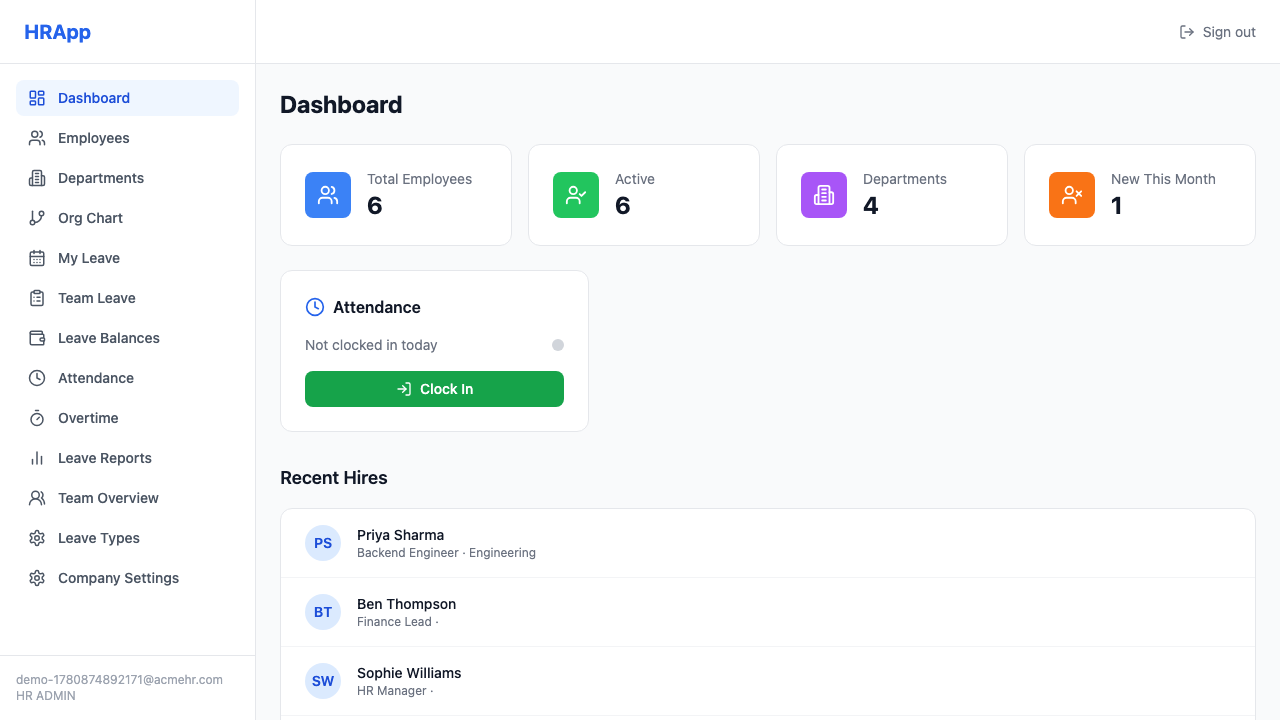
The HR dashboard — employee stats, recent hires, attendance clock-in, full navigation.
It Started Messy
Let me be honest about how this actually began.
The first sessions were chaotic. I had an idea — “build an HR platform” — but that’s not a plan. I knew I wanted something modern, something opinionated, something better than the legacy tools. But when I sat down to actually start, I hit the usual wall: where do you even begin?
What kind of companies are we targeting? How big? What features for launch, what’s deferred? UK-specific compliance or generic? Shared database or separate schemas per tenant? What does “done” even mean for a feature?
These aren’t questions you answer by typing code. I spent the first phase just talking through the product — using Claude AI as a thinking partner to stress-test ideas and surface decisions I hadn’t realised I needed to make.
What happens when an employee is deactivated — do pending leave requests auto-reject? If you’re UK-first, you need regional public holiday calendars from day one — England, Wales, Scotland, and Northern Ireland are different. Custom fields tables are a trap. Every mature HR platform regrets them. Model real domain columns instead.
Iteration after iteration of this kind of conversation turned vague intent into concrete, defensible decisions.
Requirements First: Getting the Foundation Right
After several rounds of discussion, something useful emerged: not code, but a structured requirements picture.
The core product questions became answered:
- Market: SMB to Enterprise, UK-first
- Pricing model: per employee/month — Starter, Growth, Enterprise tiers
- Multi-tenancy approach: shared database, shared schema,
company_idon every table — no per-tenant schema management complexity - Launch features vs. deferred: what ships in Phase 1 vs. what waits for Phase 4, 5, 6, 7
Then came the architecture decisions — each one a discussion, not a coin flip:
- Spring Boot 4 on Java 25 — newest LTS, built on Spring Framework 7. Not the “safe” choice, the right choice for a platform that needs to last.
- React 19 on web, React Native 0.79 on mobile — one React codebase, not two separate teams of knowledge
- PostgreSQL 17 — the multi-tenancy story works cleanly here
- Terraform managing all AWS infra —
terraform applyspins everything up,terraform destroytears it all down - Docker Compose for local dev — zero AWS spend until staging is ready
And the non-negotiable engineering rules that emerged:
- JWT auth with refresh tokens, Spring Security abstracted so OAuth2/SSO drops in later without touching business logic
- Flyway for every DB migration — never touch the database manually
- Soft deletes for employees —
employment_status = TERMINATED, never hard delete - Documents always via S3 pre-signed URLs (15-minute expiry) — never serve S3 directly
- No custom fields tables — model real domain columns
These aren’t opinions. Each one came from a concrete reason, surfaced in discussion before it became a bug in production.
From Requirements to a Roadmap
With the product and architecture defined, the next step was structure: what does “the whole thing” actually look like as deliverable work?
This is where the chaos really got resolved. Together, we mapped out the full product across 7 phases and 75 user stories.
PhaseFocusPhase 1Foundation — auth, employee management, documents, dashboardPhase 2Leave & Attendance — leave types, approval workflows, clock-in/outPhase 3Mobile App — React Native, push notificationsPhase 4Performance Reviews — OKRs, 360 feedback, review cyclesPhase 5Recruitment / ATS — job postings, candidate pipeline, offer lettersPhase 6UK Payroll — PAYE, NI, HMRC RTI, payslips, BACS, P60sPhase 7Integrations — public API, SSO, accounting exports, GDPR tools
Every story became a GitHub issue with acceptance criteria, subtasks, and test requirements. Every phase became a GitHub Milestone.
The planning artefact — the single file that captured all of this — became what I called CLAUDE.md. It's checked into the repo root. It contains every architectural decision, every engineering rule, the full phased roadmap, and the story execution playbook. It's what I read when I'm unsure what to do at 11pm. It's also what Claude reads at the start of every session — so there's no re-explaining context, no relitigating decisions already made, no starting cold.
That document is as much a product of this project as the code.
The Development Workflow: Story-Driven, One at a Time
With the foundation in place, development followed a strict workflow — for every one of the 75 stories:
- Branch from main:
issue/{n}/{short-description} - Build in order: migration → entity → service → controller → frontend → tests → E2E
- Every story ships with unit tests (JUnit 5 + Mockito, MockMvc, Vitest) and Playwright E2E specs
- PR raised, human reviews, merges — then move to the next story
No partial stories. No “we’ll write tests later.” No “it works on my machine.”
The hardest discipline: if tests fail on a clean docker compose down -v && docker compose build --no-cache, the story isn't done. A passing test on a stale Docker volume is not a passing test. That rule caught real bugs — Flyway migrations that worked against an existing schema but failed on a fresh install. Exactly what would have broken on first staging deploy.
Phase 1: Foundation — 18 Stories, Fully Done
*Milestone: Phase 1 — Weeks 1–12*
Auth
Login page — JWT auth, refresh tokens, password reset. Spring Security abstracted for OAuth2/SSO drop-in later.

(#5, #6, #7, #8): Company registration creates a company record and an HR_ADMIN user in one transaction, returns a JWT pair. Login, refresh tokens, logout, password reset with email tokens — all built, all tested. Spring Security abstracted from day one so OAuth2/SSO can drop in later without touching business logic.
Multi-tenancy: Every query goes through a Spring interceptor that injects company_id. Developers can't accidentally leak one company's data to another — it's structural, not a code convention.
Data Model
The core schema underpins everything. Here’s how the Phase 1 tables relate:

Departments & Employees
Org chart — recursive department tree using
parent_id. Clicking any department opens management view.

(#10, #11): Recursive tree using parent_id, exposed as a nested org chart. The tricky part was building a clean tree endpoint that didn't result in N+1 queries.
Employee list — search, filter by status, employee numbers auto-assigned, department and role visible at a glance.

(#12, #13, #14, #15): Full profile — personal info, employment details, manager relationship, department assignment. Soft deletes only: employment_status = TERMINATED. Never hard delete an employee record.
Documents (#16, #17): Upload to S3, generate pre-signed URLs for download (15-minute expiry). Local dev uses a filesystem service with HMAC-signed tokens that behaves identically to the S3 service — swap at staging with a Spring profile change.
Dashboard (#18): RBAC-driven stats. Employees see their own data. Managers see their team. HR Admins see everything.
By the end of Phase 1: 153 backend unit tests, 67 frontend component tests, Playwright API specs covering every endpoint.
Phase 2: Leave & Attendance — The Complex One
*Milestone: Phase 2–11 stories*
This is where most HR platforms hide their complexity, and it showed.
Leave management — request leave, view status, team calendar. Multi-level approval workflows underneath.

Leave types (#19) are fully configurable — annual, sick, maternity/paternity, unpaid, custom. Each has its own accrual rules and approval requirements.
Approval workflows (#21, #22) support multi-level chains: employee → manager → HR admin. The state machine for a leave request (PENDING → APPROVED/REJECTED, with the ability to cancel pending requests) needed careful thought to avoid race conditions when two approvers act simultaneously.
Leave balance tracking (#23) does rolling accruals — not just “you get 25 days on January 1st.” Entitlement accrues monthly, carries over with a configurable cap, and is adjusted for part-time employees by FTE ratio.
UK public holidays (#24) ship as a pre-seeded calendar for England, Wales, Scotland, and Northern Ireland — because they’re different, and getting this wrong means employees in Scotland think they have a holiday they don’t.
Attendance — clock-in/out with a single button. Overtime flagging and team dashboard for managers.

Clock-in/clock-out (#25, #26) with overtime tracking: the system detects when you’ve exceeded contracted hours and flags it. Managers see a team dashboard (#28). Everything exports to CSV (#27).
Leave email alerts (#29) use Thymeleaf templates. Local dev logs to console. Production flips to SES via Spring profiles — zero code change, just config.
Phase 3: Mobile App — React Native
*Milestone: Phase 3–6 stories shipped*
The mobile app gets you to about 90% of the feature set that matters day-to-day:
- Secure login with JWT stored in the device keychain — not AsyncStorage (#31)
- Employee directory with search (#32)
- Leave request submission and approval flows (#33)
- Attendance clock-in/out (#34)
- Push notifications for approvals and alerts (#35)
React Native 0.79 with Expo-style tooling but bare workflow — more control when you need to integrate with native device APIs. The biggest challenge was environment configuration: React Native requires dotenv values to be baked in at build time, not runtime, which catches out developers coming from web backgrounds.
Two things deferred intentionally: payslip viewing (#36 — needs the Phase 6 payroll engine to exist first) and App Store / Play Store submission (#37 — needs developer accounts, moved to Phase 7).
What’s Next: Staging Deploy
*Milestone: Phase 3b — 7 stories*
Phases 1–3 are done. The app works end-to-end in Docker. Now it’s time to make it real.
AWS Architecture

Phase 3b wires it all together:
- Full Terraform: RDS, ECS Fargate, S3, CloudFront, ALB, Secrets Manager (#95)
- GitHub Actions CI/CD activated — they’ve been skeletons until now, no point burning build minutes before staging exists (#96)
- SES wired for transactional email (#97)
- S3 wired for employee document storage (#98)
- Custom domain + SSL via Route 53 + ACM (#99)
- CloudWatch monitoring and alerting (#100)
- Playwright smoke tests running against the live staging URL (#101)
The Terraform is mostly written. The infrastructure modules — networking, ECS, RDS, CDN, secrets — are all in the repo. It’s the wiring-up phase.
The Honest Take on AI-Assisted Development
I’ve used Claude Code throughout this build — but the important thing is how.
It wasn’t a code generator I pointed at tasks. It was involved from the very beginning: the requirements discussions, the architecture decisions, the roadmap breakdown. The messy early phase where I was figuring out what I was even building — that happened in collaboration with AI, not before I brought it in.
The distinction between a code generator and an engineering partner matters:
- A code generator produces code when you describe a feature.
- An engineering partner asks clarifying questions, catches problems before they become bugs, maintains consistency across 75 stories and thousands of lines of code, and remembers that a decision made in Story 5 has implications for Story 45.
The key was writing the CLAUDE.md playbook — explicit rules about how stories get executed, what "done" means, when to ask questions and when to just make the call. That playbook is as much a product of this project as the code. And it emerged from the same requirement-shaping conversations that produced the roadmap.
Things that worked:
- Spend time on requirements and architecture before feature 1. Every decision you defer becomes a disruption mid-build.
- Non-negotiable test standards. No story ships without full test coverage. No exceptions, no “we’ll add tests later.”
- Clean Docker builds for E2E. Never trust a test that ran against a volume with accumulated state.
- One story at a time. Batching stories introduces coordination complexity that kills velocity.
What I’d do differently:
- Set up the staging deploy earlier — probably after Phase 1. Running real infra sooner would have surfaced environment-specific issues before they stacked up.
Where It’s Going
The roadmap after staging — tracked on GitHub Milestones:
- **Phase 4**: Performance reviews — review cycles, OKRs, 360-degree feedback, customizable templates
- **Phase 5**: Recruitment / ATS — job postings, candidate pipeline, offer letters, candidate-to-employee conversion
- **Phase 6**: UK Payroll — PAYE, NI, HMRC RTI submission, payslips, BACS export, P60s
- **Phase 7**: Integrations — public API, Google Workspace SSO, Xero/QuickBooks export, GDPR tools
That’s about 8 months of build ahead. The foundation is solid enough that each phase is additive, not a rewrite.
The Code
The repo is public at github.com/laxminarayanaboga/project_hr — the architecture patterns, CLAUDE.md playbook, and Terraform modules are all there to read. More posts as phases complete.
Building in public from here. More posts as the staging deploy lands and Phase 4 starts.
Solo developer building UK HR SaaS. Spring Boot 4, React, React Native, AWS, Terraform. 75 stories. One at a time.
메타데이터
- post_id
- 6633da54fccc
- slug
- im-building-a-full-saas-hr-platform-solo-here-s-the-full-story-from-messy-idea-to-working-code-6633da54fccc
- url
- https://medium.com/@laxminarayanaboga4079/im-building-a-full-saas-hr-platform-solo-here-s-the-full-story-from-messy-idea-to-working-code-6633da54fccc
- canonical_url
- https://medium.com/@laxminarayanaboga4079/im-building-a-full-saas-hr-platform-solo-here-s-the-full-story-from-messy-idea-to-working-code-6633da54fccc
- author_url
- https://medium.com/@laxminarayanaboga4079
- status
- ok
- fetched_at
- 2026-06-09 15:37:30