Tools Behind Data Engineering - Mapped to the Data Pipeline
A practical breakdown of the tools data engineers actually use — and where each one fits in a real system
Tools Behind Data Engineering - Mapped to the Data Pipeline
A practical breakdown of the tools data engineers actually use — and where each one fits in a real system
In the previous post, we looked at how data moves through a company — from a user action to a dashboard.
The natural next question is:
👉 What tools actually power each stage of that pipeline?
If you’ve looked at the modern data stack, it can feel overwhelming. There are hundreds of tools, new ones launching constantly, and endless comparisons.
But the reality is much simpler:
Tools change. The underlying structure does not.
If you understand what each stage of the pipeline is trying to solve, the tools become much easier to reason about.
The Simple Framework
Every data engineering tool falls into one of these six categories:
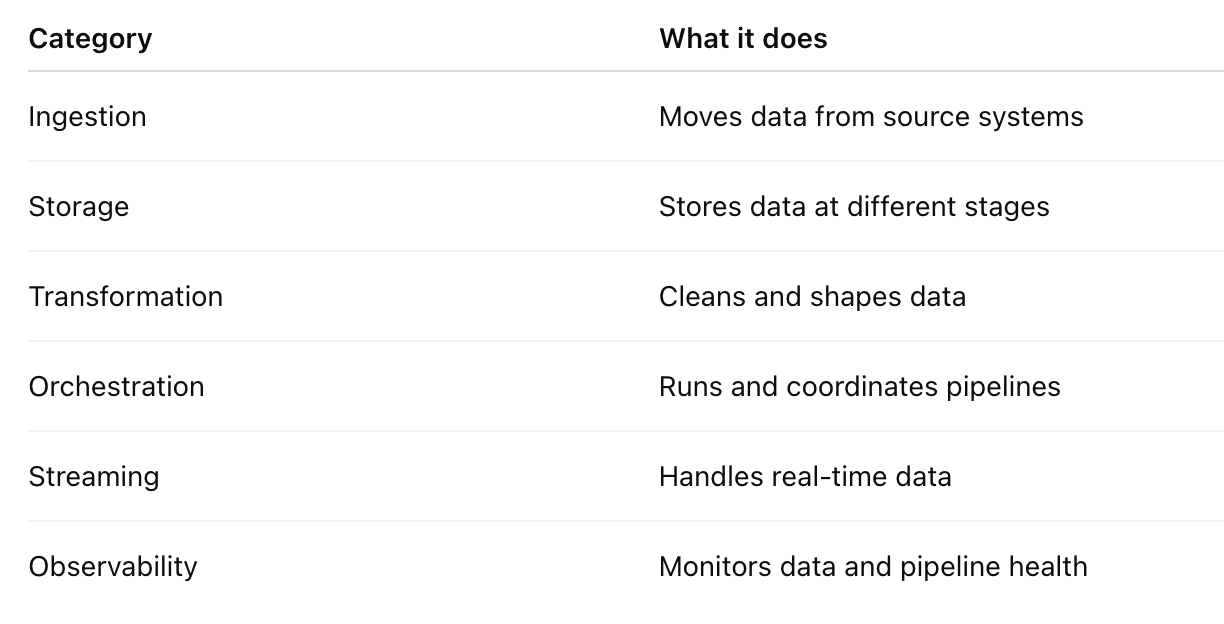
These map directly to the pipeline layers we discussed earlier. Once you understand this mapping, tool selection becomes far less confusing.
1️⃣ Source Systems — Where Data Begins
Everything starts here.
This is where real-world events are recorded:
- A customer places an order
- A payment is processed
- A user signs up
Common systems:
- PostgreSQL
- MySQL
- MongoDB
These are OLTP systems, optimized for fast transactions and high concurrency.
They are not designed for analytics.
Running heavy analytical queries directly on them is one of the fastest ways to degrade application performance.
2️⃣ Ingestion — Moving Data Out Safely
Once data is created, it needs to be moved into the data platform without affecting production systems. That’s the job of ingestion.
Common tools
- Fivetran / Airbyte / NiFi → managed batch ingestion
- Debezium → Change Data Capture (CDC)
- Kafka → event streaming
How to think about it
If the source is standard (SaaS tools, common databases):
👉 Use managed connectors
If the source is internal or complex:
👉 Build custom ingestion
Don’t build what you can buy — but don’t over-abstract what you need control over.
3️⃣ Storage — Where Data Lives
Storage choices depend on where you are in the pipeline.
Data Lake (Raw Storage)
- AWS S3
- Azure Data Lake
- Google Cloud Storage
Used to store data as-is, without transformation.
Typically uses Parquet, a columnar format optimized for analytics.
Data Warehouse (Serving Layer)
- Snowflake
- BigQuery
- Redshift
Designed for:
- large analytical queries
- aggregations
- parallel execution
Lakehouse (Modern Pattern)
- Delta Lake
- Apache Iceberg
Combines:
- scalability of data lakes
- reliability of warehouses
Real-world perspective
Storage decisions directly impact cost, performance, and flexibility.
Poor partitioning or scanning entire datasets repeatedly can become extremely expensive at scale.
4️⃣ Transformation — Where Data Becomes Usable
Raw data is rarely useful in its original form.
Transformation is where data is:
- cleaned
- standardized
- joined
- structured for analysis
Common tools
- dbt → SQL-based transformation
- Spark → large-scale distributed processing
- pandas / Polars → smaller workloads
When to use what
- Use dbt when working inside a warehouse
- Use Spark when data is large or computation is complex
Important note
Spark is not just “fast pandas.”
It requires a different way of thinking:
- partitioning strategy
- shuffle awareness
- memory management
Poor design at this stage often leads to:
- high CPU usage
- long runtimes
- unstable pipelines
5️⃣ Orchestration — Making It All Work Together
Orchestration connects all parts of the pipeline.
It ensures:
- tasks run in the right order
- failures are handled
- retries are managed
- dependencies are respected
Common tools
- Airflow (industry standard)
- Prefect / Dagster (modern alternatives)
What actually matters
Not the tool — but the principles:
- idempotency
- retry logic
- dependency management
A pipeline that “usually works” is not reliable.
Important note
Cron is not orchestration.
It lacks:
- dependency tracking
- retry handling
- visibility
6️⃣ Streaming — When Real-Time Matters
Streaming systems process data continuously.
Common tools
- Kafka
- Kinesis
- Pub/Sub
Important reality check
Most use cases do not require real-time processing.
Many problems are perfectly solved with: 15–60 minute batch pipelines
Streaming adds operational complexity — use it only when necessary.
7️⃣ Observability — The Most Underrated Layer
Pipelines don’t just fail by crashing. They fail silently.
Common tools
- dbt tests
- Great Expectations
- Monte Carlo
What to monitor
- row counts
- null values
- schema changes
- data freshness
Critical insight
A pipeline that runs successfully can still produce incorrect data.
This is one of the most common — and most dangerous — failure modes in data engineering.
What actually matters
- understanding the pipeline
- choosing tools based on need
- managing tradeoffs
- designing for failure
The best tool is not the most popular one — it’s the one that solves the problem with the least operational complexity.
⚠️ Common Mistakes
- Choosing tools before understanding the problem
- Using streaming where batch is sufficient
- Ignoring orchestration
- Skipping data validation
- Following trends instead of requirements
Final Thought
Start with the flow. Understand each stage. Then learn the tools.
Because:
Tools will change. Systems thinking will not.
메타데이터
- post_id
- 666b8d2c5484
- slug
- tools-behind-data-engineering-mapped-to-the-data-pipeline-666b8d2c5484
- url
- https://medium.com/@manoj005jha/tools-behind-data-engineering-mapped-to-the-data-pipeline-666b8d2c5484
- canonical_url
- https://medium.com/@manoj005jha/tools-behind-data-engineering-mapped-to-the-data-pipeline-666b8d2c5484
- author_url
- https://medium.com/@manoj005jha
- status
- ok
- fetched_at
- 2026-06-09 15:37:30