Recommended Books for Class 9 Students: According To New NCERT Syllabus 2026–27
If you’re a student stepping into Class 9 or a parent seeking to buy new curriculum for your child, you’ve probably noticed that the book…
Recommended Books for Class 9 Students: According To New NCERT Syllabus 2026–27
If you’re a student stepping into Class 9 or a parent seeking to buy new curriculum for your child, you’ve probably noticed that the book titles don’t match the book list from the last year. There are no Beehive, Moments, History, or Geography books available at the store. This change happens because NCERT has recently revised their old syllabus for Class 9, marking it as the most significant update in over 20 years.
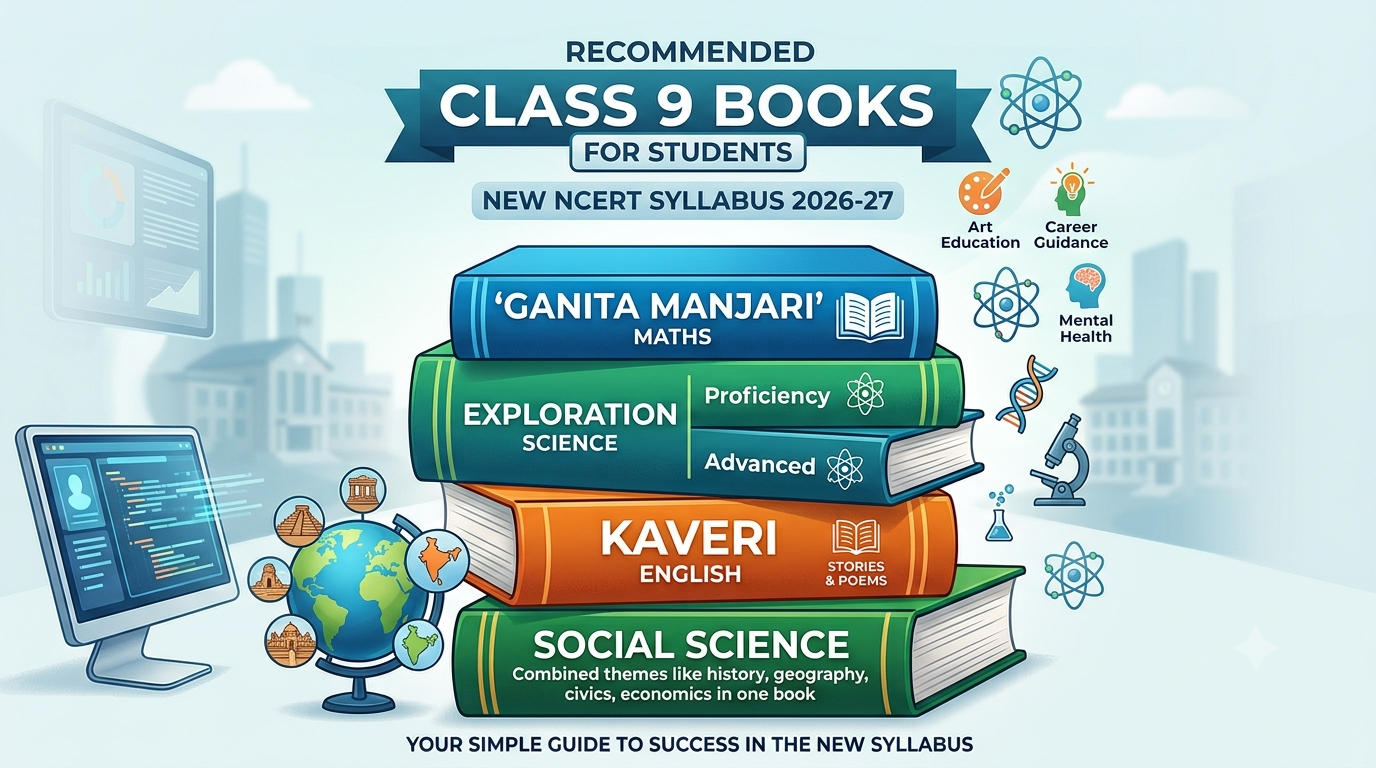
Recommended Books For Class 9 Students According to Latest NCERT Syllabus 2026–27
This can be overwhelming, particularly for parents of older children who followed the previous syllabus. And there are plenty of publications available that promise up-to-date resources, but finding the right one makes all the difference. Meanwhile, knowing what’s changed helps you select the right fits for your child. This comprehensive guide works for the same: discovering what has changed and what are the top recommended class 9 books for the new NCERT syllabus 2026–27.
The Big Shift in Class 9 Books
NCERT has rolled out its syllabus under the government guidelines of NEP 2020 and NCF 2023, transforming how school education should operate. The objective of this move is to make learning more conceptual and practical than just memorizing facts. Class 9 (and Class 11) will be the first grade to receive this latest syllabus from the 2026–27 academic year.
Here’s the thing: the old Class 9 syllabus has been completely deprecated and the books are no longer valid. The content of the previous books does not match with the latest books content of this year.
What Has Changed?
This is where many parents fall short, so here is a quick reference:
- Students now learn maths from a fresh textbook called Ganita Manjari
- Science is combined into one single book called Exploration (earlier it was split across separated books)
- Beehive and Moments are replaced by a new book, Kaveri.
- Social Science is unified into one combined book by combining four separate books for History, Geography, Civics, and Economics.
Make sure to remember these books’ names when going to buy a new syllabus, as most sellers sell old books by labeling them as “new.”
What’s Actually Changed in Each Subject
Although it’s not necessary to know every small detail for purchasing the books, understanding what’s actually changed will assist you in guiding your child and choosing the right recommended Class 9 books and additional resources.
Maths: Focuses on “Why,” Then “Just Solve It”
The new maths textbook (Ganita Majari) encourages students to think deeply through problems before jumping to solutions. Students often memorize steps instead of understanding the method used in the solution. Some advanced topics of Class 10 or 11, including sequences and patterns (also named progressions), have now been added to the new recommended textbook for Class 9. Geometry has also broadened and become a crucial part of the syllabus.
What this means for you: if you’re getting a maths guide, actually check it covers these newer topics. A lot of older guides just don’t - Educart’s Class 9 Maths question bank is one of the few that’s mapped directly to Ganita Manjari, so that’s one less thing to double-check.
Science: One Unified Book, But Different Levels
Earlier, science books came with three parts: Physics, Chemistry, and Biology. Now, NCERT launch a single book by combining all three separate subjects in one place. The new book “Exploration” also consists of a new two-level system::
- Every student must clear the basic (“Proficiency”) level
- Students who want a bigger challenge — especially those thinking ahead to competitive exams later — can also attempt an optional “Advanced” level
This is really helpful to understand before buying extra practice question banks, as many of guides only cover the basic level and won’t be effective if your child wants to go deeper.
Social Science: A Combined Book for All Four Books
This might be the most significant change in the recent years. Previously, Social Science syllabus is organized in four different books: History, Geography, Civics, and Economics, usually taught like separate concepts and doesn’ have any connection with each other. Now, NCERT has combined these into one single book, structured by themes instead of subjects.
For instances,a standalone chapter “floods” in geography is now covered in single theme why flood happens (Geography), how they affect people’s income (Economics),how old cities managed it (History), and who’s responsible for disaster relief (Civics) — all in one centralized place. Also, they focuses more on Indian history and culture, including concepts like the Harappan civilization, which used to only appear in senior classes.
Why this matters for you: Don’t consider any social science book that’s still divided into four seperate secions. If it doesn’t follow the new combined, theme-based structure, it won’t line up with what your child is actually being taught in class.
English
Kaveri combines stories, poems, and essays into themed units, written by both classic and contemporary Indian authors. The exam itself now checks reading, writing, grammar, and how well students understand literature — plus a smaller portion for speaking and listening skills, evaluated through classroom activities.
A few new, non-academic subjects
The new syllabus also introduces things that weren’t formally part of Class 9 before — like career guidance, mental health and wellbeing, and art education. These aren’t as heavy as Maths or Science, but it’s worth asking your child’s school what material (if any) they’re using for these, since it’s genuinely new territory for everyone.
Essential Checklist that Helps You Choose the Right Books
No more juggling, no more confusion. Here is a simple, practical guide to consider when you’re planning to buy recommended Class 9 books or order online.
1. Purchase the Official NCERT Textbook: Note the actual textbook names based on new syllabus — Ganita majari, Exploration, Kaveri, the New Social Science book. In addition, add other study materials, such as guides, workbooks, question banks, sample papers for additional support, not replacement. Now buy these resources from NCERT directly, reliable book store, or school, rather than picking up random new syllabus labelled copies from a random roadseller seller.
2. Check the publishing date before buying. Some guides hit shelves before the syllabus was even finalized, and a few publishers just relabel old stock. Double check the exact book names and when it was published — right now, Educart’s Class 9 books are among the ones actually built and released after the new syllabus came out, so that’s a decent starting point if you’re not sure where to look first.
3. Skip Generic Science or Maths Guides If Your Child Craves More Challenge: As these subjects now comes with basic and an advanced level, always buy any extra study material that match the level your child needs. This checklist is especially useful for students seeking to build a strong foundation before Class 10 science stream or competitive exams later. Educart’s question banks cover both levels properly, which is honestly one of the better options out there for this.
4. Make sure to choose the combined, theme-based Social Science Book: Don’t choose a guide book having separet section for history, Geography, Civics, and Economics — It’s designed for the old syllabus. New Social Science book consist a unified guide by combining alll four sections in one.
5. Verify by Your Child’s Teacher Before Buying Extra refrence Books: Teachers often know the minor changes in syllabus or chapters, as they already gone through the new textbooks. Asking them let you choose the correct reference Class 9 books for new syllabus, also tell you which chapters need extra support and which don’t.
A Quick Comparison of Recommended Class 9 Books
Here’s what some of the popular options bring to the table this year, so you can compare and figure out what actually fits your kid.

Honestly, each of these has something going for it, and what’s “best” really depends on what your kid needs — more practice, deeper explanations, or just getting used to the exam format.
What stood out to me with the Educart question banks is how closely they track this year’s actual textbooks — right down to the chapter names in Ganita Manjari and the new theme-based Social Science structure, instead of being retrofitted later. They also cover both levels in Science, which is useful if your kid’s aiming for something stronger heading into Class 10. And since sample chapters are free, you or the teacher can actually look through it before buying instead of just trusting the cover.
Final Thoughts
This year’s Class 9 change is a lot bigger than the usual small tweaks. If you’re not sure what to buy, keep it simple — start with the correctly-titled NCERT books, make sure anything extra is actually built for this syllabus (not just relabeled), and check with the teacher before adding more. Get those three things right, and picking the recommended Class 9 books for 2026–27 gets a lot less stressful, for you and your kid both.
메타데이터
- post_id
- 6af980560a2f
- slug
- recommended-books-for-class-9-students-according-to-new-ncert-syllabus-2026-27-6af980560a2f
- url
- https://medium.com/@Dikshasinghy/recommended-books-for-class-9-students-according-to-new-ncert-syllabus-2026-27-6af980560a2f
- canonical_url
- https://medium.com/@Dikshasinghy/recommended-books-for-class-9-students-according-to-new-ncert-syllabus-2026-27-6af980560a2f
- author_url
- https://medium.com/@Dikshasinghy
- status
- ok
- fetched_at
- 2026-07-14 19:19:05






