Thinking in Parallel: A New Way for AI to Reason
An introduction to diffusion models and why generating everything at once challenges traditional AI.
Thinking in Parallel: A New Way for AI to Reason
An introduction to diffusion models and why generating everything at once challenges traditional AI.
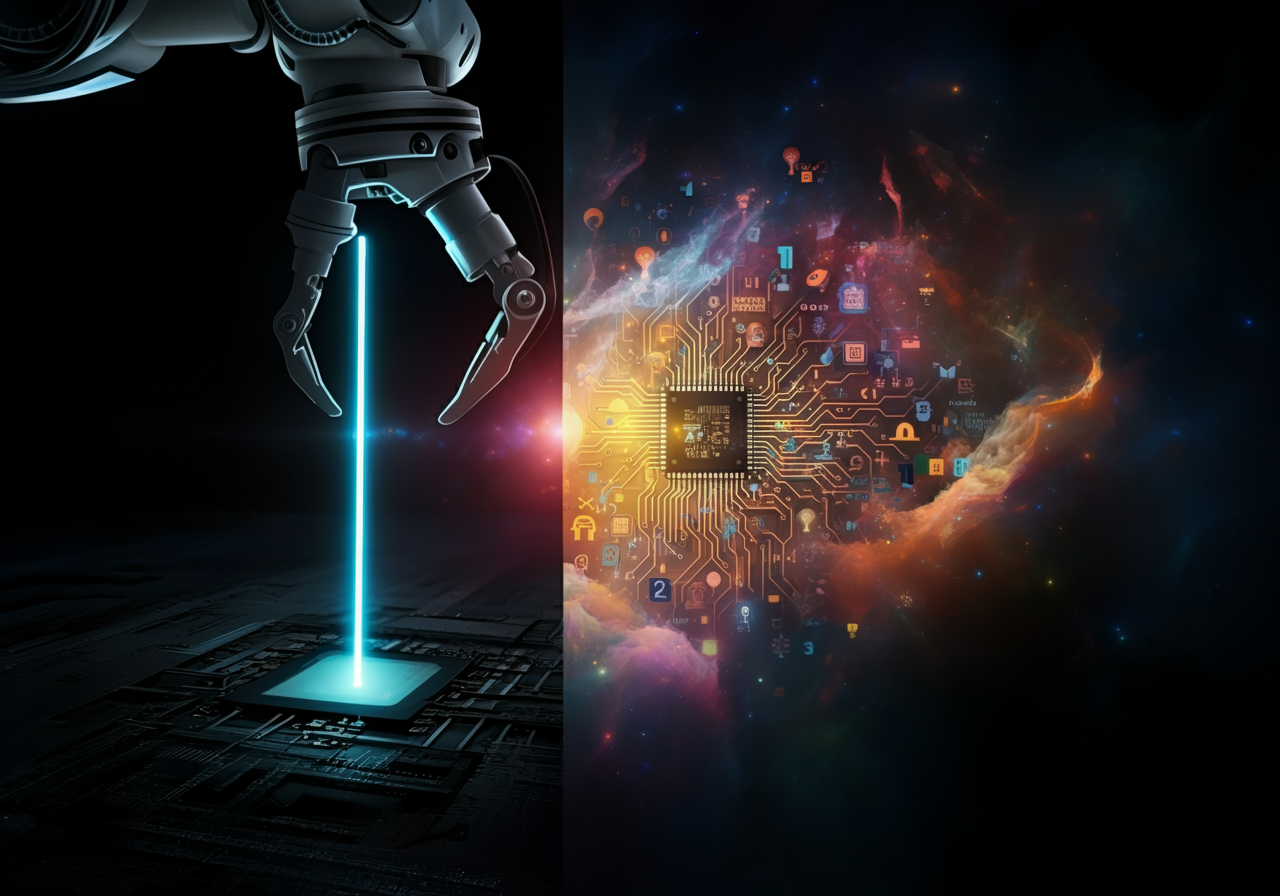
The future of AI reasoning is a tale of two methods: the meticulous, step-by-step author and the holistic, parallel painter.
Let’s talk about how AI thinks.
Imagine you’re trying to write a novel, but with a twist. The moment you type a word, it’s instantly, irreversibly carved into a marble slab. Every single word. You type “The,” — CHINK. “road,” — CHINK. “was,” — CHINK. You better be damn sure about that word, because there’s no backspace. If you realize in Chapter 5 that your main character should have been an astronaut instead of a baker, well, tough luck. You’re stuck with a story about a guy who really, really regrets his sourdough starter.
This high-stakes, one-word-at-a-time process is, in a nutshell, how most of the AI we know and love today works. Models like ChatGPT are what we call Autoregressive (AR). They are brilliant, meticulous authors, writing the story of their answer one token (a word or part of a word) at a time, based on everything that came before. It’s powerful, but it’s also terrifyingly linear. A tiny mistake early on can send the entire plot spiraling into nonsense.
Now, imagine a different way.
Instead of an author with a chisel, picture a painter standing before a huge, blank canvas. They don’t start with the top-left corner and perfect it before moving on. Of course not. They start with a messy, chaotic sketch of the entire scene. A blurry shape for a mountain here, a smudge for a tree there. It’s a vague, incoherent mess. But then, step by step, they refine the whole thing at once. They add detail to the mountain, which informs the shadow on the tree, which adjusts the reflection in the lake. The entire painting comes into focus together, a holistic vision emerging from the chaos.

The author’s chisel versus the painter’s brush — a new metaphor for two fundamentally different ways an AI can “think.”
This painter, my friend, is a Diffusion Model.
And this shift — from the linear author to the parallel painter — isn’t just a nerdy new technique. It’s a seismic rumble under the foundations of artificial intelligence. By learning to think holistically, these new models are starting to solve problems that left our stone-carving author sweating. But it also ignites a fiery debate: Is this painter truly reasoning about their art, or are they just executing a breathtakingly sophisticated paint-by-numbers?
The Bottleneck of One-Track Minds
*“The problem is that the first step is not the first step. The first step is the last step. It is the final conception.” — Ayn Rand, The Fountainhead*
For all their magic, our autoregressive author models have some serious creative blocks. Their one-word-at-a-time approach creates a few headaches.
First, there’s Error Propagation. If our author mis-spells a character’s name in Chapter 1, that mistake is baked in. In AI terms, if a model makes a small logical error in the first step of a multi-step math problem, the rest of the solution is built on that faulty foundation, leading to a confidently wrong answer.
Second, there’s the Planning Problem. Ask an author model to write a sonnet where the first and last lines have to rhyme. It’s tricky. By the time it gets to the last line, it might have written itself into a corner and have no idea how to connect it back to the beginning. This is a nightmare for real-world problems. You can’t design a computer chip or optimize a shipping route one tiny piece at a time; you have to consider how every single component affects the entire system. You need a global plan.

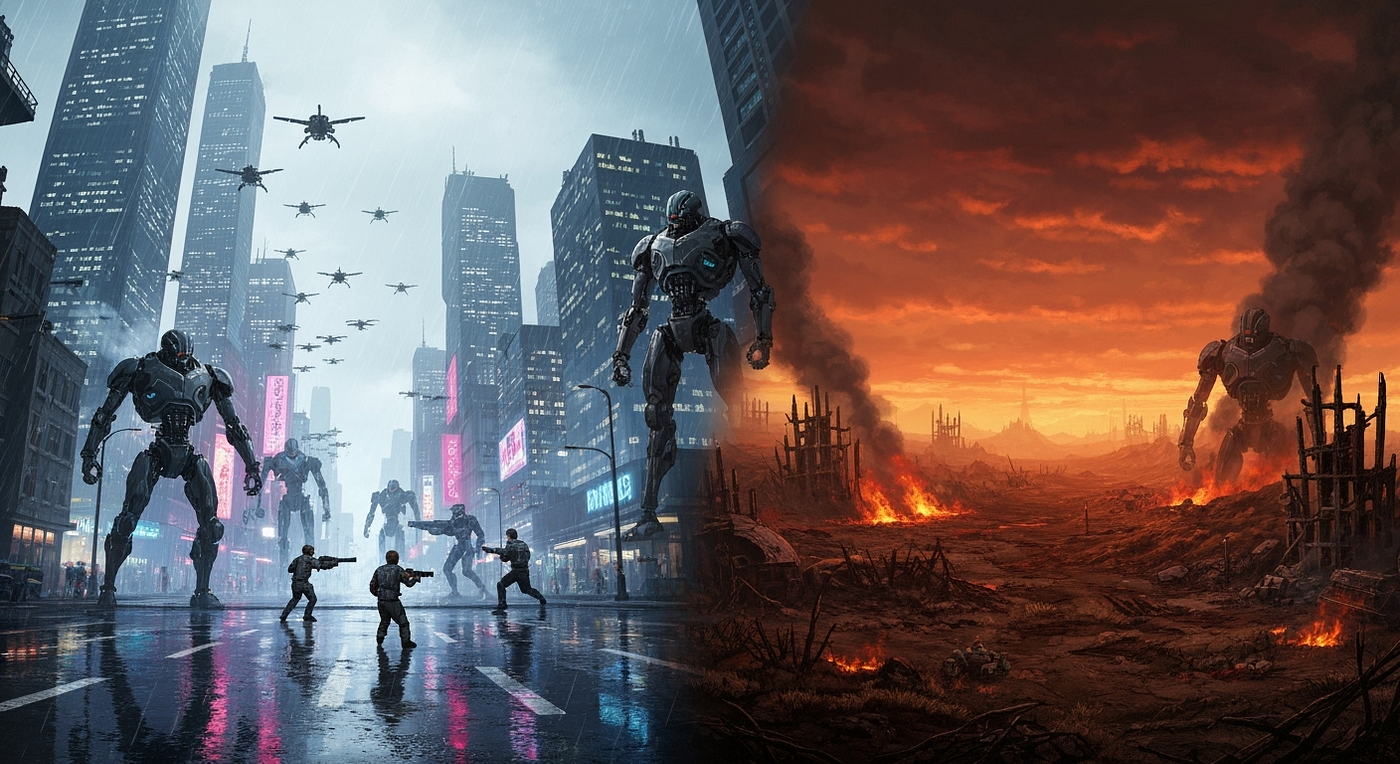
The danger of linear thinking: a single, tiny mistake made early on can doom the entire project, a problem known as error propagation.
This is why researchers started looking for a new way. As we push AI to tackle society’s grand challenges — logistics, climate modeling, drug discovery — the limitations of purely sequential thinking are becoming a major roadblock (Gu et al., 2017). We need an AI that can see the whole board, not just the next move.
ProTip: When you’re stuck on a complex problem, try the “painter’s approach.” Instead of perfecting step one, quickly sketch out a rough, end-to-end solution, even if it’s full of holes. This “coarse-to-fine” method can reveal the global structure and prevent you from getting bogged down in dead-end details early on.
From Pixels to Propositions: Teaching a Painter to Argue
Diffusion models didn’t start out as logicians. They started as artists. They’re the engines behind the stunning AI image generators like DALL-E and Midjourney. Their whole gig was to start with a canvas of pure static — literal noise — and slowly, step-by-step, “denoise” it into a photorealistic image based on a prompt (Ho et al., 2020).
The core question for AI researchers was a weird one: could you teach this painter, who thinks in pixels and color gradients, to reason with words and symbols?
This created a fundamental problem of continuous vs. discrete. Pixels are continuous; you can have infinite shades of gray between black and white, like a dimmer switch. Words are discrete; a word is either “cat” or “dog,” not something in between. It’s a light switch — on or off. How do you apply a “denoising” process to a light switch?
The breakthrough came with a clever idea called “masked diffusion” (Austin et al., 2021). Instead of starting with pure noise, the model starts with the basic structure of an answer, but with most of the words blanked out, replaced by a [MASK] token.
The answer is *[MASK]* because the *[MASK]* of the triangle is *[MASK]* to the *[MASK]*.
Then, in each step, the model looks at the whole messy sentence and refines its guess for all the blanks at the same time. Early on, its guesses are wild. But with each pass, the picture gets clearer, the logic sharpens, and a coherent answer emerges from the fog. It learns to fill in the blanks in a way that makes sense globally, turning a blurry idea into a sharp proposition.

From a blurry, masked sentence to a sharp proposition. Diffusion models refine the entire answer at once, like bringing a fuzzy photograph into focus.
New Ways of Thinking: The AI’s Inner Monologue
Okay, so we taught our painter to work with words. Now, how do we teach it to build a logical argument? This is where things get really interesting.
Diffusion-of-Thought (DoT): The Thumbnail Sketch Method
You’ve probably heard of “Chain-of-Thought” (CoT), where we ask an AI like ChatGPT to “think step-by-step” (Wei et al., 2022). It’s the author writing out their outline, line by line, to structure their thinking.
The diffusion equivalent is called, you guessed it, Diffusion-of-Thought (DoT). But it works completely differently. Instead of a linear outline, DoT treats the entire reasoning path as a single painting (Ye et al., 2024).
Imagine asking an AI to solve a complex logic puzzle.
- The Author (AR with CoT): “Okay, Step 1: If A is true, then B must be false. Step 2: Since B is false, C must be true…” It lays down one brick at a time.
- The Painter (Diffusion with DoT): It starts with a blurry mental sketch of the whole solution:
*[MASK]* -> *[MASK]* -> *[MASK]* -> Therefore, the answer is *[MASK]. Then, it refines the whole chain at once. It might realize that its idea for Step 3 contradicts its idea for Step 1, and so it adjusts them together*.
This is a superpower. The model can make sure the conclusion makes sense with the premise before it even fills in the middle steps. This holistic approach has allowed smaller DoT models to outperform AR models many times their size on specific math and logic puzzles, because they’re not just following a recipe; they’re composing a symphony (Ye et al., 2024).

Diffusion-of-Thought: Instead of laying one logical brick at a time, the model sketches the entire argument at once and refines it holistically.
The d1 Framework: Giving the AI a Cookie for Getting it Right
How do you get an AI to improve? You reward it. This is called Reinforcement Learning (RL), and it’s the secret sauce behind ChatGPT’s impressive abilities. Essentially, when the model gives a good, helpful answer, human raters (or another AI) give it a thumbs-up, which reinforces that kind of thinking.
But applying this to our painter model was a huge technical headache. The math just didn’t work for a model that generates everything at once. Recently, however, researchers cracked the code with a new method called the d1 framework (Zhao et al., 2025). Think of it as inventing a special kind of reward system that our painter can understand.
By using d1, researchers could directly reward the diffusion model for getting the final answer of a math problem correct. The results were fascinating. Not only did the models get more accurate, but they started showing "aha!" moments. Researchers could literally watch as the model, during its refinement process, would generate a faulty line of reasoning, and then in a later step, erase and correct its own mistake because the reward signal had taught it what a "correct" final painting should look like.
FactCheck: The term “diffusion” in these models is borrowed directly from thermodynamics and physics. It describes the process of particles spreading from an area of high concentration to low concentration, like a drop of ink in water. In AI, the “forward process” diffuses the data into noise, and the “reverse process” learns to reverse this diffusion to create structure.
Thinking Outside the Textbox: The Alien IQ Test
This is the part that gives me goosebumps. To truly test if a model is reasoning and not just being a fancy parrot, you have to take away its words.
Enter Raven’s Progressive Matrices (RPM). This is a classic visual IQ test for humans, and it’s beautifully simple and brutally hard. You’re shown a 3x3 grid of shapes with one missing. The shapes follow a hidden, abstract rule — maybe they rotate 90 degrees as you go across, or a new line is added as you go down. Your job is to figure out the rule and pick the missing piece. There’s no language, just pure, abstract, visual logic.

A Raven’s Progressive Matrix: a language-free IQ test that forces the AI to reason about abstract rules and patterns, not just words.
How do our models fare?
The author (AR) models struggle. They tend to just memorize patterns they’ve seen before. But our painter? The diffusion model? It excels.
Studies show that diffusion models are shockingly good at learning the underlying abstract rules of these puzzles (Wang et al., 2025). They don’t just memorize the pictures; they seem to internalize the concept of “rotation” or “progression.” They can even generalize to new types of rules they’ve never seen before.
How? It seems to happen in a hidden layer of the AI’s mind called the latent space.
Think of the latent space as the painter’s private mental workbench. It’s a compressed, abstract realm where it doesn’t manipulate pixels or words, but “thought tokens” — the pure essence of an idea. It’s here, on this unseen canvas, that the model can sketch out relationships, test hypotheses, and plan the entire logical structure before translating the final result back into the words or images we can see (Kang et al., 2025; He et al., 2026). This is where the holistic magic happens.
The Big Debate: Is This Real Thinking or a Clever Illusion?
Okay, let’s pour another cup of tea. Because this is where the philosophers (and a lot of grumpy AI researchers) storm into the art gallery. They look at our painter’s masterpiece, and they are not impressed.
This is the “Ontological Critique,” and it’s a heavy one (Anonymous, 2025). The argument goes like this: the diffusion process is fundamentally Markovian, or “memoryless.” Each step of the denoising process only depends on the state of the painting from the immediately preceding step. It has no long-term memory of how it got there.
In simpler terms: The painter has amnesia every time it touches the canvas.
It’s not building a logical argument from a premise to a conclusion. It’s just looking at the current blurry picture and making a statistically likely guess about what a slightly less-blurry version would look like, based on the millions of pictures it studied. The critique argues that this process is designed to find a plausible-looking answer, not to build a causal, step-by-step chain of reasoning. It’s an illusion of thought, not the real thing.

The philosopher’s critique: Does the diffusion painter truly understand its creation, or does it have amnesia with every brushstroke, only seeing the present moment?
The counterargument is simple: look at the canvas! Proponents point to the stunning results on the RPM tests and with DoT. If it can solve a logic puzzle it’s never seen before, who cares if the internal mechanism is different from ours? If it walks like a duck and quacks like a duck… maybe it’s a reasoning duck.
On top of this philosophical brawl, there are practical issues. The painter is slow and expensive. That step-by-step refinement process takes a ton of computing power, making it much slower than our author model for many tasks.
The Way Forward: An Author-Painter Collaboration
So, who wins? The author or the painter?
The real answer is probably both. The future of AI isn’t likely to be a cage match between these two approaches, but a collaboration.
Imagine a hybrid model: the autoregressive author acts as the high-level strategist, writing out the “script” or the main points of an argument. Then, the diffusion painter takes that script and refines the complex details, ensuring every piece fits together perfectly into a coherent whole. This “best of both worlds” approach is already being explored and is incredibly promising (Ni et al., 2024).

The future isn’t a competition, but a collaboration between the linear strategist (author) and the holistic refiner (painter).
For leaders in business and policy, the lesson is clear: don’t get locked into one way of thinking about AI. The future is a portfolio of diverse architectures, each suited for different kinds of problems. Investing in this new parallel-thinking technology could unlock solutions for massive, “global planning” problems — from optimizing national power grids to modeling complex biological systems — that have been impossible for AI to solve until now.
Conclusion: The Conversation Just Got Bigger
We started with a simple metaphor: the meticulous author versus the chaotic painter. We’ve seen how this new “painter” paradigm allows AI to think in parallel, to see the whole picture at once, and to self-correct and plan in ways its linear predecessor couldn’t. It has shown a surprising knack for abstract logic, suggesting a deeper form of understanding.
And yet, this incredible new capability comes with a profound identity crisis. Is it truly reasoning, or is it the most sophisticated form of pattern-matching we’ve ever created?
Answering that question is the next great adventure in artificial intelligence. Whether these painters end up complementing or competing with today’s literary giants, one thing is certain: they have fundamentally changed the conversation. They’ve thrown a beautiful, chaotic splash of paint onto what we thought was a black-and-white canvas, and the art of machine intelligence will never be the same.
References
Foundational Concepts & Reviews
- Austin, J., Johnson, D. D., Ho, J., Tarlow, D., & van den Berg, R. (2021). Structured Denoising Diffusion Models in Discrete State-Spaces. In Advances in Neural Information Processing Systems (Vol. 34, pp. 17981–17993). Curran Associates, Inc. https://proceedings.neurips.cc/paper/2021/hash/92E79427063D8239129E4DQFE7C85C8D-Abstract.html
- Ho, J., Jain, A., & Abbeel, P. (2020). Denoising Diffusion Probabilistic Models. In Advances in Neural Information Processing Systems (Vol. 33, pp. 6840–6851). Curran Associates, Inc. https://proceedings.neurips.cc/paper/2020/hash/4c5bcfec8584af0d967f1800d56DF71-Abstract.html
- Robison, G. (2025, June 14). A Comparative Analysis of Diffusion and Autoregressive Models for Text Generation: Architectures, Capabilities, and Frontiers. Greg Robison.
Enhancing Reasoning: RL and Diffusion-of-Thought
- Ye, J., Wu, C., Shi, H., Jiang, X., Bi, W., Li, Z., Kong, L., Chen, L., Gao, J., & Zheng, L. (2024). Diffusion of Thoughts: Chain-of-Thought Reasoning in Diffusion Language Models. arXiv preprint arXiv:2402.07754. https://arxiv.org/abs/2402.07754
- Zhao, S., Gupta, D., Zheng, Q., & Grover, A. (2025). d1: Scaling Reasoning in Diffusion Large Language Models via Reinforcement Learning. arXiv preprint arXiv:2504.12216.
The Role of Latent Space in Reasoning
- He, A., Welleck, S., & Fried, D. (2026). Reasoning with Latent Tokens in Diffusion Language Models. arXiv preprint arXiv:2602.03769.
- Kang, M., et al. (2025). LaDiR: Latent Diffusion Enhances LLMs for Text Reasoning. arXiv preprint arXiv:2510.04573.
Abstract & Visual Reasoning Capabilities
- Wang, B., Shang, J., & Sompolinsky, H. (2025). How do diffusion models learn and generalize on abstract rules for reasoning? International Conference on Learning Representations.
Critiques & Fundamental Limitations
- Anonymous. (2025, December 16). A Reasoning Critique of Diffusion Models. ResearchGate.
- Gu, J., Bradbury, J., Xiong, C., Li, V. O. K., & Socher, R. (2017). Non-Autoregressive Neural Machine Translation. arXiv preprint arXiv:1711.02281. https://arxiv.org/abs/1711.02281
Other Cited Works
- Ni, F., Hao, J., Wu, S., Kou, L., & Liu, J. (2024). Generate Subgoal Images Before Act: Unlocking the Chain-of-Thought Reasoning in Diffusion Model for Robot Manipulation with Multimodal Prompts. In Proceedings of the IEEE/CVF Conference on Computer Vision and Pattern Recognition (pp. 16537–16547). http://openaccess.thecvf.com/content/CVPR2024/html/Ni_Generate_Subgoal_Images_before_Act_Unlocking_the_Chain-of-Thought_Reasoning_in_CVPR_2024_paper.html
- Wei, J., Wang, X., Schuurmans, D., Bosma, M., Chi, E., Le, Q., & Zhou, D. (2022). Chain-of-thought prompting elicits reasoning in large language models. In Advances in Neural Information Processing Systems (Vol. 35, pp. 24824–24837). https://proceedings.neurips.cc/paper_files/paper/2022/hash/9d5609613524ecf4f15af0f7b31ABCD-Abstract-Conference.html
Disclaimer: The views and opinions expressed in this article are my own and do not necessarily reflect the official policy or position of any of my affiliations. I used AI assistance for research, drafting, and image generation for this article. This work is licensed under a Creative Commons Attribution-NoDerivatives 4.0 International License.
메타데이터
- post_id
- 7036873776d7
- slug
- new-way-for-ai-reasoning-7036873776d7
- url
- https://levelup.gitconnected.com/new-way-for-ai-reasoning-7036873776d7
- canonical_url
- https://levelup.gitconnected.com/new-way-for-ai-reasoning-7036873776d7
- author_url
- https://medium.com/@dr-mohitsewak
- status
- ok
- fetched_at
- 2026-06-09 15:37:30