When a Handmade Board Game Came to Life
A summer camp project that combined creativity and digital technologies.
When a Handmade Board Game Came to Life
A summer camp project that combined creativity and digital technologies.
Looking for a creative activity with a real “wow” factor? Here’s an idea that turned out even better than I expected.
During our five-day summer camp, the children and I created our own handmade board games and added interactive challenges to them.
At first, it looked like a simple arts-and-crafts project.
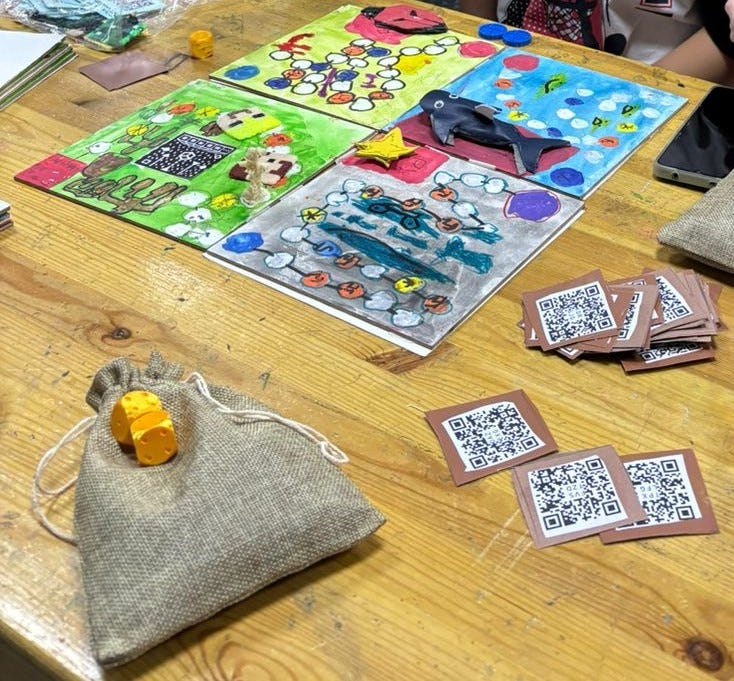
By the end of the week, every board game had become an interactive adventure that combined paper, 3D-printed game pieces and digital experiences created in Delightex Edu.
Here’s how we did it.
Every Great Game Starts with a Story
The first day wasn’t about technology.
We didn’t even switch on the computers.
Instead, we started with one simple question:
“If you could invent your own adventure, where would it take place?”
The answers came immediately.
Some children wanted to travel through space.
Others imagined underground dungeons guarded by dragons.
Some dreamed about magical forests full of mysterious creatures.
Each child chose a theme they genuinely cared about because I wanted every board game to become a personal project rather than just another classroom assignment.
Before drawing a single line, everyone already had a story to tell.

Drawing the World
The next day the classroom became an art studio.
Large sheets of paper covered the tables.
Markers, coloured pencils and paints were everywhere.
The children spent hours drawing their game boards.
Every square became part of the adventure.
Some paths crossed distant planets.
Others disappeared into dark caves.
Some wandered through enchanted forests.


Looking around the classroom felt like visiting several different worlds at once.
That’s one of the things I love most about project-based learning.
You can give every child exactly the same task and the same materials, yet every project turns out completely different.
Creating the Heroes
Once the game boards were finished, it was time to make all the game components.
The children designed simple playing tokens and dice in KOMPAS-3D, and we printed them on a 3D printer.

Then everyone chose their own way of creating the characters. Some children sewed them from faux leather. Others used fuse beads.
One thing I really like about this stage is how flexible it is.
You don’t need a 3D printer to run this project.
Game pieces can be built from LEGO bricks, made from fuse beads, sculpted from polymer clay, cut from cardboard or created from almost any craft materials you already have.
The goal isn’t to make perfect game pieces.
The goal is to give children another opportunity to create something that belongs to their own world.
By the end of the third day, every team had created an entire world.
It looked complete.
Or so we thought.
Adding a Digital Twist
By the fourth day, the board games were almost finished.
The children had created their stories, drawn the boards, made their game pieces and written the rules.
Now it was time to add one final element.
I wanted to make the games even more exciting by adding interactive challenges.
The children came up with these challenges themselves and built them in Delightex Edu.
Some children built animated 3D scenes.
Others experimented with augmented reality.
Some created simple quizzes, while others added sounds, animations or interactive elements.


The goal wasn’t to build complex digital projects.
Even a short animation or a small AR experience was enough to make the game feel different.
To connect the physical board game with these digital experiences, we used QR codes.
Special spaces appeared on the game boards.
Whenever a player landed on one of them, they received a matching QR card, scanned it with a phone or tablet, and instantly opened the Delightex project created by another child.
That was the moment when the ordinary board game suddenly came to life.
Players weren’t just rolling dice anymore.
Every now and then, the paper game opened a door into a digital world — and then brought everyone back to the table to continue the adventure.


The children’s reactions were priceless.
“It works!”
“Look! That’s my dragon!”
“Let’s scan another one!”
For a while, nobody cared whose turn it was.
Everyone wanted to discover what was hiding behind the next QR code.
That was the moment when an ordinary handmade board game came to life.


One Project, Many Technologies
Looking back, I realised that this project naturally combined several different technologies.
The children sketched their ideas on paper.
They turned their main characters into 3D models in KOMPAS-3D.
They watched those models become real objects on a 3D printer.
They created additional characters by hand from fuse beads.
Finally, they expanded their games with interactive experiences in Delightex.
None of these steps felt isolated.
Each one became a natural continuation of the previous one.
And that’s exactly what made the project feel so complete.
Why I’d Do It Again
People often talk about educational technology as if we have to choose.
Paper or screens.
Crafts or digital skills.
After this project, I don’t think we need to choose at all.
Our children spent several days drawing, painting, modelling, printing and crafting.
Only after that did they open their laptops.
Technology wasn’t the starting point.
It was the final piece that connected everything together.
That’s one of the reasons I enjoy working with Delightex Edu.
It allows children to transform their own ideas into interactive experiences without taking away the joy of creating something with their own hands.
By the end of the week, every child packed their game pieces, QR cards and characters into a small fabric pouch and took home a board game they had created from scratch.
I think that’s exactly what project-based learning should feel like.

메타데이터
- post_id
- 758567aa71ca
- slug
- when-a-handmade-board-game-came-to-life-758567aa71ca
- url
- https://medium.com/@marinamarkelova/when-a-handmade-board-game-came-to-life-758567aa71ca
- canonical_url
- https://medium.com/@marinamarkelova/when-a-handmade-board-game-came-to-life-758567aa71ca
- author_url
- https://medium.com/@marinamarkelova
- status
- ok
- fetched_at
- 2026-08-01 18:11:02