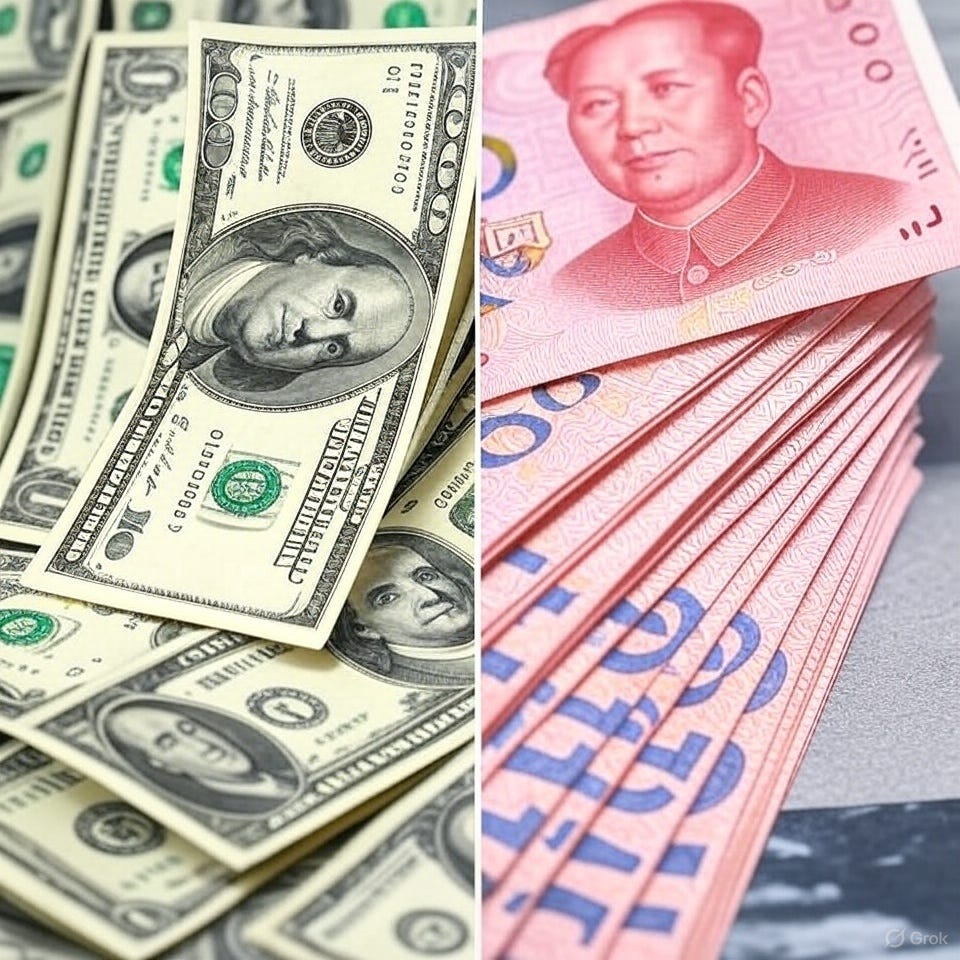
Why Printing Money Won’t End Poverty: The Lie We All Wish Was True
If governments control the money, why can’t they just make more of it? The shocking truth about inflation, inequality, and economic…
Why Printing Money Won’t End Poverty: The Lie We All Wish Was True
If governments control the money, why can’t they just make more of it? The shocking truth about inflation, inequality, and economic collapse.

Image generated by the author using Gork AI
Economics has always interested me; specifically, the deceptively simple questions that have complex answers. The other day I was talking to my nephew about scarcity: “If food and water are so important Uncle,” he asked with genuine concern, “everyone should have plenty of food and water, right?”
It’s such an innocent question, but it tiptoes into one of the most basic economic concepts. But then it occurred to me that a lot of people — not just kids — must be curious about this. So today, I am going to discuss to you what I have learned why printing money isn’t the miracle cure of poverty that it appears to be.
The Tempting Logic Behind Printing More Money
I must admit that the first time I heard this question, it did sound very reasonable. The people are destitute, unemployment is at record levels, and the cost of essentials is prohibitive. So why not just make more money? Everybody gets rich, everybody’s happy, problem solved, except hardly, if at all.
I thought about this during the 2008 financial crisis, when I saw families lose their homes and their jobs. The frustration was tangible — look at us, with all this technology and information, and yet people all around me were in miseries for the lack of something as nebulous as “no money.” It almost felt cruel that we couldn’t just make more of it.
But as I continued to learn more and more about economics over the years, I began to realize that this seemingly straightforward answer opens up a Pandora’s box of problems that can be so devastating they can bring whole economies to their knees.
Understanding the Basics of Inflation
I’ll begin by addressing the basic idea driving the entire conversation: inflation. I’ve directly experienced inflation in small ways in my life — the $2 cup of coffee used to cost a dollar and fifty cents for potentially inferior coffee, and my grocery bill has grown steadily over the decades. But what exactly is inflation?
Inflation occurs when prices rise because there is more money flowing into the economy and the same amount of goods and services to purchase. It’s as though you had more people at an auction but no increase in the number of items — prices just do to get bid up higher.
Our economy functions on the basic principle of supply and demand, and I learned the difficulty of it first hand when I tried to purchase concert tickets for a popular band. When supply is abundant and demand is thin, prices fall. But when supply is low and demand is high, the prices jump. When this rise in prices is particularly bad and rapid, economists refer to it as hyperinflation — and that’s when we have a really big problem.
The Bread Example: A Simple Illustration
When I tried to explain this idea to my nephew, I came up with an easy example, using bread — his grandma’s homemade loaf bread, in this case. Read it and I’ll share because it really made the problem clear for me.
There are five people living in a village: Bob, John, Alex, Jack and Tony. They each have precisely $5 to spend, and there’s a bakery that produces exactly 5 loaves of bread, which cost a total of $5, per day. Everybody can have one loaf — that’s fair.
So now if the government decides to print more money and gives each person $5, then what? Suddenly, everyone has $10. You might think, “Great! They can buy more bread now.
But here’s where men and women with two feet firmly planted in reality are forced to face the fact: The bakery continues to bake only 5 loaves daily. They cannot suddenly double their output — they require additional ovens, extra bakers, more ingredients, and more time. That makes 5 people with 10 dollars each, who all want to buy more bread but can’t because there are just 5 loaves.
Of course, what occurs next is only human. The owner of the bakery looks at people competing for bread with one another, and he thinks, “Clearly they are able to pay more, as such, let us increase our prices and make greater profit.” The price is raised from $5 to $10 a loaf.
The end result? Bob, John, Alex, Jack and Tony still receive only one loaf each, but they now will pay twice as much for it. They are not, in fact, richer, in the sense of what they can buy. The additional money didn’t buy more bread — it made the bread already out there more expensive.
The Ripple Effect Throughout the Economy
But the story doesn’t stop there, and it is in this next part that things really start to get interesting from an economic viewpoint. You might say: “OK, but at least now the bakery owner is richer, right?”
Not exactly. Yes, at first the bakery earns more. But of course all the bakers in the vicinity are now earning more, and can they’ll all want to buy more wheat in order to take advantage of that increased business! The issue is that wheat grows on fields, and fields are finite. Farmers can’t just magically create more farmland or get wheat to grow faster.
So bakeries are now fighting to buy wheat, pushing up wheat prices. Bakeries need to pass an even steeper increase along to consumers to maintain profit margins. It’s a downward spiral that reverberates throughout the economy.
I have seen it myself in my country when we had a lot of inflation. As the government expanded the money supply, I saw not only bread prices rise, but all prices — for bread, rent, transportation. My income remained static — my purchasing power declined sharply.
Real-World Disasters: When Countries Actually Tried It
At this point, of course, you may be thinking, “There’s no way any government would be stupid enough to behave this way.” Sadly, history provides no shortage of examples of when countries did precisely this and ended up in disaster. Let me provide three examples that brought home to me how dangerous printing money is.
The Weimar Republic: Germany’s Economic Nightmare (1920s)
The very first example that jolted me when I studied it was Germany after World War I, when the German Empire is defeated, and out of that chaos was established this thing called the Weimar Republic. The war had left a depleted country, its roads and buildings in shambles, to make matters worse Treaty of Versailles heavy war reparations were imposed by the Allied forces.
The government was desperate. They had no money, they had all these people unemployed, they had to pay these great reparations. When all else failed, they started printing money like nobody’s business.

Image generated by the author using Gork AI
The results were mind-boggling. By November 1923, prices were doubling every few hours, in part because people expected them to double again. You had to bring wheelbarrows filled with cash in order to purchase anything, even a little bit of food.” But what cost 250 marks for a loaf of bread in January 1923, cost 200 billion marks in November 1923. Just imagine — 200 billion marks for one loaf of bread!
Here, the hyperinflation wiped out people’s life savings overnight. Imagine spending a lifetime working, saving for retirement, only to wake up one day to find that what you’ve saved wouldn’t buy you a cup of coffee. And the social unrest and economic disruption that ensued fueled extremist political movements that would go on to transform history in the most disastrous way possible.
Zimbabwe: A Modern Catastrophe (2007)
The second illustration is more recent and no less wrenching. Rhodesia, later renamed Zimbabwe, had experienced hyperinflation on a scale that captured the attention of the world. Now, as a current affairs observer I remember those distressing pictures in the news — from Zimbabwe.
After achieving independence in the 1980s, President Robert Mugabe of Zimbabwe introduced land reform measures, expelling white land owners and redrawing land ownership in favor of black farmers. Although the aims were to right the wrongs of history, the new farmers often had little agricultural experience and no training. That caused a massive collapse in food output, soaring unemployment, and economic misrule.
To combat these problems, the government began printing money to pay its bills and to try to right the ailing economy. The results were catastrophic. By 2008, Zimbabwe’s annual hyperinflation rate had soared to an unfathomable 89.7 sextillion percent. That’s 89.7 with a 20 and a whole bunch of zeros!
The Zimbabwean dollar was rendered nearly worthless. People had to travel with enormous bricks of cash simply to make small purchases, such as eggs. Prices might double within a day, or even hours. I recall reading about parents who would send their children off to school in the morning with money to buy lunch, only to discover that by afternoon, that same amount was insufficient to buy a piece of candy.
Venezuela: The Oil Curse (2016)
The third example is home for me — Venezuela which was one of the richest countries in Latin America. They possess more oil reserves, the biggest in the world (more than those of Saudi Arabia). Venezuela did used to be rich — way back in the aughts, when oil prices were soaring and the government was raking in petrodollars.
But rather than using this windfall to spur development in a variety of industries and foster a sustainable economy, the government doled out huge subsidies to the people. The socialist government nationalized everything, controlled the economy and didn’t let the private companies expand. All the oil money was paid out in subsidies, everything was priced at very cheap prices, and everyone was happy.

Image generated by the author using Gork AI
That truce, apparently, was good until a big decline in oil prices took hold after 2008. Venezuela, too reliant on oil, suffered a devastating loss of income and stability. This was exacerbated through widespread corruption, lack of private sector revenues, and economic mismanagement.
And as a socialist government they couldn’t cancel or reduce the subsidies directly without angering the people. So they kept the subsidies flowing by printing money. All this printing caused hyperinflation, where prices grew just insanely quickly. Venezuela’s currency lost so much value, people were literally tossing it in the street because it was worthless and couldn’t buy anything.
I have a friend who moved to America from Venezuela during this nightmare of a crisis, and her stories are heartbreaking. She recounted the way in which her family’s middle-class lifestyle had disappeared overnight, how professionals, such as doctors and engineers, were fleeing the country to work as labourers in neighbouring countries just to make enough money to feed their families.
The Global Pattern: Why This Never Works
And these three are not isolated. Throughout history, other countries — Hungary and Yugoslavia among them — encounter similar problems when they attempt to solve their problems by printing cash. It’s a tale as old as time: short-term relief followed by economic devastation.
What I find most frustrating is the fact that these disasters could have been averted if governments had understood the basic economic concepts that I have just described. The lesson you learn is that if you make more money while production doesn’t increase, prices just become more expensive. It’s like combating a water shortage by adding water to the water you already have — it’s a larger volume of liquid, but you can’t drink more.
Why People Want Money (And Why It Matters)
This leads me to an elementary question; what do people want money for, ever? This is something I’ve considered deeply, particularly in times of my own financial hardship. People want money because they want to be able to use their money to buy things they need and want — food, shelter, education, health care, entertainment.
But here’s the key intuition: what’s the value of billions of dollars if there’s one loaf of bread on the planet, or, even worse, no bread in existence? After all, you can’t eat money. Money is merely a mechanism to facilitate the exchange of goods and services, a means to lay claim to a portion of the economic pie.
That’s why printing more money when there are no more goods and services to exchange it for is not ultimately all that helpful. You’re not producing additional wealth; you’re just producing additional claims on the same limited pool of wealth.
The Foreign Debt Question
Now, you might be saying, “Okay, well, what about using printed money specifically to pay off foreign debt? That way, it’s not going to the people, so it can’t create inflation, right?”
I used to believe this might be a loophole also, but it doesn’t go down like that. When a nation prints more of it, other nations take notice in a variety of ways, from economic reports to the currency markets to the inflation bars. But even when the new money is spent solely on foreign debt, it adds to the total money supply.
That devalues the currency and makes it less reliable in the eyes of foreign creditors. As the Bolivian economist Fernando Cossío has argued, foreign creditors don’t want deflated money because it lowers the real value of the debt payments they collect. They may consider this money as “toy money” and become distrustful of the currency, which would damage the country’s economic reputation and stability.
I’ve seen this up close in my own country’s relationships with international lenders. When there’s even the sugggestion that a government might be engaged in printing money to pay off its debts, the result is a rise in interest rates on future borrowing, and sometimes a cut off altogether of lending.
The Right Solution: Creating Real Value
So, what’s the correct solution? After many years studying economics and seeing how other countries undertake this, I think it is about finding real value, not just printing more money.
Governments should invest in education, construction of infrastructure, technology, business, resources management. It should be to increase supplies of goods and services while keeping demand relatively stable.
And here are a few good things that can happen when the government encourages business to do more of it:
· More people get hired by businesses. Jobs are made
· Products grow more available and affordable
- People who get these jobs can afford to buy products
- Because they work hard to earn their money, they value it and are more mindful of their spending
This serves to reduce waste and to restrain demand. And sellers, even with strong demand, can’t hike prices willy-nilly because products are abundant and there is tons of competition.
Success Stories: Countries That Did It Right
I look to countries like Japan and South Korea, both of which used smart policy focused on education, technology and manufacturing to pull themselves up from relatively poor nations to economic powerhouses.
Japan was flattened after World War II, so they were focused on rebuilding their industrial base — education and technology. They didn’t try to print their way to prosperity; instead, they earned their way there by making things, notably high-quality products that the world wanted to buy.
South Korea also took a similar path, going from being among the poorest countries in the world in the 1960s to a modern, advanced economy. They spent on education, promoted crucial industries and constructed the infrastructure for economic growth.

Image generated by the author using Gork AI
The Special Case of the United States
There’s an important exception to the “don’t print money” rule, and that, of course, is the United States. The US also has a special status in the world economy as the currency it issues, the US dollar, is the world reserve currency. Most international transactions of worth, among them oil and gold, are priced in US dollars.
It also mean if it wants to buy more things from abroad the US really can print more Dollars to some degree. However, this privilege isn’t unlimited. If the US printed so many dollars that led to global inflation, then it might put the dollar’s status as the world’s reserve currency in jeopardy.
This is interesting to me as it illustrates the way in which international economics can differ from domestic economics. The US effectively offloads its inflation onto other countries via the globalisation of the dollar.
When Printing Money Can Actually Help
Interestingly, there are certain conditions where it actually makes sense to print money. This occurs when a country lacks the money to begin with — the kind of thing economists refer to as a “liquidity crisis.”
If there’s not enough money, businesses cannot sell enough, nor pay all their workers. People cannot even borrow from the banks, which do not have that much themselves. In this case, printing more money can help people spend more, companies produce more, and a positive cycle begins.
This is precisely what occurred in the 2008 global financial crisis. The banks lost a huge amount of money and could not afford to lend to their customers. Central banks in the rest of the world printed additional money to get their economies moving again. I recall that time quite well — credit was locked up, businesses were closing, and unemployment was growing by leaps and bounds.
The difference here is that the money printing was more temporary and aimed at returning to normal economic function, not creating wealth out of thin air. After the crisis eased, central banks endeavoured to wind down the money supply back toward its normal level.
The Delicate Balance
What I’ve come to learn from exploring these issues is the fact to what extent economics is a compromise. Not enough money causes prices to drop (deflation) and that can be just as bad as inflation. When prices are expected to fall, people defer purchases, which suppresses demand, which leads to more price declines — a deflationary spiral.
But when there isn’t more production to buy with that new money, printing more cash makes prices rise — and that, too, can be ruinous. It’s no accident that economics is sometimes referred to as the “dismal science” — it’s replete with these tough trade-offs and consequences that no one intended, much less wanted.
Personal Reflections and Lessons Learned
As I consider everything I’ve learned about money printing and inflation, I think about how these economic principles have influenced my personal money-management choices. Knowing that money is simply a claim on real resources has made me more focused on acquiring real skills and investing in productive assets as opposed to hoarding dollars.
I’m also more sceptical of politicians promising easy answers to complex economic problems. When somebody tells me we can solve poverty by printing more money, I think of those wheelbarrows of money in 1920s Germany, or the Venezuelan bolivars lying in the streets.
Yet I have also developed a greater respect for the intricacies of economic management. Central bankers and government officials have incredibly difficult decisions to make, as they try to walk the tightrope between growth and stability.
Looking Forward: What This Means for the Future
Understanding these principles has the utmost urgency for the way we conceive of economic policy. As we confront new challenges — climate change, technological disruption and global inequality — the lure of quick fixes like printing money will remain powerful.
But the teachings from history are straightforward: there are no shortcuts to prosperity. True wealth comes from adding value by creating products and services that people want, not by conjuring up more claims on wealth that doesn’t yet exist.
Conclusion: The Hard Truth About Easy Money
Having burrowed deep into this issue myself, I realize that the question “Why can’t we just print more money?” is a fundamental confusion about what money is and what economies do. Money is not wealth in itself — it is a vehicle for trading wealth.
The countries that have lifted millions of people out of poverty while enhancing prosperity focused on the basics: education, infrastructure, rule of law and an environment that attracts businesses and encourages them to create jobs. There are no quick fixes, no panaceas, no simple answers.
As I told my nephew, and as I hope I’ve shown you, the superficial simplicity of printing money obscures vast complexity and risk. The next time someone says this is the key to economic troubles, remember those lessons of Germany, Zimbabwe and Venezuela. Keep in mind that real wealth is about adding value not simply making money.
The painful truth is that a successful economy is built through hard work, good policies and patience. But the encouraging news is that it is possible — we have many examples across the world of countries that have in fact managed to transform their economies by adhering to these tenets.
In the final analysis, there’s no good way around the real work of building a productive, innovative and just economy. And that’s a lesson worth keeping in mind in an era of seemingly easy solutions to difficult problems.
References and Further Reading
This article draws insights and information from several credible sources that helped shape my understanding of monetary policy and inflation:
Primary Sources:
Open University Research — “Curious Kids: Why Don’t Poorer Countries Just Print More Money?”
- This academic source provided foundational insights into the economic principles behind money printing and its consequences for developing nations.
Educational Video Content — “Why Can’t We Just Print Money to End Poverty?”
- This video explanation helped clarify complex economic concepts and provided real-world examples of hyperinflation cases.
Additional Context:
In the final analysis, there’s no good way around the real work of building a productive, innovative and just economy. And that’s a lesson worth keeping in mind in an era of seemingly easy solutions to difficult problems.
Recommended Further Reading:
- Central bank publications on monetary policy
- Academic papers on hyperinflation case studies
- Economic textbooks covering supply and demand principles
- Historical accounts of economic crises and recoveries
Disclaimer: While this article references credible sources, readers are encouraged to conduct their own research and consult with financial professionals for specific economic advice.
메타데이터
- post_id
- 76bc0378ffe4
- slug
- why-printing-money-wont-end-poverty-the-lie-we-all-wish-was-true-76bc0378ffe4
- url
- https://medium.com/the-geopolitical-economist/why-printing-money-wont-end-poverty-the-lie-we-all-wish-was-true-76bc0378ffe4
- canonical_url
- https://medium.com/the-geopolitical-economist/why-printing-money-wont-end-poverty-the-lie-we-all-wish-was-true-76bc0378ffe4
- author_url
- https://medium.com/@nairsahil08
- status
- ok
- fetched_at
- 2026-07-28 17:41:00