Workflow Archetypes in Reasoning Systems
Analytical Introduction
Workflow Archetypes in Reasoning Systems
Analytical Introduction
Multi‑layered reasoning systems represent a structural approach to organizing cognitive processes across several interconnected layers. Instead of relying on a single mode of reasoning, these systems distribute tasks across multiple strata, each contributing a distinct function. Workflow archetypes become the essential patterns that define how reasoning unfolds across these layers.
The conceptual study of workflow archetypes focuses on the recurring structures that emerge when reasoning processes are organized into layered systems. These structures reveal how distributed cognition can be coordinated into coherent, long‑running workflows. They also highlight the architectural commitments required to support reasoning that evolves across multiple levels of abstraction.
Understanding workflow archetypes provides insight into how multi‑layered reasoning systems maintain internal order, regulate interactions, and integrate diverse outputs into coherent structures. It reveals the mechanisms that allow layered reasoning to function as a unified cognitive architecture.
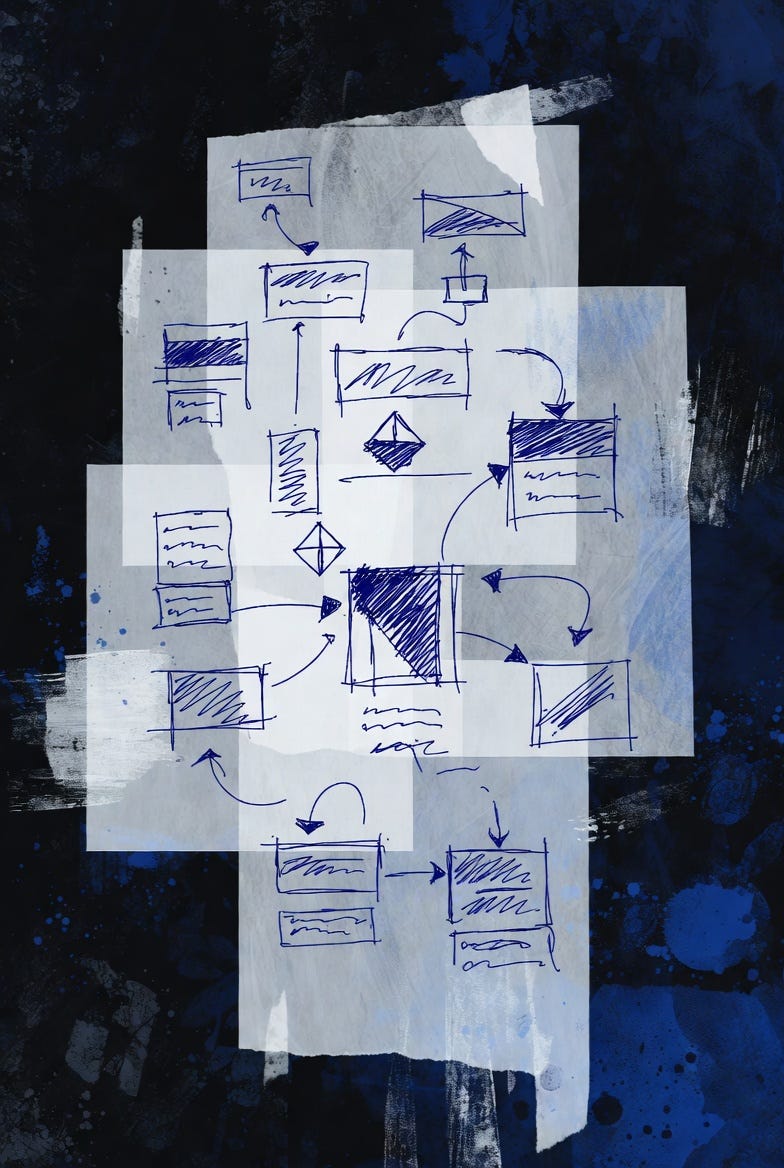
Conceptual representation of layered workflow patterns within multi‑layered reasoning systems.

Abstract illustration of multi‑level interactions across distributed reasoning layers.
To understand these dynamics more clearly, it is useful to examine the structural layers that support them.
1. Architecture
The architecture of a multi‑layered reasoning system can be understood as a hierarchical structure composed of foundational layers, intermediate layers, and integrative layers. These layers operate in parallel, yet their interactions follow patterns that create a coherent architectural whole.
At the foundation lies the substrate layer. This layer provides the environment in which reasoning processes operate continuously, maintaining stability and predictable resource allocation. It forms the physical and logical base upon which the system is built.
Above this substrate sits the structural layer. This layer defines the rules, constraints, and logical boundaries that shape the system’s behavior. It ensures that reasoning remains consistent and aligned with predefined principles.
The intermediate layers introduce abstraction. These layers transform input into structured representations, refine internal models, and generate alternative formulations. They form the conceptual core of the system, where reasoning unfolds across multiple levels of abstraction.
The integrative layer sits at the top. This layer aggregates outputs from lower layers, synthesizes perspectives, and produces coherent results. It ensures that the system behaves as a unified cognitive architecture rather than as a collection of isolated components.
Together, these layers form a structural pattern in which continuity, coordination, and differentiation coexist. The architecture is not defined by any single layer, but by the relationships between layers and the patterns that emerge from their interactions.
With this structural foundation in place, the next question concerns how these layers operate and interact internally.
2. Internal Functioning
Internal functioning in multi‑layered reasoning systems is shaped by the interactions between layers, the workflows that traverse them, and the mechanisms that regulate these workflows. These interactions follow structural patterns that define how reasoning unfolds across the system.
Each layer processes input according to its internal parameters, transforming it into structured output. These transformations may involve pattern recognition, abstraction, or synthesis. The conceptual view focuses on the fact that each layer operates within a defined logical space, contributing a specific perspective to the system.
Workflows traverse these layers in structured sequences. A workflow may begin at the substrate layer, move through intermediate layers, and culminate in the integrative layer. Alternatively, a workflow may begin at an intermediate layer, refine internal representations, and return to a lower layer for validation.
State management is another internal dimension. Layers may maintain internal histories, caches, or contextual buffers. The system must decide which parts of this state are preserved and which are discarded. These decisions create patterns of persistence that influence how reasoning evolves across multiple cycles.
Internal functioning can therefore be understood as a combination of layered transformations, orchestrated workflows, and controlled state persistence. These patterns define how the system behaves as a unified whole, even though its reasoning is distributed across multiple layers.
Consider a system tasked with analyzing a complex dossier. The substrate layer maintains the execution environment. The intermediate layers generate multiple representations of the dossier: one centered on factual structure, another on relational patterns, and a third on hypothetical scenarios. The integrative layer then synthesizes these perspectives into a coherent output. Depending on the workflow archetype, the process may unfold sequentially, in parallel, or through iterative refinement across layers.
These internal dynamics become more intelligible when viewed through the mechanisms that regulate and coordinate them.
3. Mechanisms
The mechanisms that govern workflow archetypes in multi‑layered reasoning systems can be grouped into three conceptual categories: routing, transformation, and integration. These mechanisms shape the structural patterns that emerge within the system.
Routing determines how workflows traverse layers. A simple routing mechanism may follow a fixed sequence, while a more dynamic mechanism may route workflows based on context, complexity, or historical performance. Routing patterns define the pathways that workflows follow.
Transformation governs the internal operations of each layer. When a workflow enters a layer, the layer transforms the input according to its internal logic. Transformation mechanisms may involve abstraction, refinement, or synthesis. These mechanisms ensure that each layer contributes a distinct perspective to the workflow.
Integration governs the relationships between layers. When multiple layers contribute to a single outcome, the system must determine how their outputs are combined. Integration mechanisms may involve sequential refinement, parallel aggregation, or hybrid patterns that combine both.
Together, these mechanisms form the operational backbone of workflow archetypes. They define how workflows traverse layers, how transformations occur, and how coherence is maintained across long‑running sessions.
Taken together, these mechanisms give rise to recurring patterns of interaction, which can be formalized as workflow archetypes.
4. Workflow Archetypes
Workflow archetypes represent recurring patterns of interaction between layers. These archetypes illustrate how reasoning unfolds across multi‑layered systems.
One archetype is sequential layered refinement. In this pattern, a workflow moves through layers in a fixed sequence, with each layer refining the output of the previous layer. This archetype emphasizes stability and predictability.
Another archetype is parallel layered interpretation. Here, a workflow is split across multiple layers simultaneously. Each layer generates a distinct perspective, and the integrative layer aggregates these perspectives into a composite output. This archetype leverages the diversity of layers to create a multi‑dimensional interpretation.
A third archetype is iterative layered exploration. In this pattern, a workflow moves back and forth between layers, gradually refining internal representations. This archetype emphasizes flexibility and adaptability.
A fourth archetype is persistent layered reasoning. In this pattern, layers maintain long‑running context, gradually building internal representations of a subject. Other layers may intervene periodically to reorganize or validate these representations.
These archetypes reveal how multi‑layered reasoning systems create recurring patterns of interaction. They show how workflows traverse layers, how context is maintained, and how multiple perspectives are integrated into coherent outputs.
These archetypes are not merely conceptual; they carry concrete technical and economic implications for system design.
5. Technical and Economic Implications
Multi‑layered reasoning systems carry technical and economic implications that arise from their structural patterns.
From a technical perspective, these systems require sustained computational resources. Layers that operate continuously demand memory, processing capacity, and storage for logs or state. The underlying substrate must be dimensioned for long‑term stability rather than intermittent use.
Resource management becomes a central concern. The system must balance responsiveness with efficiency, ensuring that layers remain available without over‑allocating capacity. Techniques such as process isolation, priority scheduling, and adaptive throttling can be conceptually associated with these systems.
From an economic perspective, multi‑layered reasoning systems imply a structural commitment to continuity. Maintaining multiple layers in persistent operation requires long‑term provisioning and predictable resource allocation. The economic implications are therefore tied to infrastructure planning and energy consumption.
Scalability is another implication. These systems are inherently bounded by the number of layers and the capacity of the underlying substrate. Scaling may involve upgrading the substrate, refining workflows, or optimizing mechanisms rather than adding more layers.
These implications highlight the structural commitments and constraints that shape multi‑layered reasoning systems.
These implications also reveal the structural constraints and boundaries within which such systems must operate.
6. Limitations
Multi‑layered reasoning systems, despite their structural sophistication, have inherent limitations.
One limitation is workflow complexity. As workflows become more intricate, the coordination layer must manage increasingly subtle interactions. Ensuring coherence across multiple layers can become challenging.
Another limitation is state divergence. Layers may maintain different internal representations of the same subject. Aligning these representations requires careful orchestration.
A further limitation is resource contention. Layers require predictable resource allocation, and balancing these needs can be difficult.
Finally, there is the limitation of interpretability. When several layers contribute to a single output, tracing the reasoning path can become difficult. The system behaves as a composite entity, and the contribution of each layer may not be immediately transparent.
These limitations define the boundaries within which multi‑layered reasoning systems operate.
Despite these limitations, several scenarios illustrate how multi‑layered reasoning systems can be applied effectively.
7. Use Cases
Multi‑layered reasoning systems lend themselves to scenarios that require sustained, multi‑perspective analysis.
One use case involves multi‑view interpretation, where layers generate complementary perspectives that are aggregated into a composite output.
Another use case is distributed scenario exploration, in which layers explore alternative formulations of a concept in parallel.
A third use case is long‑form analytical processing, where layers collaborate over extended periods to refine internal representations of a subject.
These use cases illustrate how workflow archetypes support complex reasoning tasks within multi‑layered systems.
Synthetic Conclusion
Workflow archetypes play a central role in structuring multi‑layered reasoning systems. They define how workflows traverse layers, how transformations occur, and how coherence is maintained across long‑term operation. By examining these archetypes through a conceptual lens, it becomes possible to understand how multi‑layered reasoning can be organized into coherent, layered structures capable of sustained cognitive activity.
메타데이터
- post_id
- 76c2dd8b6c30
- slug
- workflow-archetypes-in-multi-layered-reasoning-systems-76c2dd8b6c30
- url
- https://medium.com/@najet.hamdi08/workflow-archetypes-in-multi-layered-reasoning-systems-76c2dd8b6c30
- canonical_url
- https://medium.com/@najet.hamdi08/workflow-archetypes-in-multi-layered-reasoning-systems-76c2dd8b6c30
- author_url
- https://medium.com/@najet.hamdi08
- status
- ok
- fetched_at
- 2026-07-21 06:15:37






