What is empathy in design in the age of simulated empathy?
For years, UX designers have repeated the same principle almost like a rule that nobody questions anymore:
What is empathy in design in the age of simulated empathy?
For years, UX designers have repeated the same principle almost like a rule that nobody questions anymore:
“Design with empathy.”
But lately, I’ve been wondering if we’ve become too comfortable with that phrase without really examining what it means today.
Especially now, when machines can simulate empathy surprisingly well.
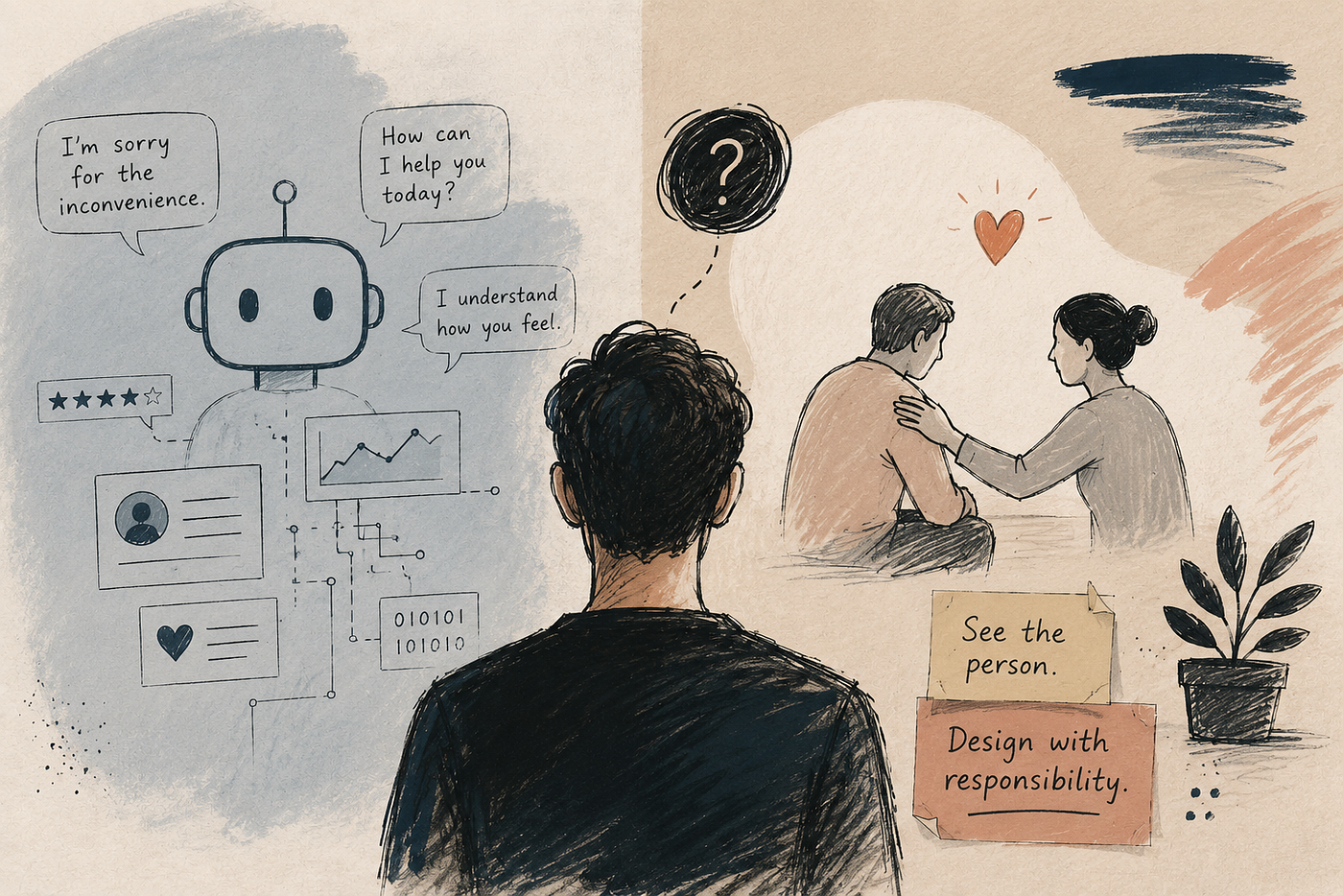
AI assistants apologize when they fail. Chatbots adapt their tone depending on user emotion. Interfaces can personalize themselves around behavior patterns. Some products already sound more emotionally aware than the people or companies behind them.
Which is why I think the current conversation around AI and design is still too shallow.
Most discussions stop at: “AI can’t replace designers because it lacks empathy.”
But if empathy simply means making users feel understood, then machines are already becoming very good at performing it.
So maybe the better question is not whether AI has empathy.
Maybe the real question is: What does empathy actually mean in design now that machines can simulate it convincingly?
And more importantly, what part of empathy still remains deeply human?
Empathy was never just emotional warmth
One thing I think the design industry gets wrong sometimes is treating empathy like emotional softness.
As if empathy only means:
- being kind to users
- writing warm microcopy
- reducing friction
- or creating pleasant experiences
But empathy in design was never just emotional sensitivity. It’s rigorous perspective-taking.
It’s the discipline of building an accurate understanding of another person’s reality — their context, limitations, emotional state, fears, motivations, mental load, habits, and constraints; and then refusing to let design decisions ignore that understanding.
That’s very different from emotional performance.
And I think many designers unknowingly stop too early in the empathy process.
To me, empathy in UX exists in three layers.
1. Cognitive empathy
Understanding what users think.
This is where most UX processes already operate:
- interviews
- analytics
- personas
- usability testing
- journey maps
- behavioral patterns
It helps us intellectually understand problems.
But understanding a problem doesn’t automatically mean we understand the emotional weight behind it.
2. Emotional empathy
Feeling what users feel. This usually happens when designers observe real friction directly.
Watching someone hesitate during a payment flow. Seeing confusion during onboarding. Watching a user repeatedly fail at something that looked “simple” inside a Figma file.
These moments change how you design because the experience stops being abstract.
You stop seeing users as flows and start seeing them as emotionally affected people.
3. Compassionate empathy
Acting responsibly because of that understanding. This is the layer I think matters most.
Compassionate empathy is when understanding actually changes decisions.
It’s when a designer chooses:
- clarity over engagement tricks
- accessibility over visual novelty
- dignity over speed
- emotional safety over conversion optimization
This is where empathy stops being a research activity. It becomes judgment.
Practicing empathy is mostly structured discomfort
I don’t think empathy develops in comfort.
It develops when your assumptions break.
Some of the strongest learning moments in design happen when you watch someone struggle with something you created and realize the problem was invisible to you before.
A “simple flow” becomes cognitively exhausting under stress. An “efficient dashboard” becomes emotionally overwhelming during burnout. A clean interface suddenly feels cold during moments of vulnerability.
Those moments recalibrate your instincts.
Not because the data changed, But because proximity changed. And I think that’s important.
Because empathy in design is not just about collecting insights. It’s about staying close enough to human friction that your decisions remain grounded in reality instead of abstraction.
The rise of simulated empathy
What makes this conversation more interesting now is that AI is becoming genuinely good at simulating emotional understanding.
And honestly, simulated empathy is not fake. It’s useful.
AI is already excellent at:
- identifying patterns
- synthesizing research
- detecting sentiment
- adapting tone
- scaling feedback analysis
- and generating emotionally intelligent responses
In many cases, AI can help teams understand users at a scale that traditional research methods never could.
But there’s still a structural limitation.
AI can only interpret what was expressed, measured, recorded, or observed in data.
It can recognize patterns in human behavior.
But it cannot experience stakes.
And I think that distinction matters more than we realize.
Because many of the most important parts of human experience never appear clearly inside analytics dashboards.
AI cannot notice:
- the person who abandoned the process before entering the funnel
- the user who never submitted feedback because they felt intimidated
- the emotional weight behind a risky financial decision
- or the quiet shame someone feels when a system repeatedly makes them feel incapable

Those experiences often exist outside measurable interaction. And yet they shape how people remember products.
Prediction is not accountability
I think this is where many conversations about AI replacing designers become shallow.
AI can predict human behavior remarkably well. But prediction is not accountability. Empathy in design is ultimately a moral commitment.
A decision about whose experience you refuse to compromise. And moral commitments require responsibility. They require someone who can be questioned for the outcomes being created. Especially now, because interfaces are no longer passive tools.
Modern products shape:
- confidence
- trust
- stress
- behavior
- attention
- access
- and sometimes even self-worth
A productivity dashboard can silently increase anxiety. A recommendation system can slowly affect identity. An onboarding experience can determine whether someone feels capable or excluded.
Design decisions are no longer just functional decisions.
They are psychological ones too.
And as AI-generated experiences become more emotionally persuasive, I think designers will need stronger judgment, not less.
Because emotionally intelligent interfaces can still produce emotionally harmful outcomes.
A system can sound caring while being manipulative. It can feel personalized while reducing autonomy. It can optimize efficiency while quietly eroding dignity.
Good UX metrics do not automatically mean humane experiences. That distinction will matter a lot in the coming years.
What will make designers valuable
I don’t think AI will eliminate UX designers.
But I do think it will expose shallow design thinking very quickly.
The designers who remain valuable won’t simply be the ones who can produce polished screens faster.
They’ll be the ones who can:
- recognize invisible human costs
- understand emotional consequences beyond analytics
- question incentives
- navigate ethical tradeoffs
- think systemically
- and make judgment calls where data alone is insufficient
Because in the age of simulated empathy, real empathy becomes something deeper than emotional awareness.
It becomes responsibility. And responsibility cannot be automated. AI has no stakes in the outcomes it generates.
Designers do.
메타데이터
- post_id
- 77153554fb16
- slug
- what-is-empathy-in-design-in-the-age-of-simulated-empathy-77153554fb16
- url
- https://medium.com/@swarnajha25/what-is-empathy-in-design-in-the-age-of-simulated-empathy-77153554fb16
- canonical_url
- https://medium.com/@swarnajha25/what-is-empathy-in-design-in-the-age-of-simulated-empathy-77153554fb16
- author_url
- https://medium.com/@swarnajha25
- status
- ok
- fetched_at
- 2026-06-09 15:37:30