When Live Location Tracking Starts Crushing Your Database
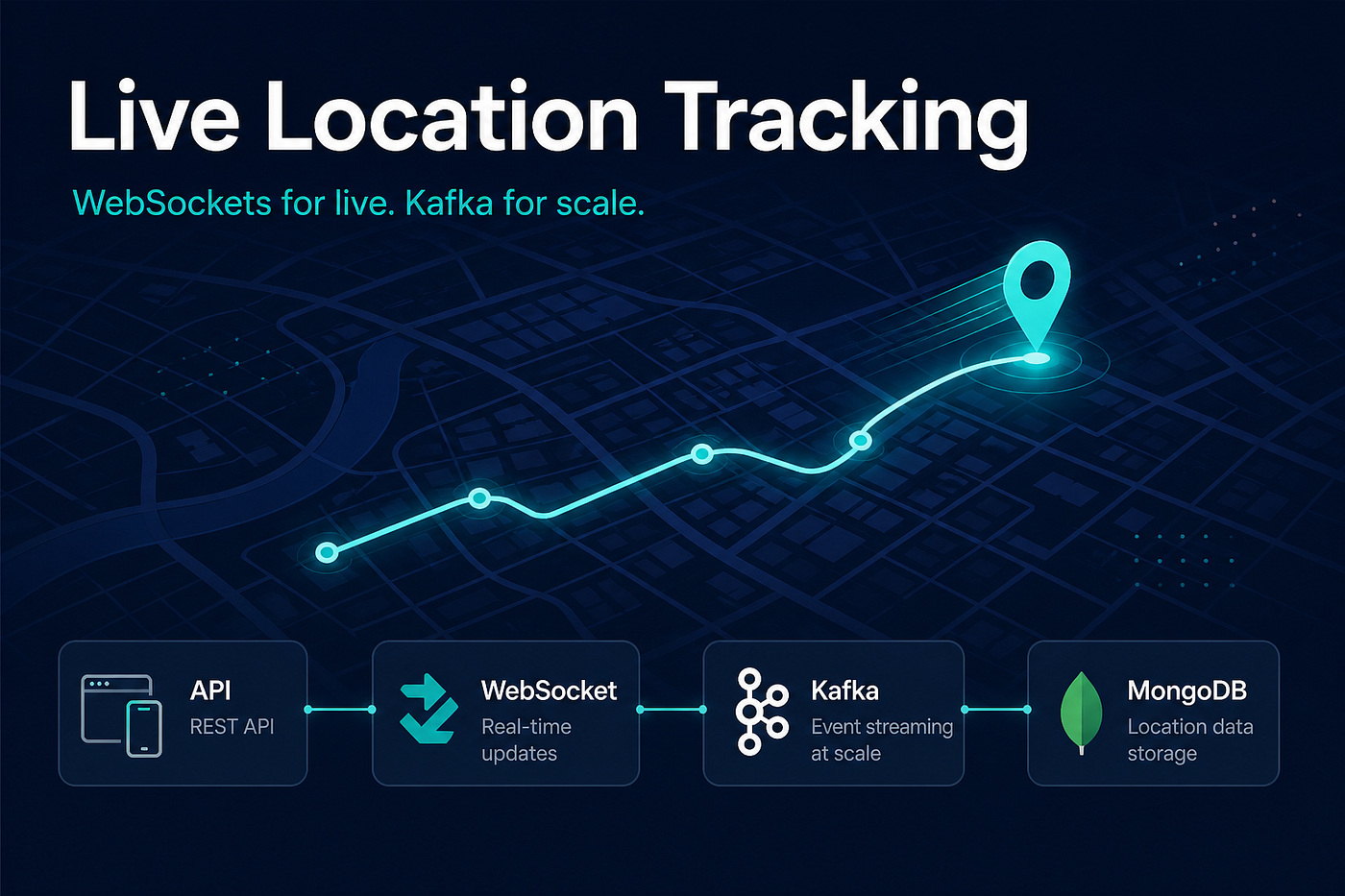
WebSockets for live delivery. Kafka for decoupling. Same event, two responsibilities.
Most people think live location tracking means one simple thing:
The driver sends a location… and you update the database.
That story is incomplete.
Live tracking does not start as an infrastructure decision. It starts as a product need.
A customer wants reassurance that the order is close. Operations and support want to see drivers on the map in real time. Nobody wants to guess.
So the real question is not:
Did we save the location?
The real question is:
Can the person watching the map see the truth at the same moment?
This article walks through how a live tracking system usually evolves — from a simple backend write, to WebSockets, to write reduction, and finally to Kafka — and why each step exists.
1. Why live location tracking exists
Live tracking is valuable because it turns uncertainty into visibility.
In delivery, ride-hailing, logistics, or field operations, location is not just a data point. It is trust:
- “Where is my order?”
- “Is the driver moving?”
- “Why is this trip delayed?”
If the map is stale, the product feels broken even when the backend is “working.”
That is why live tracking systems are judged by two outcomes at once:
- Freshness — how close the map is to reality
- Reliability — whether the system survives high update rates
Those two goals often pull the architecture in different directions.
2. The first design is supposed to be simple

In the beginning, the design should be simple.
The driver app or frontend sends location as coordinates, with a few supporting fields:
{
  “tripId”: “trip_8841”,
  “coordinates”: [31.2357, 30.0444],
  “timestamp”: “2026–08–16T19:30:01Z”
}
The backend receives the event, updates MongoDB, and the map reads the latest state.
Driver / Frontend → Backend → MongoDB → Map
With 10 drivers, this is excellent. With a small fleet, this is not only enough — it is the correct design.
A common mistake is introducing Kafka, multiple consumers, and complex retry logic before the product has proven the load. That is not architecture maturity. That is premature complexity.
3. Live tracking is actually two problems
The moment the product says, “We need true live tracking,” you discover you do not have one problem. You have two:
- Ingest location updates quickly
- Deliver those updates immediately to people watching the trip
This distinction matters.
Saving a location is persistence. Streaming a location is realtime delivery.
If you treat both as one database update path, the system will feel fine at low volume and painful at scale.
4. Why WebSockets enter the design

HTTP is great when a client asks for data and leaves.
It is a poor fit when a live map asks every second:
“Any new location?”
That pattern is polling, and it creates three problems quickly:
- backend pressure
- network waste
- a laggy user experience
WebSockets solve the delivery side more cleanly.
You keep an open connection between server and client. When new coordinates arrive, the server emits them to subscribers of that trip.
Frontend sends coordinates ↓ API receives and validates ↓ WebSocket emits to trip subscribers ↓ Live map moves
Now the map does not chase the location. The location is pushed to the map.
This is the first major upgrade in the user experience.
Important note: WebSockets improve delivery. They do not automatically solve database write pressure.
5. Then scale exposes the write problem
Devices often send coordinates about once per second.
That means:
- 100 drivers ≈ 100 writes/second
- 1,000 drivers ≈ 1,000 writes/second
And that is only location traffic — before the rest of the system’s normal database workload.
Suddenly the database feels constantly under pressure.
Not because GPS is magically complex. Because every location event is treated as equally important and equally worth persisting at full rate.
Before anyone says “Let’s add Kafka,” ask the simpler question:
Does every coordinates update need a database write?
Usually, no.
6. The first real optimization: reduce unnecessary writes
The frontend may send every second, or every five seconds. Business needs are often less strict.
You can persist only when:
- the distance moved is meaningful, or
- a time threshold has passed
In other words: filtering / throttling before the database.
This is cheap, simple, and easy to reason about. It often removes a large percentage of write load immediately.
But be honest about the trade-off:
The persisted location is not necessarily the latest received location.
If the product can tolerate a small freshness gap in stored state, do not add distributed complexity early.
If the product cannot tolerate it — for example, strict auditing or legal/trace requirements — then your persistence policy must be stricter, and your cost model changes.
7. The deeper problem: tight coupling
Even after write reduction, another issue remains.
Realtime ingestion and database persistence are still glued together if your API path looks like this:
Receive event → Write MongoDB → Respond
In that design, MongoDB sits on the critical path of realtime processing.
If the database slows down, ingestion slows down. If ingestion slows down, live experience degrades.
That is an architectural smell: tight coupling.
Receiving coordinates quickly is one responsibility. Persisting them intelligently is another.
When load grows, those responsibilities need different speeds, failure modes, and scaling strategies.
8. Where Kafka becomes justified

Kafka becomes useful when you need to separate:
- how fast events can be accepted from
- how fast events can be persisted
A cleaner flow looks like this:
Driver / Frontend ↓ API (Receive → Validate → Publish) ↓ Kafka ↓ Consumer (Process → Throttle → Persist) ↓ MongoDB
So the full architecture is not “Kafka instead of WebSockets.” It is both, with clear roles:
LayerResponsibility
WebSockets
Deliver live coordinates to UI
Kafka
Buffer events and decouple ingestion from DB
MongoDB
Store the state you actually need
A practical detail that matters: use tripId as the Kafka message key.
Why?
So updates for the same trip tend to land in the same partition and keep stronger ordering for that trip. That reduces the chance of an older location overwriting a newer one during parallel processing.
Example producer shape:
await producer.send({
topic: “trip-location”,
messages: [
  {
    key: tripId,
    value: JSON.stringify({tripId, coordinates, timestamp})
  }
 ]
});
The API now owns the event. The consumer owns persistence.
9. The correct mental model (no conflicts)
They are not.
They solve different problems on the same event:
- Left path: realtime experience
- Right path: durable state and write control
Same event. Two responsibilities.
That is the system design.
10. Kafka does not solve everything
Kafka removes some coupling, but it introduces distributed-systems concerns:
- consumer lag
- retries
- duplicate events
- ordering edge cases
- idempotency
- partitioning strategy
- offset management
Ask hard questions early:
- If the same event is processed twice, what happens in MongoDB?
- If an older location arrives late, can it overwrite a newer one?
- If consumers fall behind, is stale persistence acceptable while live WebSocket updates continue?
If you do not have answers, Kafka is not an upgrade. It becomes a source of harder bugs.
That is why Kafka is an architectural decision, not a library add-on.
11. Why not Kafka on day one?
Because it is not free.
You add:
- infrastructure
- monitoring
- failure handling
- operational complexity
- consistency concerns
For a small fleet, that is often overengineering.
A healthier evolution looks like this:
Version 1 — Simple
Frontend → API → MongoDB → Map
Version 2 — Live delivery
Frontend → API → WebSocket → Live Map
↘ MongoDB
Version 3 — Smarter writes
Frontend → API → Filter/Throttle → MongoDB
↘ WebSocket → Live Map
Version 4 — Decoupled persistence
Frontend → API → WebSocket → Live Map
↘ Kafka → Consumer → MongoDB
Same product feature. Different load reality. Different complexity budget.
12. What to decide before you write code
If you are designing this system, lock these decisions early:
- What is “live” for the product? Sub-second UI updates? 2–3 seconds lag acceptable?
- What must be persisted? Every point? Every N seconds? Only meaningful movement?
- What is the source of truth for the map? Latest websocket event, latest DB document, or both with different freshness rules?
- How do you prevent out-of-order overwrite? Compare timestamps, store version/sequence, ignore stale updates.
- What is your idempotency strategy? Especially once retries and consumers exist.
These questions matter more than choosing a trendy tool.
The real lesson
The lesson is not “use Kafka.” It is also not “WebSockets are enough.”
The lesson is:
Understand the workload before choosing the architecture.
Live tracking needs balance between:
- a truly live user experience
- sustainable database pressure
- decoupling only when scale forces it
In system design, the hard part is rarely knowing many tools. The hard part is knowing which tool, when, why, and which trade-offs you are willing to carry.
Start simple. Measure. Reduce unnecessary writes. Separate realtime delivery from persistence. Introduce Kafka when coupling becomes the bottleneck — not before.
That is how live location tracking grows up without collapsing under its own architecture.
메타데이터
- post_id
- 7d115d8badb9
- slug
- when-live-location-tracking-starts-crushing-your-database-7d115d8badb9
- url
- https://medium.com/@khelmy173/when-live-location-tracking-starts-crushing-your-database-7d115d8badb9
- canonical_url
- https://medium.com/@khelmy173/when-live-location-tracking-starts-crushing-your-database-7d115d8badb9
- author_url
- https://medium.com/@khelmy173
- status
- ok
- fetched_at
- 2026-08-18 07:17:45




