Beyond Tokenization: How Embeddings Give AI a Mathematical Sense of Meaning 🧠📐
When people learn about Large Language Models, they learn that tokenization breaks text into numbers. But raw numbers like 4821 and 9102…
Beyond Tokenization: How Embeddings Give AI a Mathematical Sense of Meaning 🧠📐
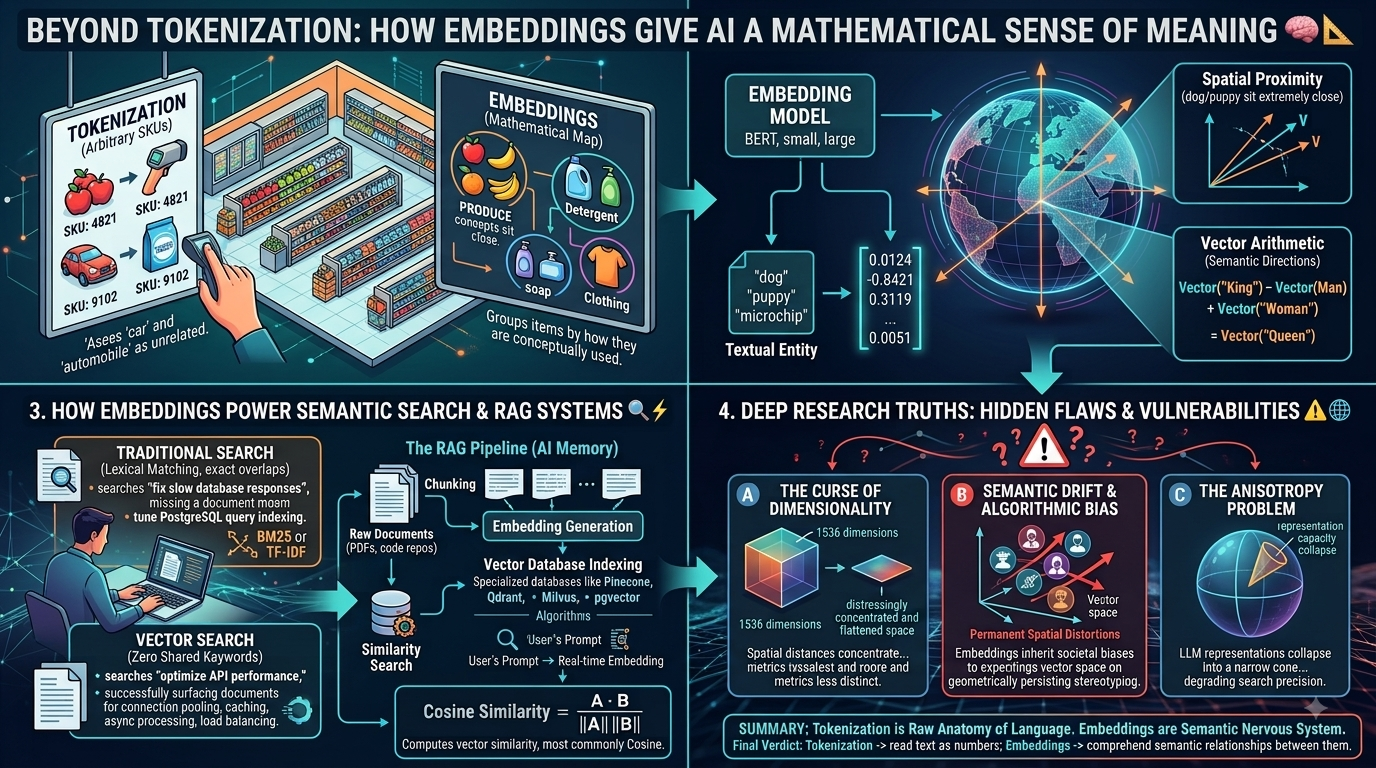
When people learn about Large Language Models, they learn that tokenization breaks text into numbers. But raw numbers like 4821 and 9102 carry no inherent meaning. If "car" is token 4821 and "automobile" is token 9102, an LLM sees them as entirely unrelated entities.
This is where Vector Embeddings step in. Embeddings are the exact mathematical bridge where raw numbers transform into semantic intelligence, geometric direction, and conceptual reasoning.
1. The Simple Explanation: The Grocery Store Analogy 🛒
Imagine walking into a massive supermarket you have never visited before. You walk into the produce section and see Apples. Right next to them, you find Oranges and Bananas. On the complete opposite side of the store, past the clothing section, you find Laundry Detergent and Dish Soap.
Why are these items arranged this way? Because the store manager grouped them by how they are conceptually used.
This is exactly what Embeddings do for artificial intelligence:
- Tokenization gives every item an arbitrary SKU bar code number.
- Embeddings place those items onto a massive, multi-dimensional store map where concepts with similar meanings naturally sit right next to each other.
2. Deep Technical Breakdown: Mechanics of High-Dimensional Vector Space 🗺️
Computers cannot feel human context, but they can calculate geometry. An embedding model maps tokens or whole sentences into a continuous, high-dimensional vector space — typically 768 dimensions (BERT), 1536 dimensions (text-embedding-3-small), or 3072 dimensions (text-embedding-3-large).
- Numerical Vectors: An embedding converts a textual entity into an array of floating-point numbers:v = [0.0124, -0.8421, 0.3119,..., 0.0051]
v = [0.0124, -0.8421, 0.3119,……, 0.0051]
- Spatial Proximity: Semantic similarity directly translates to geometric distance. The vectors for “dog” and “puppy” sit extremely close to each other, while the vector for “microchip” points in a completely different direction.
- Vector Arithmetic (Semantic Directions): The famous Word2Vec breakthrough proved that relationships between concepts translate into directional movements in vector space:
Vector(“King”) — Vector(Man) + Vector(“Woman”) = Vector(“Queen”)
This equation proves that abstract concepts like “royalty” and “gender” are encoded as distinct spatial vectors inside the matrix.
3. How Embeddings Power Semantic Search & RAG Systems 🔍⚡
Traditional search engines rely on lexical matching (like BM25 or TF-IDF), which looks for exact string overlaps. If a user searches for “fix slow database responses”, lexical search misses documents that say “tune PostgreSQL query indexing”. Vector search solves this completely.
- Zero Shared Keywords: Searching for “optimize API performance” using vector similarity surfaces concepts like “connection pooling”, “caching”, “asynchronous processing”, and *”load balancing” — even if the original words “API performance” never appear in the source text.
- The Retrieval-Augmented Generation (RAG) Architecture:
- Chunking: Raw unstructured documents (PDFs, code repos, docs) are split into optimal textual chunks.
- Embedding Generation: Chunks pass through an embedding model to extract dense numerical representations.
- Vector Database Indexing: Vectors are stored in specialized vector databases (Pinecone, Qdrant, Milvus,pgvector) using algorithms like HNSW (Hierarchical Navigable Small World).
- Similarity Search: A user’s prompt is embedded in real-time, and the database computes vector similarity — most commonly via Cosine Similarity:

4. Deep Research Truths: Hidden Flaws & Vulnerabilities in Vector Space ⚠️🌐
While embeddings underpin modern AI memory and enterprise search, AI researchers have uncovered several structural flaws:
- The Curse of Dimensionality: In hyper-dimensional space (e.g., 3072 dimensions), spatial distances between points begin to concentrate and flatten. This phenomenon makes Euclidean distance metrics less distinct and increases computational overhead exponentially.
- Semantic Drift & Algorithmic Bias: Embeddings inherit societal biases present in training corpora. Historical stereotyping (e.g., geometrically associating specific professions with gender vectors) persists as permanent spatial distortions inside vector weights.
- The Anisotropy Problem: Research shows that LLM representations often collapse into a narrow cone within the vector space rather than occupying the full 360-degree volume. This severely degrades representation capacity and degrades search precision for nuanced queries.
🏁 Final Verdict
Tokenization represents the raw anatomy of language, whereas Embeddings represent its semantic nervous system. Tokenization gives AI the ability to read text as numerical tokens; Embeddings grant AI the ability to comprehend the semantic relationships between those numbers.
메타데이터
- post_id
- 7d65ae3fb8c6
- slug
- beyond-tokenization-how-embeddings-give-ai-a-mathematical-sense-of-meaning-7d65ae3fb8c6
- url
- https://medium.com/@gideonsivak2007/beyond-tokenization-how-embeddings-give-ai-a-mathematical-sense-of-meaning-7d65ae3fb8c6
- canonical_url
- https://medium.com/@gideonsivak2007/beyond-tokenization-how-embeddings-give-ai-a-mathematical-sense-of-meaning-7d65ae3fb8c6
- author_url
- https://medium.com/@gideonsivak2007
- status
- ok
- fetched_at
- 2026-08-17 16:12:30