The End of the Design Handoff: How Claude Opus 5 is Redefining Product Design
For the past decade, the technology industry has accepted a massive, expensive bottleneck as a standard cost of doing business: the design…
The End of the Design Handoff: How Claude Opus 5 is Redefining Product Design
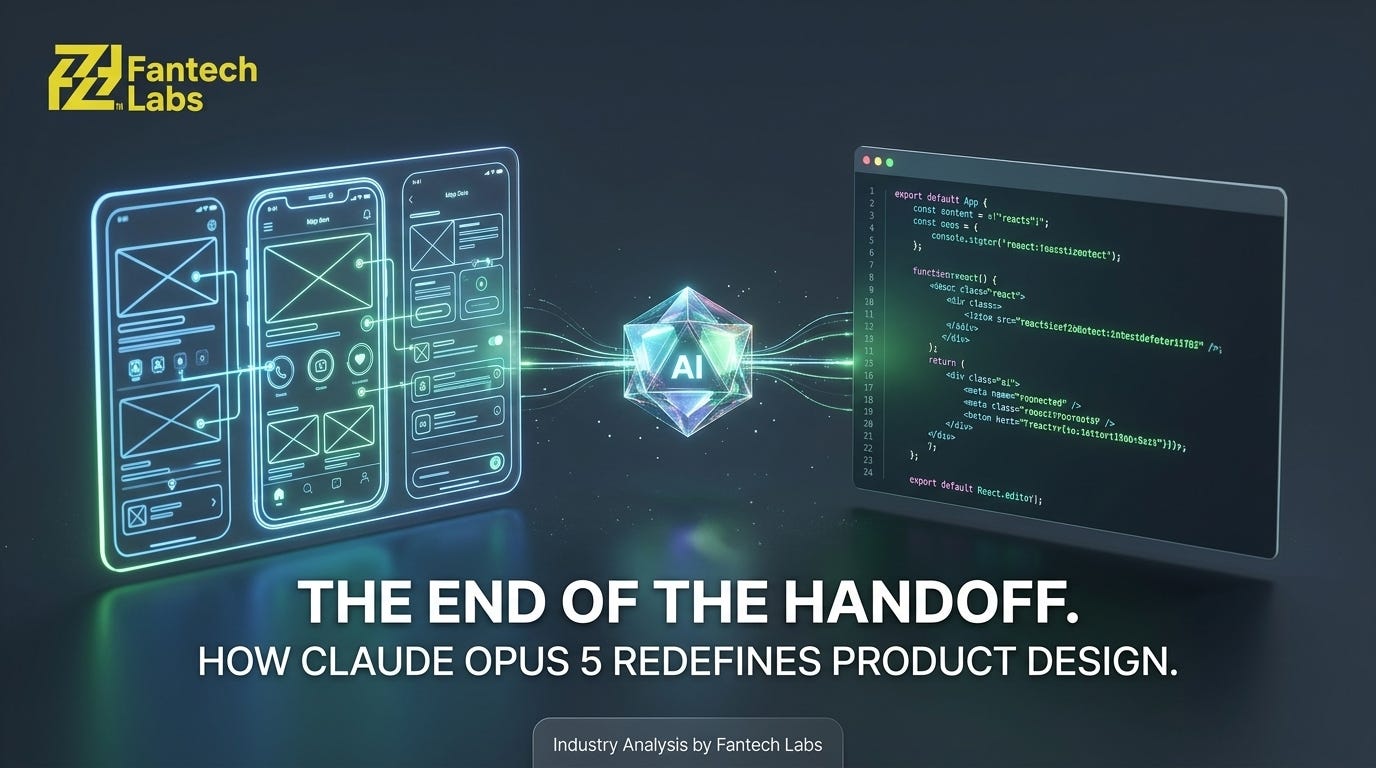
For the past decade, the technology industry has accepted a massive, expensive bottleneck as a standard cost of doing business: the design handoff.
A Product Designer spends weeks in Figma, crafting pixel-perfect user interfaces, establishing design tokens, and documenting complex user flows. Then comes the handoff. The designs are thrown over the proverbial wall to the engineering team. What follows is a frustrating, time-consuming cycle of misinterpretation, CSS misalignments, compromised animations, and endless QA loops. The product that gets coded rarely looks exactly like the product that was designed.
At Fantech Labs, we sit at the intersection of web application engineering and digital marketing. We monitor the bleeding edge of technology because our clients rely on us to build faster, smarter, and more scalable systems. Recently, we have been analyzing the impact of a monumental shift in the AI landscape: the release of Claude Opus 5.
Claude Opus 5 is not just another chatbot. With its flawless multi-modal vision and massive context windows, it is fundamentally obliterating the wall between design and engineering. Here is our deep-dive analysis into how Claude Opus 5 is redefining the role of the Product Designer in 2026, and why the industry will never be the same.
Beyond “Chat”: The Multi-Modal Design Brain
To understand why Claude Opus 5 is a paradigm shift for product design, you have to understand the evolution of context in artificial intelligence.
Earlier models (like the GPT-4 generation or Claude 3) were great at reading text or writing basic boilerplate code. But product design is inherently visual and spatial. It relies on negative space, typography hierarchies, and interactive states. Opus 5 possesses an advanced multi-modal vision architecture combined with a context window so large that it can hold an entire enterprise design system, the frontend repository guidelines (React/Vue), and WCAG accessibility rules all in its active memory simultaneously.
When a designer interacts with Opus 5 today, they aren’t asking it to “write code for a blue button.” They are uploading a complex, 40-screen Figma user flow and asking the model to analyze the UX hierarchy, identify accessibility flaws in the contrast ratios, and generate the corresponding Tailwind configuration tailored exactly to a specific codebase standard.
It does not just see the image; it understands the spatial relationships, the z-index layers, and the design intent.
1. The Zero-Friction Engineering Handoff
The most immediate industry impact of Opus 5 is on frontend velocity. In traditional workflows, translating a complex, animated dashboard from Figma to a React application took days of back-and-forth between design and development.
Today, forward-thinking product teams are using Opus 5 as a direct translation engine. Because the model understands exact engineering constraints, a designer can feed it a high-fidelity mockup and request the exact frontend architecture.
The prompt looks something like this:
Attached is the new analytics dashboard flow. Review it against our attached
globals.cssand existing React component library. Generate the modular TypeScript/React code for the central data grid, ensuring the container is responsive. Use our exact Tailwind design tokens for padding, typography, and hover states.
In seconds, Opus 5 outputs production-ready, componentized code. It doesn’t write messy, inline CSS; it aligns with the exact design system variables provided.
Does this replace the frontend engineer? Absolutely not. It removes the tedious, repetitive translation work. Engineers no longer need to waste time measuring pixel padding or matching hex codes. They receive perfectly structured boilerplate, allowing them to immediately focus on what actually matters: data fetching, complex state management, and backend API integration. The time saved across a sprint is staggering.
2. Autonomous Design System Auditing
One of the hardest parts of scaling a digital product is maintaining the integrity of the Design System. As projects grow and multiple designers collaborate on the same files, “design drift” occurs. Designers accidentally introduce new hex codes, slightly different border radii, or inconsistent typography scales. Slowly, the system bloats, leading to an inconsistent user experience.
Claude Opus 5 acts as an autonomous design auditor. A Design Lead can now export the raw JSON/SVG data of a master Figma file and feed it into Opus 5 with a simple directive: “Audit for design system deviations.”
Because of its deep reasoning capabilities, Opus 5 doesn’t just flag errors; it categorizes them. It will point out that a designer used #1A1A1A instead of the official --surface-dark token on three specific modal screens. It will identify that the touch-target size on the mobile navigation bar is 34px, failing the WCAG accessibility standard of 44px. It can then automatically generate the script required to update and merge those styles back into strict compliance.
This capability keeps design files completely synchronized with production code, ensuring the source of truth remains pristine at all times.
3. Conversion-Driven UX and Marketing Synergy
At Fantech Labs, we know that a beautiful interface is completely useless if it doesn’t convert. Product design must be intrinsically linked with user psychology and marketing data.
Traditionally, a data analyst would decipher user behavior data (heatmaps, drop-off rates, session recordings) and spend hours drafting a brief for the design team. Opus 5 collapses this timeline. Product teams can now feed raw analytical data directly into Opus 5 alongside screenshots of the current UI.
A designer can ask the model:
Users are dropping off at the pricing tier selection screen. Based on the attached heatmap data and the UI layout, suggest structural UX changes to decrease cognitive load and increase conversion to the Enterprise tier.
Opus 5 excels at this deep psychological and spatial reasoning. It might suggest that the visual hierarchy of the “Basic” tier is pulling eye-tracking away from the primary Call-To-Action. It might note that the tooltip copy is causing friction on mobile viewports. It proposes structural UX solutions based on hard data, which designers can then rapidly prototype and deploy.
Visualizing the Velocity Shift
To truly grasp the impact of this new workflow, you have to look at resource allocation. The hours previously spent on manual documentation, red-lining, and QA ping-pong are being heavily reduced across the industry.
Interact with the tool below to see our analysis of how advanced models like Claude Opus 5 shift a Product Designer’s time away from tedious execution and towards strategic product architecture.
The Evolution of the Designer: From Pixel Pusher to Product Architect
The rapid advancement of AI models has sparked anxiety in the design community. There is a lingering fear that if an AI can write React code from a Figma mockup, the Product Designer will become obsolete.
Our analysis points to the exact opposite.
When you remove the manual labor of pushing pixels, writing redline documentation, and arguing over CSS flexbox alignments, what remains is the true essence of product design: Problem Solving.
Designers are no longer constrained by execution time. They can explore ten different architectural solutions to a user problem in the time it used to take to build a single solution. They can build tighter, more accessible, and more high-converting digital experiences because they have a world-class, multimodal reasoning engine serving as their copilot.
The future of digital agencies and tech companies does not belong to those who use AI to generate generic, thoughtless layouts (the “slop”). It belongs to teams that understand how to leverage models like Claude Opus 5 to deeply integrate design, marketing, and engineering into one seamless, frictionless pipeline.
The tools have evolved. The workflow must evolve with them. At **Fantech Labs**, we are closely watching this shift as we continue to engineer the web applications and digital systems of tomorrow.
Let’s build something extraordinary.
메타데이터
- post_id
- 812caaacc9f8
- slug
- the-end-of-the-design-handoff-how-claude-opus-5-is-redefining-product-design-812caaacc9f8
- url
- https://medium.com/@fantechlabs.ca/the-end-of-the-design-handoff-how-claude-opus-5-is-redefining-product-design-812caaacc9f8
- canonical_url
- https://medium.com/@fantechlabs.ca/the-end-of-the-design-handoff-how-claude-opus-5-is-redefining-product-design-812caaacc9f8
- author_url
- https://medium.com/@fantechlabs.ca
- status
- ok
- fetched_at
- 2026-08-09 04:52:39