“Retrain the Operator” — The Four Most Expensive Words in Pharmaceutical Quality
Why the most common CAPA in the industry fixes nothing, and what strong corrective action actually looks like
“Retrain the Operator” — The Four Most Expensive Words in Pharmaceutical Quality
Why the most common CAPA in the industry fixes nothing, and what strong corrective action actually looks like
Read time: 8 minutes | ~1,850 words
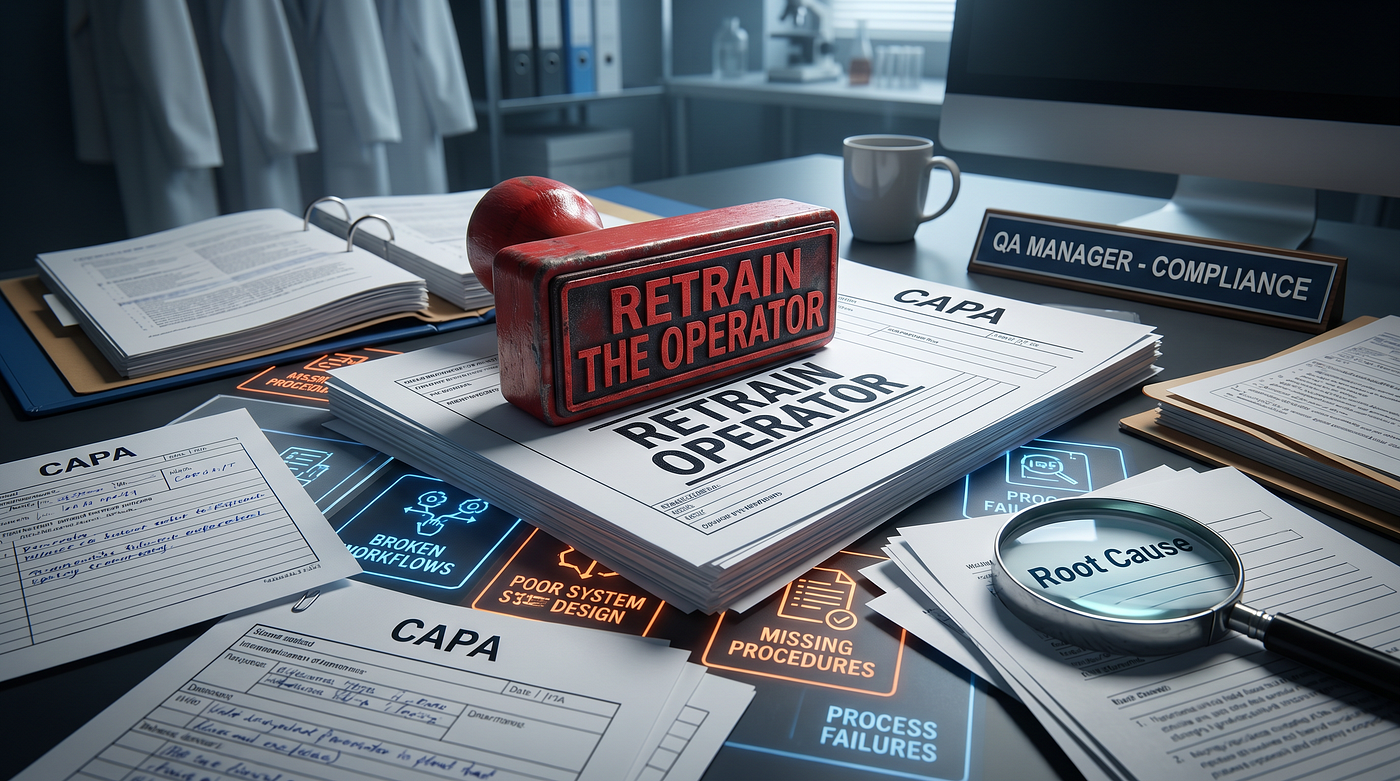
Do not Mention the sentence “Retrain the Operator” — FDA Inspection
I’ve reviewed hundreds of CAPAs across pharmaceutical and medical device companies over the past decade. Different sites, different products, different deviation types. But there’s one corrective action that shows up more than any other, regardless of the problem:
“Retrain the operator.”
It appears in 60–70% of deviation responses. Sometimes dressed up as “refresher training” or “enhanced oversight” or “coaching session,” but the core is the same: the problem was the person, so the fix is telling that person not to do it again.
And the part that keeps me up at night: it almost never works. The same deviations keep happening. Different operators. Different batches. Same root cause. But we keep retraining, because retraining feels like doing something without actually having to change anything.
The Appeal of Retraining (And Why It Persists)
I get why retraining is so popular. It’s fast. It’s cheap. It doesn’t require cross-functional alignment, budget approval, system changes, or vendor negotiations. A training session takes two hours. You document attendance, update a training log, and close the CAPA.
From a QA manager’s perspective, it checks the box.
You addressed the deviation. You took action. You can defend it in an inspection if asked, at least superficially.
The problem is that FDA inspectors stopped accepting “retrain the operator” as a serious CAPA about five years ago.
They’ve seen it too many times as a placeholder for actual root-cause remediation.
When they read a CAPA that says “retrain all staff on GDP,” they know what it means: the company didn’t want to fix the real problem.
What Five Whys Actually Reveals
Let me walk through a real case (details changed to protect the guilty).
Deviation: Operator signed an electronic batch record step before actually performing the weighing. Clear contemporaneity violation.
Immediate conclusion: Operator error. Retrain on the importance of signing after work is complete, not before.
The CAPA that was written: “Retrain all manufacturing operators on contemporaneous documentation requirements.
Owner: Training Manager.
Timeline: Complete within 30 days.”
I happened to be on-site during the investigation and pushed back.
“Before we write the CAPA, let’s run Five Whys.”
Why #1: Why did the operator sign before performing? Investigation revealed the EBR workflow was designed so the signature prompt appeared before the balance reading display. The button to sign the step came first.
Why #2: Why is the workflow designed that way? The EBR was configured in 2019 to mirror the layout of the old paper form. Nobody questioned it during implementation.
Why #3: Why hasn’t the workflow been updated in seven years? No periodic review of EBR workflow design exists at the site.
Why #4: Why is there no periodic review? No SOP requires post-implementation workflow assessment for electronic systems.
Why #5: Why no such SOP? Quality system gap. The site never established a procedure for governing EBR workflow design after go-live.
Look at where we ended up.
We started with “operator signed before performing.”
We ended with “no procedure for governing EBR workflow design.” Completely different problem. Completely different fix.
The CAPA became: “Establish EBR Workflow Governance SOP defining periodic review, change control triggers, and human-factors assessment for all EBR workflows.
Immediate action: reconfigure Step 12 to display balance reading before signature prompt. Target completion: 90 days.”
That CAPA prevents the next operator and the operator after that, from making the same mistake. Retraining wouldn’t.
The Pattern I See Everywhere
This isn’t one isolated case. It’s a pattern that repeats across deviation types:
Deviation: Late entries (work performed yesterday, documented today).
Weak CAPA: “Retrain operators on the importance of real-time documentation.”
What Five Whys reveals: Operators are recording at end of shift because the workflow requires them to complete 15 steps before they can access the signature screen. By the time they reach it, some steps are already an hour old.
Strong CAPA: Reconfigure EBR to allow step-by-step signing, not bulk signing at end of sequence.
Deviation: Identical yield values across five consecutive batches (statistically impossible).
Weak CAPA: “Retrain operators on recording actual values, not target values.”
What Five Whys reveals: The SOP lists a target yield but doesn’t explain how to calculate actual yield. Operators are copying the SOP value because they don’t know how else to complete the field.
Strong CAPA: Revise SOP to include actual yield calculation procedure. Add a worked example.
Deviation: Missing signatures on batch records discovered during QA review.
Weak CAPA: “Retrain on the importance of complete documentation.”
What Five Whys reveals: The paper form has 47 signature fields across 12 pages. Statistically, someone will miss one occasionally. The form itself is the problem.
Strong CAPA: Redesign the form to consolidate signature fields or migrate to an EBR with mandatory field enforcement.
The surface cause is always “the operator didn’t follow the procedure.”
The systemic cause is almost always “the procedure, the form, or the system set the operator up to fail.”
Retraining addresses the surface. Strong CAPAs address the system.
What Actually Prevents Recurrence
I’ve started tracking this informally. When a deviation recurs within six months after a “retrain the operator” CAPA, I go back and look at what a systems-level CAPA would have been.
The pattern is consistent: system-level CAPAs prevent recurrence at roughly 80–85%. Retraining-only CAPAs prevent recurrence at maybe 20%.
The 20% that work are the cases where the operator genuinely didn’t know something and training filled a real knowledge gap. “Operator was unaware that FriXion pens are prohibited in GMP” is a training gap. Training fixes it.
But most deviations aren’t knowledge gaps. They’re workflow problems, form-design problems, system-design problems, or under-resourcing problems dressed up as operator errors.
You can’t train your way out of a bad EBR workflow. You can’t train your way out of a 47-field signature form that someone will inevitably miss a field on. You can’t train your way out of understaffing that forces operators to rush.
The Inspection Test
Here’s how FDA inspectors evaluate CAPAs now.
They pull your last 20 closed CAPAs. They look for repeat deviation types.
If the same deviation recurs after CAPA closure, they ask: “Why did this CAPA fail to prevent recurrence?”
If your answer is “well, we retrained, but a different operator made the same mistake,” the inspector’s conclusion is that your CAPA was inadequate. And they’re right.
A CAPA that worked would have made the mistake impossible or at least harder for the next person. Retraining makes the same mistake just as easy. It just asks the next person to be more careful.
What a Strong CAPA Looks Like
The SMART criteria everyone knows (Specific, Measurable, Assigned, Realistic, Time-bound) are a good start. But they’re not enough. A CAPA can be perfectly SMART and still completely miss the point.
Here’s what I look for beyond SMART:
Root cause, not surface cause.
Does the CAPA address why the problem happened at a systemic level, or just who made the mistake?
Effectiveness verification built in.
How will you know in 90 days whether this CAPA actually worked? What data will you check?
Preventive reach.
Does this CAPA prevent only the exact cited instance from recurring, or does it address the class of problems?
Lets see few examples:
Weak CAPA: “Action: Retrain QC analysts on proper audit trail comment writing. Owner: Lab Manager. Timeline: Within 14 days.”
Strong CAPA:
“Action: Develop and implement a 4-element audit-trail-comment template (what changed, why it was wrong, correct value with source, how verified) embedded as help text in LIMS. Template becomes mandatory field; empty comments prevented by system validation.
Measured by: 100% of audit trail comments include all 4 elements post-implementation.
Owner: Maria Rodriguez, LIMS Administrator.
Timeline: 30 days for template design and UAT, 60 days for LIMS configuration and retest, 90 days for go-live.
Target completion: 15-September-2026.
Effectiveness verification: 90-day audit trail review post-implementation to verify comment quality improved and vague comments eliminated. Documented comparison of pre/post comment quality.”
That CAPA makes vague audit trail comments impossible. Not harder. Impossible. The system enforces it.
Training makes vague comments possible but discouraged. There’s a big difference.
The Cost of Weak CAPAs
I said these four words are expensive. Let me quantify that.
The average pharmaceutical deviation takes 40–60 hours to investigate and close (conservatively). If your CAPA doesn’t prevent recurrence and the same deviation happens again six months later, you’ve just spent another 40–60 hours. That’s $4,000–$8,000 in fully loaded labor costs per recurrence, assuming an average burden rate of $100/hour for the people involved.
Five recurrences over two years because a weak CAPA never fixed the root cause: $20,000–$40,000 in wasted investigation effort.
Now add the inspection risk. Repeat deviations are a red flag. If an FDA inspector sees the same deviation type appearing three times in your deviation log, they start asking whether your CAPA process works at all. That question can cascade into findings about your entire quality management system.
I’ve seen companies spend six figures on third-party CAPA-process remediations triggered by an inspection finding that their CAPAs don’t prevent recurrence. All traceable back to “retrain the operator” appearing 40 times in their closed-CAPA log.
So What to Do Monday ?
If you’re a QA manager or anyone who reviews CAPAs, here’s the simplest test:
Pull your last 10 closed CAPAs. Count how many say “retrain” or “refresher training” as the primary or sole corrective action.
If it’s more than 2 out of 10, you have a pattern.
Then do this: for each “retrain the operator” CAPA, ask yourself, “If we had reconfigured the system, redesigned the form, or changed the workflow instead of retraining, would the deviation be impossible now?”
If the answer is yes, that’s a weak CAPA you can strengthen.
You don’t have to go back and reopen them. But the next time you’re writing a CAPA and “retrain the operator” is your first instinct, stop. Run Five Whys. See where it takes you.
I can almost guarantee it takes you somewhere more expensive in the short term (system changes, vendor calls, cross-functional meetings) and far cheaper over the life of the product.
— - About The Author: The Author is affiliated with GRC Times and this article draws on his experience in reviewing quality systems across pharmaceutical and medical device companies. More resources on FDA Inspection Templates, Free Checklists, at grctimes.gumroad.com. FDA Inspection Readiness Guide — -
메타데이터
- post_id
- 82e782eb8776
- slug
- retrain-the-operator-the-four-most-expensive-words-in-pharmaceutical-quality-82e782eb8776
- url
- https://medium.com/@grctimes/retrain-the-operator-the-four-most-expensive-words-in-pharmaceutical-quality-82e782eb8776
- canonical_url
- https://medium.com/@grctimes/retrain-the-operator-the-four-most-expensive-words-in-pharmaceutical-quality-82e782eb8776
- author_url
- https://medium.com/@grctimes
- status
- ok
- fetched_at
- 2026-06-23 19:38:28