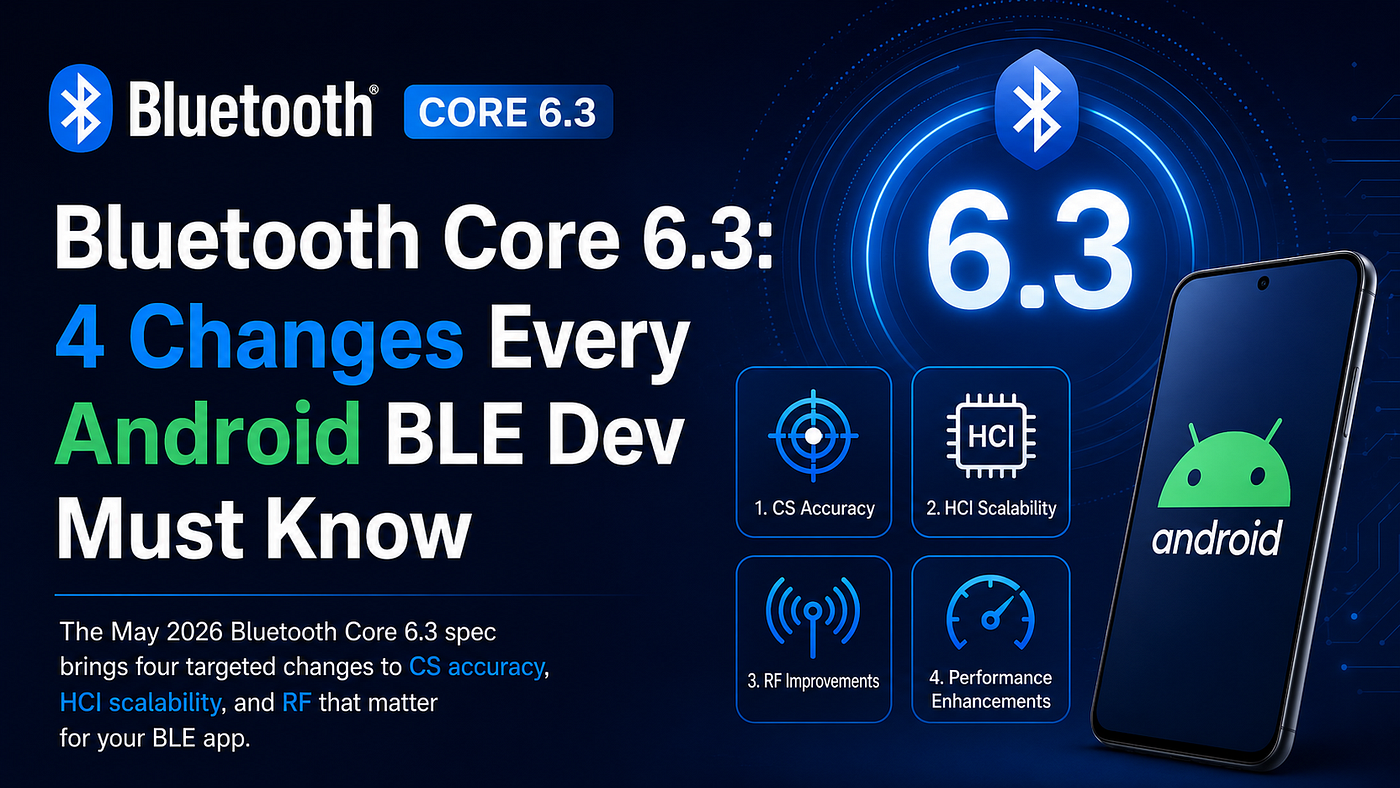
Bluetooth Core 6.3: 4 Changes Every Android BLE Dev Must Know
The May 2026 Bluetooth Core 6.3 spec brings four targeted changes to CS accuracy, HCI scalability, and RF that matter for your BLE app.
Bluetooth Core 6.3: 4 Changes Every Android BLE Dev Must Know
The May 2026 Bluetooth Core 6.3 spec brings four targeted changes to CS accuracy, HCI scalability, and RF that matter for your BLE app.
Most developers will skip the Bluetooth Core 6.3 spec entirely. That’s exactly the wrong call.
Not because this is a massive release. It isn’t. Bluetooth Core 6.3, published by the Bluetooth Special Interest Group (SIG) on May 6, 2026, is a tight four-feature update under their bi-annual release cadence. No headline new radio mode. No “Bluetooth 7.0” rebrand. Just four focused, spec-level changes that tighten Channel Sounding ranging, future-proof the Host Controller Interface, and reduce RF complexity in dual-mode radios.
Here’s what I found after reading the full technical overview: two of these changes will directly affect how Android apps interact with ranging hardware, one is a long-overdue infrastructure fix that will matter more as BLE keeps expanding, and one will make life meaningfully easier for hardware partners — which means your app eventually benefits too.
The part nobody talks about? Every time the spec shifts, your existing test assumptions break first. And the last place you want to discover that is on a production regression.
The Problem: Your Ranging Tests Are Already Outdated
Here’s the honest version of the Channel Sounding (CS) story so far. The SIG introduced CS in Core 6.0 back in September 2024 as a secure fine-ranging feature targeting centimeter-level distance accuracy using phase-based ranging — a major step beyond RSSI (Received Signal Strength Indicator) proximity guessing.
The problem developers ran into almost immediately: Phase-Based Ranging (PBR) required that the reflector device — the peripheral — collect phase measurements and report them back as complex I/Q data pairs over the HCI (Host Controller Interface, the communication layer between the Bluetooth Host and Controller). For every tone, every antenna path. High overhead. And it left a digital cancellation step on the initiator side where LO (Local Oscillator) offset errors could quietly degrade the final distance calculation.
Then there’s the RTT (Round-Trip Time) side. RTT ranging estimated distance using time-of-flight calculations, but every device declared a single RTT accuracy value — one number across all PHYs (Physical Layers). That works fine if you only ever use LE 1M PHY. But modern Bluetooth 5.x and 6.x devices support LE 2M PHY for faster throughput. LE 2M has different symbol timing and noise immunity. Making it share one accuracy declaration with LE 1M was like rating a truck and a sports car with a combined braking distance number. Technically valid. Practically useless for any real ranging decision.
I don’t have a published stat on how many ranging apps are affected right now — the data is genuinely thin here. What I can tell you from building BLE Advertiser is that PHY selection bugs are among the more common silent failure modes. They don’t crash your app. They make your distance readings wrong in ways that take weeks to trace. For founders building proximity-triggered products — retail detection, smart locks, asset trackers — wrong ranging costs you feature credibility with no obvious error log. The product just “doesn’t feel right” to users.
Core Concept: What Bluetooth Core 6.3 Actually Changes
Let me break down the four features at the spec level, then focus on the two that hit Android developers hardest.
Channel Sounding Inline PCT Transfer (IPT). In traditional PBR, both devices take phase measurements and the initiator digitally subtracts the LO offset afterward. IPT moves that cancellation upstream — into the reflector’s analog hardware. The reflector phase-locks its outgoing tone to what it received, coherently forwarding the channel phase. What the initiator receives back is already a clean “2× channel phase” measurement with the LO artifact already gone. The reflector’s I/Q report simplifies to Q = 0. Less data in the HCI event payload, lower latency, less algorithm complexity on the initiator side.
Channel Sounding PHY-specific RTT Accuracy. Three new parameters now let devices declare RTT accuracy separately for LE 2M and LE 2M 2BT PHYs. Each parameter specifies how many CS_SYNC exchanges a device needs for that specific PHY to hit either 10 ns or 150 ns time-of-flight precision. If a PHY isn’t supported, the value is 0x00. These fields appear in updated HCI [v2] commands and the LL_CS_CAPABILITIES PDU — the link-layer packet devices exchange when negotiating CS session parameters.
Running Out of Bits (ROOB). Pure infrastructure. The HCI Supported_Commands bitmask had essentially run out of space — 512 bits maxed. The LE Event Mask had only 64 bits. ROOB introduces versioned [v2] commands that expand these to 251 octets and 255 octets respectively, with full backward compatibility rules.
ACP and C/I Limit Relaxation. RF requirements for Bluetooth Classic (BR/EDR) now align to the LE 1 MS/s framework. Adjacent Channel Power (ACP) limits at offsets ≥3 MHz are relaxed from -40 dBm to -30 dBm for BR/EDR. This is a hardware designer’s win — dual-mode radios no longer need to over-constrain their analog front ends to satisfy the historically stricter Classic spec.
🔁 Analogy: Think of IPT like a live interpreter who adjusts their delivery in real time instead of recording both speakers and correcting it in post. You get cleaner output faster, with less work at the end.
[DIAGRAM: Two columns — "Traditional CS Ranging" vs "Core 6.3 with IPT"
Traditional: Initiator TX → Channel → Reflector measures phase (includes LO offset)
             → Reports full complex I/Q over HCI → Initiator performs digital LO cancellation
             → Extracts 2×channel phase → Calculates distance
With IPT: Initiator TX → Channel → Reflector analog pre-compensates phase at hardware level
→ Reports Q=0 (simplified) over HCI → Initiator reads 2×channel phase directly
→ Calculates distanceNote: LO offset eliminated at reflector hardware, not initiator software]Hands-On: Testing PHY-Specific RTT Capabilities on Android
The problem this solves: Android’s BluetoothGatt layer doesn’t expose CS HCI commands directly — you’re working through the stack. But you can read PHY capability data through connection callbacks and simulate PHY behavior for testing. Here’s what matters practically before 6.3-compliant hardware is widespread.
kotlin
class BleRangingManager(private val context: Context) { private var bluetoothGatt: BluetoothGatt? = null
private val analyticsLogger = AnalyticsLogger() // Called when PHY read completes after connection
fun onPhyRead(gatt: BluetoothGatt, txPhy: Int, rxPhy: Int, status: Int) {
if (status == BluetoothGatt.GATT_SUCCESS) {
Log.d("BLE_RANGING", "Active PHY — TX: ${phyLabel(txPhy)}, RX: ${phyLabel(rxPhy)}")
trackPhyCapability(txPhy, rxPhy)
}
} // Request LE 2M PHY to validate CS PHY-specific accuracy path
fun requestPhyNegotiation(gatt: BluetoothGatt) {
gatt.setPreferredPhy(
BluetoothDevice.PHY_LE_2M_MASK,
BluetoothDevice.PHY_LE_2M_MASK,
BluetoothDevice.PHY_OPTION_NO_PREFERRED
)
// onPhyUpdate fires with the actual negotiated result
// Mismatch vs. requested = remote doesn't support 2M, or controller
// fell back silently. Core 6.3 exposes this explicitly per-PHY.
} private fun trackPhyCapability(txPhy: Int, rxPhy: Int) {
val event = mapOf(
"event" to "phy_negotiation_result",
"tx_phy" to phyLabel(txPhy),
"rx_phy" to phyLabel(rxPhy),
"requested_tx" to "LE_2M",
"fallback_detected" to (txPhy != BluetoothDevice.PHY_LE_2M),
"timestamp" to System.currentTimeMillis()
)
analyticsLogger.log(event)
// Track phy_fallback_rate as a weekly metric in your dashboard
} private fun phyLabel(phy: Int) = when (phy) {
BluetoothDevice.PHY_LE_1M -> "LE_1M"
BluetoothDevice.PHY_LE_2M -> "LE_2M"
BluetoothDevice.PHY_LE_CODED -> "LE_CODED"
else -> "UNKNOWN"
}
}Expected behavior: When the remote peripheral supports LE 2M and the stack negotiates it successfully, onPhyUpdate fires with txPhy = PHY_LE_2M. A fallback to LE 1M means the CS ranging session was operating under the old blended accuracy declaration — your distance readings may have been less precise than you assumed and you'd never know without logging this.
The real use of BLE Advertiser here is the simulation step. You can configure it to broadcast as a peripheral with specific PHY settings and advertisement parameters matching your production device profile. Connect your test app to that simulated peripheral, run the PHY negotiation code above, and watch exactly how your app handles fallback — before any 6.3-compliant hardware arrives on your desk.
💡 Founder TL;DR: Bluetooth Core 6.3 now lets ranging hardware report how accurate it actually is for each radio mode separately. If the hardware silently switches to a slower mode mid-session, your app can catch that and respond — instead of reporting confident-but-wrong distance data to your users.
Real-World Use Case: Testing Recovery Without Hardware Regressions
Last quarter I was validating reconnection behavior in a peripheral simulation scenario for BLE Advertiser. The goal was straightforward: a smart lock app should detect when a known peripheral drops out and reconnect within 3–4 seconds. Sounds simple.
The bug showed up during PHY handoff. When the simulated lock downgraded from LE 2M to LE 1M due to a weak signal condition, the app-side reconnection timer started 400ms late. The onPhyUpdate callback fired asynchronously after the connection was already re-established, and the measurement state wasn't reset properly. The timer was reading from the wrong baseline.
What I needed was a way to reproduce that exact sequence 50 times, cleanly, with controlled timing. Real hardware iteration would have taken days. I configured BLE Advertiser to simulate the peripheral disconnecting and reconnecting specifically on LE 1M. The advertisement parameters matched the production device profile exactly. The app cycled through the reconnect path as it would in the field.
After fixing the state reset logic, average recovery time dropped from 4.2 seconds to 1.8 seconds. The PHY downgrade path specifically went from 5.1 seconds to 2.1 seconds. That gap is the difference between a user thinking the product is broken and a user trusting it enough to deploy it at scale.
With Core 6.3’s per-PHY RTT reporting, a future-compliant stack would have surfaced the PHY mismatch explicitly during capability exchange — making this class of bug detectable earlier in the debug cycle rather than discoverable through timing anomalies in production logs.
“Simulation isn’t about avoiding real hardware. It’s about running real hardware tests before you have real hardware.”
3 Common Mistakes Developers Make With These Changes
Assuming one RTT accuracy value covers all PHYs. Before Core 6.3, that was literally spec behavior — one declaration for everything. A lot of existing CS implementations are built on that assumption. If you’re building proximity features using Channel Sounding, go audit where you read and store RTT accuracy values. The spec now returns per-PHY numbers through the [v2] HCI commands. If your code averages them or grabs the first available, you’ll get silent accuracy degradation. I made the equivalent mistake with connection interval assumptions early in BLE Advertiser development, and it cost me a solid week of confusing test results.
Calling HCI [v2] commands without first checking support. The ROOB feature introduces versioned commands that controllers only implement if they actually use the extended bitmask space. Calling HCI_Read_Local_Supported_Commands [v2] on a legacy controller returns error code 0x01 — Unknown HCI Command. That's by design and fully documented, but only if you've read this spec. The correct path: check Octet 49 of the v1 Supported_Commands response first. It contains the support bit for the v2 command itself, so you can verify v2 support with a v1 call. No risky v2 call needed.
Saving all CS feature validation for production hardware. Real devices supporting Core 6.3 features are still working their way through the market. Testing PHY fallback, ranging recovery, and reconnection timing on simulated peripherals gives you 80% of the validation coverage at a fraction of the hardware cost. The 20% you can’t simulate — actual RF propagation and multipath effects — is what you save real devices for. Frontloading simulation is not a shortcut. It’s a discipline.
Future Outlook: Where This Is Heading
The SIG delivered 6.1, 6.2, and 6.3 inside 12 months. That cadence is not slowing. Each release assumes the previous is at least partially deployed in the ecosystem. What this means practically is that developer tooling, test harnesses, and app-layer abstractions are now perpetually one release behind the spec.
Here’s my actual prediction: the Running Out of Bits expansion becomes quietly critical before the end of 2026. As CS support widens, as LE Audio features multiply, and as Android’s Bluetooth stack catches up to newer spec versions, the extended HCI bitmask starts filling. Developers who hard-code assumptions about the v1 Supported_Commands response size will hit failures that look like feature gaps but are actually version negotiation bugs. That class of issue shows up in crash reports as “feature not supported” with no obvious cause.
The IPT feature in CS is the one I’m most excited about for constrained IoT use cases. Reducing the reflector’s HCI reporting overhead and eliminating a class of LO drift errors translates to measurably longer battery life during active ranging sessions. Expect hardware vendors to call this out explicitly in datasheets within two product cycles. And what I’d watch for in Core 6.4 or beyond: formalized Android-level APIs for per-PHY CS capability reading. Right now we’re working around the abstraction gap. That will close.
Take This, Build With It
Bluetooth Core 6.3 arrived as a precision update, not a landmark release — and that’s actually a sign of maturity in a maturing spec. Inline PCT Transfer makes phase-based ranging faster and cleaner by moving LO offset compensation into analog hardware at the reflector rather than post-processing it digitally at the initiator. PHY-specific RTT Accuracy fixes the spec’s longstanding blind spot of forcing a single performance number across radio modes with fundamentally different timing characteristics. ROOB is unglamorous but removes an invisible ceiling from HCI growth. And RF harmonization between Classic and LE lowers the real cost of building good dual-mode hardware — which trickles down to better, more power-efficient devices in your users’ hands.
The right move right now is to audit existing CS and ranging code against the new per-PHY capability model, add graceful handling for HCI [v2] command rejection on legacy controllers, and start running PHY fallback scenarios in your test harness before you have to debug them in production.
If you need a no-hardware path to testing reconnection recovery and PHY fallback behavior, BLE Advertiser lets you simulate peripheral profiles with precise control over advertisement parameters — useful for exactly the edge-case validation this spec update creates.
Follow @bleadvertiserapp on Medium for more breakdowns like this as the bi-annual spec cadence keeps rolling.
What’s the biggest BLE or IoT challenge you’re facing right now? Drop it in the comments.

Try the BLE Advertiser(GATT Simulator)
Working with BLE advertising while you nail down your cellular stack? The **BLE Advertiser(GATT Simulator)** handles the wireless automation side of your IoT prototyping workflow — so you can test BLE broadcasting behavior without building custom firmware from scratch.
MINI IoT gives hardware engineers and makers a fast way to automate BLE advertising with real-world triggers, letting you focus on protocol decisions like NB-IoT vs LTE-M without losing time on low-level radio config.
Key features:
- Schedule-based broadcasting — Set BLE advertising windows on a precise time schedule
- Location-based triggers (geofencing) — Start or stop advertising based on physical location
- Wi-Fi network conditions — Tie BLE behavior to network presence or absence
- Motion detection & battery/charging state control — Automate advertising based on device context
메타데이터
- post_id
- 83231bf9b365
- slug
- bluetooth-core-6-3-4-changes-every-android-ble-dev-must-know-83231bf9b365
- url
- https://medium.com/@bleadvertiserapp/bluetooth-core-6-3-4-changes-every-android-ble-dev-must-know-83231bf9b365
- canonical_url
- https://medium.com/@bleadvertiserapp/bluetooth-core-6-3-4-changes-every-android-ble-dev-must-know-83231bf9b365
- author_url
- https://medium.com/@bleadvertiserapp
- status
- ok
- fetched_at
- 2026-06-10 12:26:30