COMPLEXITY AND STRATEGY: What Good Strategy Looks Like #9
Complexity and Strategy | Post 9 of 15
From Noise to Clarity | Track 6
COMPLEXITY AND STRATEGY: What Good Strategy Looks Like #9
Complexity and Strategy | Post 9 of 15
Before you read: If someone asked the ten most senior people in your organisation to explain the strategy in their own words, how similar would the answers be? Not the words, but the underlying logic, the challenge being addressed, the choices being made, the outcome being pursued. The distance between those answers is often the distance between strategy and the appearance of strategy.
What good strategy looks like
Spend enough time working inside organisations and a pattern becomes difficult to ignore.
People talk about strategy constantly. Strategic planning cycles. Strategic priorities. Strategic initiatives. Strategic transformation programmes. The language of strategy is everywhere. And yet when you ask a simple question, not a complicated one, not a trick, just a direct and genuine request for clarity, what is the strategy, the answers often become surprisingly vague.
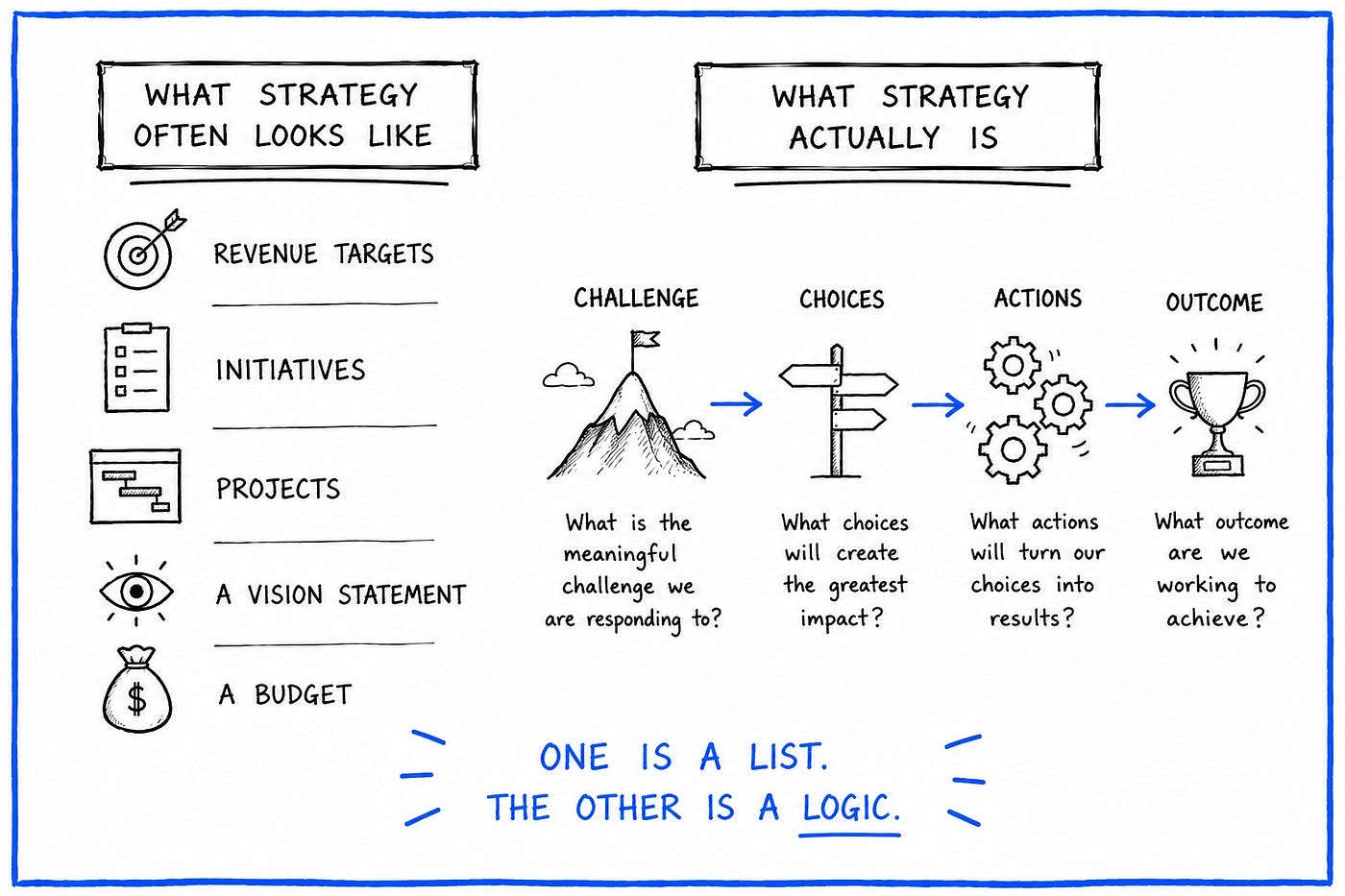
A list of revenue targets. A collection of projects that are currently underway. A vision statement from the last offsite. A set of aspirations about where the organisation wants to be in three years. A budget allocation that reflects this year’s priorities.
These things may support strategy. They are not strategy. And the difference between them is not a matter of presentation or sophistication. It is a matter of whether a coherent logic exists that connects a specific challenge to a specific set of choices to a specific intended outcome.
Without that logic, what organisations call strategy is usually a wish list. A collection of things that would be good to achieve, organised by function or by financial year, without a clear argument for why this particular combination of activities is more likely to produce the desired outcome than any other combination of activities would be.
Good strategy is not more elaborate than that. But it is more disciplined. And in complex environments where resources are genuinely limited and choices have genuine consequences, the difference between a strategy and a wish list is the difference between an organisation that makes deliberate progress and one that stays very busy without quite understanding why the results keep disappointing.
Visual Prompt 1 Title: Strategy vs a list of goals Hand-drawn sketchnote, black ink throughout, blue accents on key elements only, white background, rough sketch aesthetic. Two documents side by side. Left document labelled “strategic plan”: a list of six equally weighted items with no visible connections between them. Right document labelled “strategy”: a simple diagram showing a challenge at the top, three connected choices in the middle, and an outcome at the bottom, with arrows showing how each element produces the next. Blue note beside the right document: “the logic makes it a strategy. without the logic it is just a list.” Rough sketch aesthetic.

Strategy begins with a challenge, not a goal
Most strategic planning processes begin in the wrong place.
They begin with goals. Revenue targets. Market share ambitions. Growth rates. Customer satisfaction scores. These are destinations. Useful destinations, and worth specifying clearly. But a destination is not a strategy. Knowing where you want to go does not tell you why the current route is the right one, what you are responding to, or what makes this particular set of choices more likely to get you there than alternatives you considered and set aside.
Good strategy begins with a challenge.
A specific, honest description of the situation the organisation is actually in. A market that is changing in ways that make the current approach less effective than it was. A competitor who has altered the terms on which customers make their choices. A shift in customer expectations that the current product or service does not fully address. A capability gap that is limiting what the organisation can deliver. A structural change in the environment that creates either a meaningful threat or a meaningful opportunity, or both.
The challenge matters because it is what the strategy is a response to. A strategy that cannot be traced back to a specific challenge is a strategy that cannot explain why these choices rather than those choices. And a strategy that cannot explain its own logic is a strategy that will be interpreted differently by every person who reads it, which returns us to the alignment problem that the previous posts in this track have been examining.
I have sat in leadership conversations where the strategic plan was comprehensive, well-presented, and entirely disconnected from any honest account of what the organisation was actually facing. The goals were real. The initiatives were reasonable. But the strategy could not answer the question that matters most: why this, now, rather than something else. Without a challenge as the starting point, there is no way to answer that question. And without an answer to that question, the strategy is not a guide to decisions. It is a record of intentions.
The logic chain that most strategies are missing
Of all the things that separate good strategy from its imitations, the most consequential is the presence or absence of a visible cause and effect argument.
Strong strategy contains a logic chain. If we respond to this challenge in this way, then this becomes possible. If this becomes possible, it creates this outcome. If this outcome is achieved, it moves the organisation closer to this longer term position. Each link in the chain is explicit. Each assumption is visible. Each connection can be examined, questioned, and if necessary, revised as conditions change.
Most strategies skip this step entirely.
They describe goals without explaining the mechanism through which those goals will be achieved. They describe initiatives without explaining how those initiatives relate to each other or to the outcome. They describe priorities without explaining what the priorities are prioritised over or why the trade offs were made in that direction rather than another.
The result is a collection of intentions rather than a strategic argument. And intentions, however carefully articulated, cannot guide decisions at the boundary cases, the moments when priorities conflict, when resources run short, when the plan meets a reality it did not anticipate. At those moments, people default to their own interpretation of what the organisation is trying to do. Which is, as Post 77 established, almost never identical across a leadership team.
The cause and effect logic chain is not an optional addition to a strategy. It is what makes a strategy a strategy rather than a plan. It is the difference between a document that tells people what the organisation intends and a document that tells people why those intentions make sense, which is the only version that can actually guide the decisions that matter.
Visual Prompt 2 Title: The missing logic chain Hand-drawn sketchnote, black ink throughout, blue accents on key elements only, white background, rough sketch aesthetic. Two versions of the same strategy. Top version: a list of three goals with no connections shown. A gap visible between the goals and a desired outcome. Label: “intentions without logic.” Bottom version: the same three goals now connected by arrows, each arrow labelled with a brief mechanism. The outcome is connected to the chain. Label: “a strategic argument.” Blue note beside the bottom version: “the arrows are doing more work than the boxes.” Rough sketch aesthetic.

The test most strategies fail
There is a practical test for whether a strategy is genuinely strategic rather than merely comprehensive.
After reading it, can people tell what the organisation will not do?
If the answer is no, the strategy has not made a choice. It has made a list. And a list, however long or well-organised, is not a guide to decisions because it does not tell you what to stop, what to deprioritise, or what to decline when the next opportunity or demand arrives.
Every meaningful strategy excludes something. It allocates attention and resources in specific directions, which means it does not allocate them in other directions. This is not a limitation of strategy. It is what strategy is. The Latin root of the word refers to the generalship of armies, the art of deploying limited resources in ways that produce disproportionate results. You cannot deploy resources in all directions simultaneously and call that strategy. You can only call it activity.
The absence of trade offs in a strategic plan is almost always a warning sign. It suggests that the planning process optimised for inclusion rather than choice. That each function submitted its priorities and those priorities were incorporated rather than evaluated against each other. That the difficult conversations about what matters more than what were deferred rather than resolved.
Those conversations are uncomfortable. They require someone to say that this matters more than that, which means telling the person responsible for that that their priority, however legitimate, is not the organisation’s priority right now. That is a difficult thing to say and a difficult thing to hear. But without it, the strategy does not focus the organisation. It describes it.
Focus is not a nice property for a strategy to have. In complex environments where attention and resources are genuinely limited, focus is what determines whether the organisation makes progress or distributes its effort so widely that none of it is sufficient to produce the change it was intended to produce.
Shared understanding, not just alignment
There is a final quality of good strategy that is worth examining because it is the one most likely to determine whether the strategy actually influences what happens in the organisation.
Good strategy creates shared understanding, not just agreement.
Agreement is relatively easy to achieve. People nod at the presentation. They sign off on the document. They express support in the meeting. Agreement is the social outcome of a strategic conversation. It does not tell you whether the people who agreed are working from the same picture of what the strategy means.
Shared understanding is harder and more valuable. It means that the people responsible for executing the strategy have a sufficiently similar mental model of the challenge, the choices, the logic, and the intended outcome that their decisions will be consistent with each other at the moments when the strategy cannot be consulted directly.
The test I described in the previous section, asking people individually to draw or describe the strategy, is specifically designed to reveal the gap between agreement and shared understanding. Ten people who agreed on the strategy in the same room will often produce ten meaningfully different descriptions of it when asked to articulate it independently. Not because they were being careless. Because the conversation produced agreement on language without producing alignment on meaning.
This is where making the strategy visible, as a picture rather than as a document, does work that verbal communication and written plans cannot. When the challenge, the choices, the logic, and the intended outcome are drawn in a form that the whole leadership team can look at together, the differences in mental model become examinable rather than hidden. The question shifts from do we agree to are we seeing the same thing. And that question, asked honestly, almost always surfaces the conversations that the planning process assumed had already been had.
Visual Prompt 3 Title: The four questions Hand-drawn sketchnote, black ink throughout, blue accents on key elements only, white background, rough sketch aesthetic. A simple whiteboard with four questions written in clear ink: “What challenge are we responding to?” “What matters most right now?” “What are we deliberately not doing?” “How does our approach create the outcome we want?” Beside each question, a small gap or blank space, indicating where the answers should be. Blue note at the bottom: “if ten people answer these differently, the strategy is not yet shared.” Rough sketch aesthetic.

If this resonates with you
The ideas in this series sit at the heart of the work Sherrie Low and I explore in The S.T.A.R. System: Applying Visual Thinking for Career and Business Success, published by Marshall Cavendish Business. The book is a practical guide to using visual thinking as a structured discipline for clearer communication, stronger decisions, and more confident professional navigation. If you want to go deeper than a series of posts allows, you can find it on Amazon.
Closing reflection
Strategy is one of the most used and least understood words in organisational life.
It is used to describe plans, goals, initiatives, transformation programmes, and vision statements. All of these things matter. None of them is strategy on its own. Strategy is the coherent logic that connects a specific challenge to a specific set of choices to a specific intended outcome, in a form that is clear enough to guide decisions and shared enough to produce consistent behaviour across the people responsible for execution.
That is a more demanding standard than most strategic planning processes are designed to meet. It requires honest diagnosis of the challenge rather than optimistic description of the goal. It requires explicit trade offs rather than inclusive lists. It requires a visible cause and effect argument rather than a collection of intentions. And it requires the kind of shared understanding that can only be tested by asking people to articulate the strategy independently rather than assuming that agreement in a meeting room means alignment in practice.
None of this is complicated in principle. In practice, it requires the discipline to have the uncomfortable conversations that most planning processes are designed to avoid.
Can you articulate the strategy you are currently working inside as a single coherent logic, the challenge, the choices, the mechanism, and the outcome? If not, what is the conversation that has not yet been had?
The next post examines why so many strategies remain permanently abstract and never translate into the clarity that execution requires. Coming up: “Why most strategies stay abstract.”
I am Ai Yat Goh, a visual thinking strategist and co-author of The S.T.A.R. System. I write about thinking clearly in a world full of noise. Follow me here on Medium for the rest of this series, or connect with me on LinkedIn www.linked.com/in/aiyatgoh
FromNoiseToClarity #VisualThinking #Leadership #Strategy #Clarity
메타데이터
- post_id
- 87af8d12e392
- slug
- complexity-and-strategy-what-good-strategy-looks-like-9-87af8d12e392
- url
- https://medium.com/@aiyat.goh/complexity-and-strategy-what-good-strategy-looks-like-9-87af8d12e392
- canonical_url
- https://medium.com/@aiyat.goh/complexity-and-strategy-what-good-strategy-looks-like-9-87af8d12e392
- author_url
- https://medium.com/@aiyat.goh
- status
- ok
- fetched_at
- 2026-07-21 02:32:38