THE ARCHITECTURE OF EXCELLENCE: CSS Essay Writing
THE ARCHITECTURE OF EXCELLENCE: CSS Essay Writing
THE ARCHITECTURE OF EXCELLENCE: CSS Essay Writing
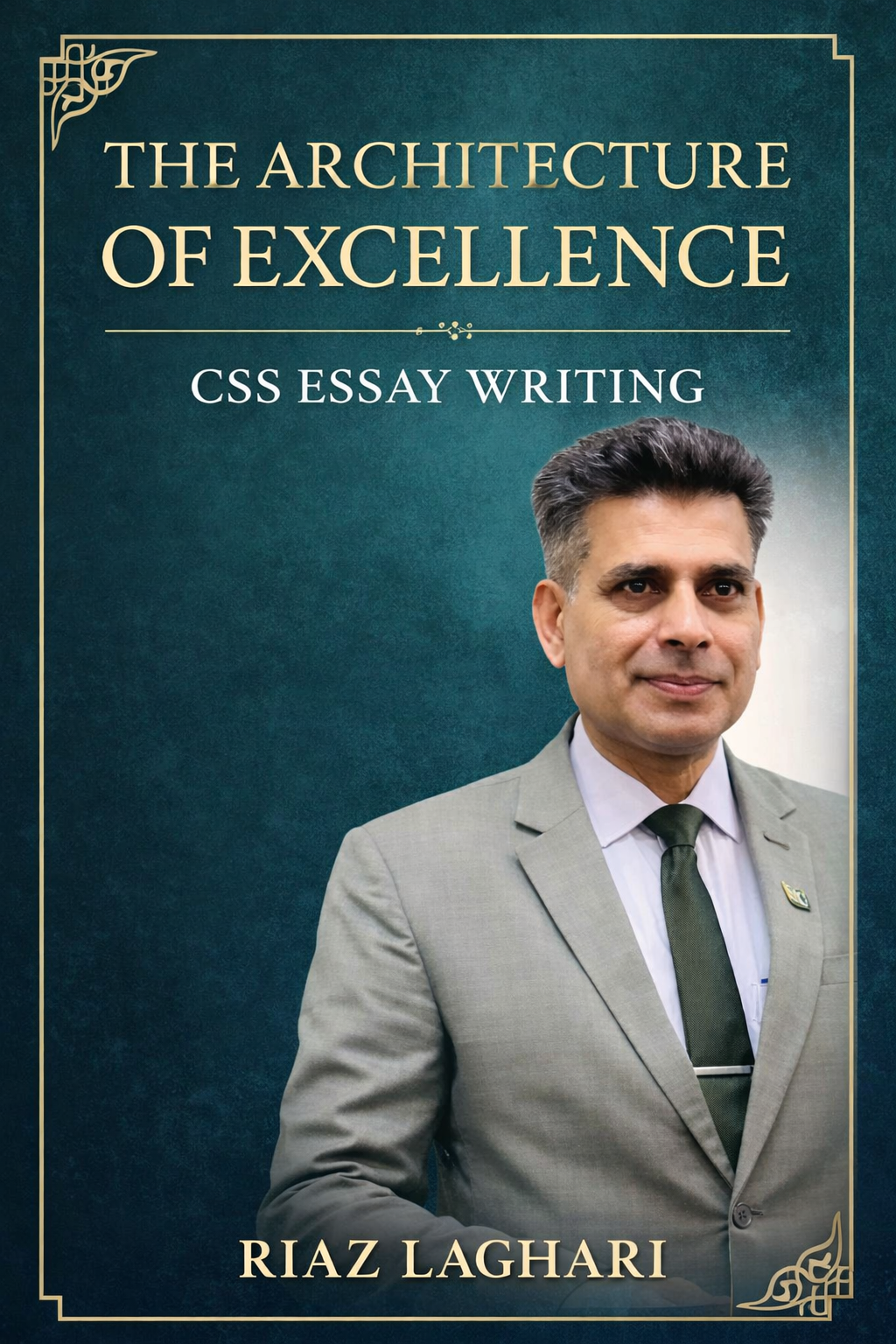
THE ARCHITECTURE OF EXCELLENCE: CSS Essay Writing
Riaz Laghari
Beyond the Examination
The **CSS essay** is often misunderstood as a test of knowledge. It is not.
It is an examination of judgment.
Each year, thousands of candidates enter the examination hall armed with facts, quotations, and rehearsed arguments. Yet only a fraction succeed. This disparity cannot be explained by differences in knowledge alone. Rather, it reflects a deeper distinction between those who possess information and those who possess intellectual architecture.
The CSS essay demands the ability to organize complexity, reconcile contradictions, and articulate a coherent vision under constraint. It is not a memory test; it is a cognitive performance.
Failure, therefore, is rarely due to ignorance. It is due to the absence of structure, the inability to transform information into argument, and the lack of epistemic control over one’s own writing.
This Medium post is written to address that gap. It does not aim to help candidates merely attempt the essay. It aims to enable them to command it.
I — FOUNDATIONS: REDEFINING THE ESSAY
1: What the CSS Essay Really Tests
At its core, the CSS essay evaluates three interrelated capacities.
1. Cognitive Organization
This refers to the ability to structure ideas in a logical and hierarchical manner. A well-organized essay reflects a mind that can:
- Distinguish primary arguments from secondary ones
- Sequence ideas coherently
- Maintain thematic continuity
Disorganized writing signals disorganized thinking.
2. Analytical Depth
Beyond description lies analysis. Candidates must move from stating what exists to explaining:
- Why it exists
- How it functions
- What its implications are
This requires engagement with causality, consequence, and interdependence.
3. Intellectual Authority
Authority is not achieved through loud assertions but through measured articulation. It manifests as:
- Balance in judgment
- Precision in language
- Control over argument
An authoritative essay does not persuade through force; it persuades through clarity and inevitability.
The Central Misconception
A widespread but flawed belief persists among aspirants:
- More facts produce a better essay
- More quotations yield higher marks
This assumption reduces writing to accumulation. The examiner, however, is not measuring memory. The examiner is assessing mental discipline.
2: The Failure Pattern
An examination of failed essays reveals a consistent pattern:
- Absence of structure
- Use of irrelevant or generic evidence
- Repetition of ideas without progression
- Lack of synthesis
- Emotion-driven or opinionated tone
These are not deficiencies of knowledge. They are failures of thinking and execution. The solution, therefore, does not lie in reading more but in thinking better.
II — THE ARCHITECTURE OF EVIDENCE
3: What Counts as Evidence
Evidence, in the context of the CSS essay, extends beyond numerical data. It includes:
- Empirical data and statistics
- Observed trends and patterns
- Expert interpretations and scholarly arguments
- Case studies and real-world examples
- Comparative insights across contexts
A mature essay integrates multiple forms of evidence, thereby achieving both breadth and depth.
4: Extracting Evidence — The Core Skill
The ability to extract usable evidence from complex texts is fundamental.
Argument Deconstruction
Every paragraph in an academic text contains:
- A claim (what is being asserted)
- A support structure (why it is valid)
The support structure constitutes evidence.
The reader’s task is to isolate this support and reformulate it independently.
The Transformation Principle
Academic texts often present ideas in dense and indirect forms. These must be transformed into clear, concise, and exam-ready statements.
Example:
Raw statement: “Artificial intelligence is expanding globally across multiple sectors.”
Refined evidence: “Contemporary global analyses indicate the rapid integration of artificial intelligence across governance and economic systems.”
Transformation involves clarity, precision, and contextual relevance.
5: Multiplying Evidence
A single high-quality source can yield multiple forms of evidence:
- Statistical (quantitative data)
- Analytical (interpretation of causes)
- Comparative (cross-regional insights)
- Illustrative (examples and case studies)
Thus, one source can generate numerous distinct evidential points. Efficiency in preparation depends on this multiplicative capacity.
6: The Evidence Bank
Effective candidates maintain a structured repository of evidence.
Methodology
- Record one-liner pieces of evidence
- Categorize by theme (e.g., governance, economy, technology)
- Use refined, reusable phrasing
This system reduces cognitive load during writing and enhances recall under time constraints.
III — THE EPISTEMOLOGY OF ESSAY WRITING
7: From Evidence to Justification
Evidence provides support; justification provides necessity.
The essential question shifts from:
“What is true?” to “Why must this be accepted as true?”
This requires logical integration of evidence within argumentation.
Provisional Precision
Advanced writing avoids absolute claims. Instead, it employs calibrated language:
- “Contingent upon institutional capacity”
- “Primarily attributed to structural factors”
- “Underscored by systemic limitations”
Such phrasing reflects intellectual sophistication and guards against oversimplification.
8: The Triad of Persuasion
Effective essays balance three dimensions:
Logos (Reason)
Logical structure and evidence-based reasoning.
Ethos (Credibility)
Balanced tone and intellectual neutrality.
Pathos (Public Interest)
Connection between policy and societal impact.
The Bureaucratic Lens
In the CSS context, pathos must align with public interest:
- Institutional trust
- Social equity
- Human development
The essay must demonstrate awareness of how abstract ideas affect lived realities.
9: The Dialectical Method
Advanced essays adopt a dialectical structure:
Thesis
The central argument
Antithesis
A credible opposing perspective
Synthesis
A higher-order resolution
Clarification
Synthesis is not compromise. It is integration through institutional or conceptual design.
IV — ADVANCED THINKING FRAMEWORKS
10: Conceptual Mapping
Preparation must move beyond accumulation toward structural understanding.
Thematic Conflicts
- Growth vs Sustainability
- Efficiency vs Equity
- Authority vs Accountability
Each issue is understood through its internal tensions.
Relational Thinking
Use analytical verbs to express relationships:
- Exacerbates
- Mitigates
- Reinforces
- Undermines
This transforms writing from description to analysis.
11: The Golden Thread
Every essay must be unified by a central conceptual tension.
Example:
Climate Change → “Short-term economic gain vs long-term survival”
Function
- Ensures coherence
- Guides argument development
- Provides philosophical depth
V — LANGUAGE AND EXPRESSION
12: The Grammar of Authority
Language must reflect analytical precision.
Avoid weak verbs:
- Shows
- Says
- Tells
Adopt stronger alternatives:
- Demonstrates
- Postulates
- Exacerbates
- Ameliorates
13: Sentence Engineering
An effective sentence exhibits:
- Structural clarity
- Lexical precision
- Logical progression
Strong sentences form the backbone of strong paragraphs.
VI — EXAM HALL STRATEGY
14: The 3-Hour Execution Model
Given the 3-hour duration and ~3000-word expectation:
Phase 1: Planning (40 minutes)
- Topic analysis
- Outline development
Phase 2: Writing (2 hours)
- Structured execution
Phase 3: Revision (20 minutes)
- Refinement and correction
15: Introduction
An effective introduction:
- Defines the issue
- Establishes context
- Presents a clear thesis
16: Body Paragraphs
Each paragraph must include:
- Topic sentence
- Evidence
- Analysis
- Link to central argument
17: Conclusion
A strong conclusion:
- Synthesizes arguments
- Offers direction
- Projects a vision
VII — MODEL EXECUTION
18: High-Level Argument
Example:
“Contemporary governance increasingly integrates artificial intelligence to enhance efficiency; however, its effectiveness remains contingent upon regulatory capacity, as unstructured adoption risks exacerbating institutional inequalities.”
19: Common Mistakes
- Overreliance on quotations
- Repetition of sources
- Weak structure
- Emotional argumentation
VIII — MASTERY
20: From Knowledge to Vision
At the highest level, essays function as:
- Analytical frameworks
- Interpretive models
- Policy-oriented arguments
21: The Mind of a CSP
A successful candidate demonstrates:
- Balance
- Clarity
- Judgment
- Vision
Finale: The Governing Mind
The CSS essay is not merely written; it is constructed.
It reflects:
- The ability to understand complexity
- The capacity to resolve conflict
- The vision to imagine direction
Truth
The examiner is not reading your essay. The examiner is reading your mind.
Reflection
Those who memorize will attempt. Those who understand will write. Those who synthesize will lead.
Best wishes.
메타데이터
- post_id
- 8b587bd348ad
- slug
- the-architecture-of-excellence-css-essay-writing-8b587bd348ad
- url
- https://medium.com/@riazleghari/the-architecture-of-excellence-css-essay-writing-8b587bd348ad
- canonical_url
- https://medium.com/@riazleghari/the-architecture-of-excellence-css-essay-writing-8b587bd348ad
- author_url
- https://medium.com/@riazleghari
- status
- ok
- fetched_at
- 2026-06-26 21:52:29