A 16th Century Book in the Shape of a Bottle
…from the Armenian monastic library on the Island of San Lazzaro (Venice, Italy)
A 16th Century Book in the Shape of a Bottle (Venice, Italy)
…from the Armenian monastic library on the Island of San Lazzaro
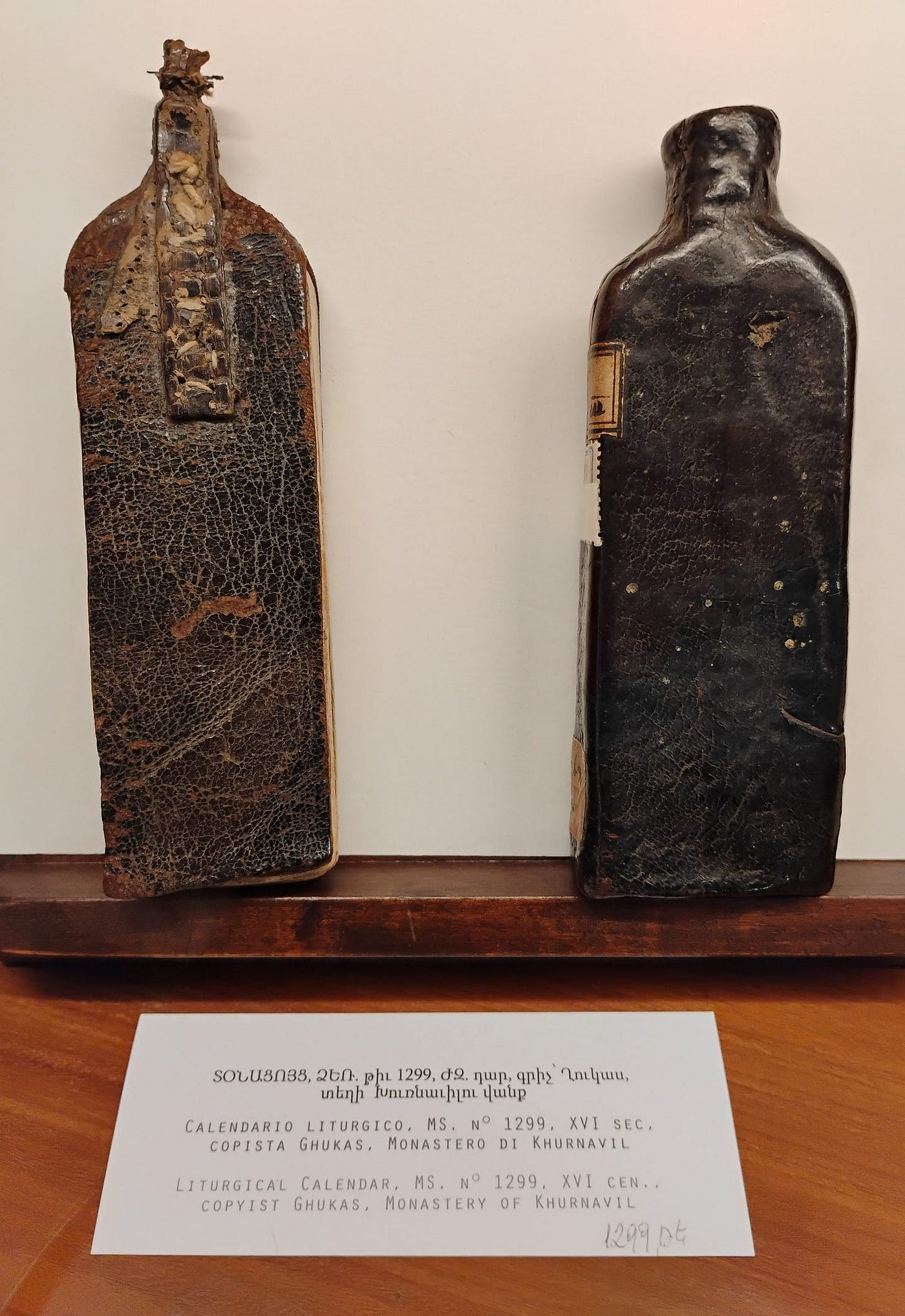
The book on the left is a 16th century Armenian manuscript bound into the shape of a bottle. It is designed to fit into the leather bottle-shaped case on the right. Initially, this might just look like a fun and unique way to bind and protect a book. It is easy to imagine a contemporary book artist adopting the idea. Commercial publishers already have. Here is an image showing a book titled Wines of the World printed and bound in a book that is shaped like a wine bottle.

While the vast majority of the manuscript and printed books produced in the western world during the Middle Ages and the Renaissance were in the shape of a rectangle (just as they still are today), there were rare exceptions. Here is a page from a heart shaped songbook produced in 1475:

To dismiss the bottle shaped book above as an oddity or an entertainment would, however, be a mistake. Books, like people, have their histories and the one above is neither a cute marketing idea nor a romantic gesture for the enjoyment of a chivalric minded nobility. The book above is an Armenian liturgical calendar, or calendar of the church year, a guide that structures and organizes time according to distinct seasons and guides the worship, scriptural readings, and daily life of a people.
In 301 C.E., Armenia was the first country in the world to adopt Christianity as its official religion. According to the website of the Armenian Apostolic Church, the Bible was the first book to be translated and the liturgical calendar was among the second group of documents to be translated into Armenian from Greek (around 439 C.E., shortly after the invention of the Armenian alphabet). The liturgical calendar, then, is quite important. This excerpt from an essay on the Hill Museum & Manuscript Library website helps to explain:
In the Armenian Christian tradition, one way that physical and spiritual worlds are brought together is in the arrangement of the [ ] calendar. The Armenian liturgical calendar positions the daily/hourly, weekly, and yearly cycles in a way that is not independent of natural/physical cycles.
By observing the harmony of the cyclic flow of nature and combining it with the liturgical calendar, the life of prayer and the spiritual world of human beings was synchronized with the natural world. Over many centuries, there emerged a structure for human life to experience a rich inner and external harmony.
So why bind something as important as a church calendar into the shape of a bottle? The book’s label says that it was produced at the monastery of Khurnavil in what was once Western Armenia and is now Eastern Turkey. During the 16th century, when the book was produced, Armenia was the site of significant geopolitical conflict between two major Islamic powers: the Ottoman Empire and Safavid Persia (Iran). It was a period of upheaval, destruction, and persecution for Armenian Christians.
One can imagine that hiding a liturgical calendar might have been not only a good idea, but also necessary. Once inserted into the case, the book would have easily passed as one bottle among many in a crate, or one bottle among many on a shelf, or even as a bottle in a pocket during a pat down.
Perhaps a second question would be Why is this bottle-shaped book in an Armenian monastic library on a small island in the Venetian lagoon?
Bizarrely, because it does not seem to be all that well-known, the Island of San Lazzaro degli Armeni is only a short vaporetto ride from St. Mark’s Square. The entire island is home to the Armenian Catholic monastery of the Mekhitarists. In 1717, the Venetian Republic ceded the island to a group of Armenian Catholic monks fleeing the Peloponnese region of Greece following its invasion by the Ottoman Empire.
In Venice itself there was, and had been for some time, a small but very important community of Armenian merchants as well as a long-standing history of trade and business relationships between the Venetian Republic and Armenia. (In fact, the only historical church in Italy that still holds services in accordance with the Armenian Rite is the 15th century Venetian church of Santa Croce, or Church of the Holy Cross of the Armenians.)
Not terribly long after disestablishing the Venetian Republic in 1797, Napoleon abolished all monastic orders in the Venetian Republic and in the Kingdom of Italy. This was in 1810. He did not, however, close the monastery on the Island of San Lazzaro. The story goes that Napoleon’s bodyguard was of Armenian origin and through his intercession Napoleon allowed the monastery to continue unmolested. He did rename it an Academy. Napoleon’s decree to that effect hangs today in the anteroom to the library on the island.
The monks were actively involved in scholarship, translation, education, and printing and had set up a printing shop at the monastery. The first book printed in Armenian was produced in 1512 in Venice, which itself was an important center for printing.
Today the monastery houses the third largest collection of Armenian manuscripts in the world and is an important center for Armenian studies. Sources vary, but the library contains over 150,000 printed volumes as well as over 4,500 manuscripts. Many of the most valuable manuscripts are kept in a lovely mid-20th century library built in the shape of a rotunda and offering a temperature and humidity controlled environment. (Temperature and humidity controlled environments are still not always the norm in Italy; the State Archives of Venice, for example, still relies on thick walls, natural air flow, and pre-climate change seasonal shifts in temperature and humidity to maintain their collections.)
The monastery is still very much a monastery and a small group of monks still lives there. It is possible to visit the island by reservation but the majority of the island is private so you must sign up for a guided tour. The book shaped like a bottle is only one of their very many treasures.
I thought the book in the shape of a bottle was not only ingenious in and of itself but, for me, it was also emblematic of the history of Armenian culture and the many ways in which the Armenian people searched for ways to preserve what meant most to them.
The book in the shape of a bottle perhaps begs a third question. What do I (we, you) care deeply enough about to camouflage as something else in order to safeguard and preserve it?
메타데이터
- post_id
- 8d553508fd25
- slug
- a-16th-century-book-in-the-shape-of-a-bottle-8d553508fd25
- url
- https://medium.com/being-in-italy-librorum/a-16th-century-book-in-the-shape-of-a-bottle-8d553508fd25
- canonical_url
- https://medium.com/being-in-italy-librorum/a-16th-century-book-in-the-shape-of-a-bottle-8d553508fd25
- author_url
- https://medium.com/@beinginitaly
- status
- ok
- fetched_at
- 2026-07-15 09:39:26