Twilight on Shell-Scarred Walls
A Cloud-Filtered Calm from the Pacific to the Adriatic
Twilight on Shell-Scarred Walls
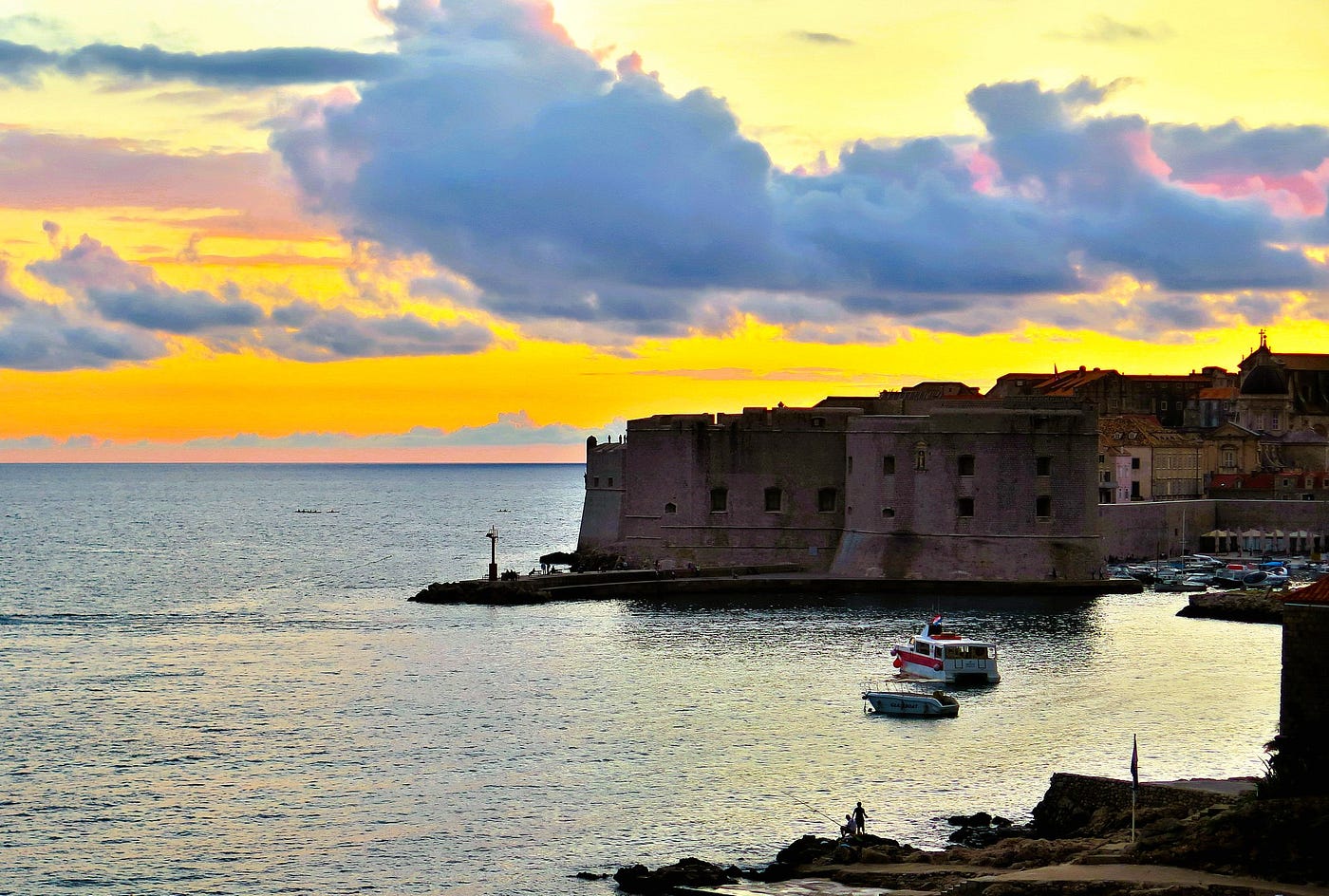
Dubrovnik Sunset, by Karmela Kortixija —Wikimedia Commons
I live on the ocean, figuratively speaking. Not like Kevin Costner in Waterworld, but close enough that I can walk to the shore for a stroll, feel the sea mist in the morning and hear the sea lions barking in the night. From the days of my youth searching for swells in SoCal, and romancing my wife along the bluffs of Isla Vista, to exploring the islets and inlets of Puget Sound; blue water has always been near.
I’ve cruised every coastal highway from TJ to BC, breathing the open air on a motorcycle. The west coast of the US feels like the palm of my hand. Countless rose-colored sunsets tint Pacific horizons with hope. The most vivid come through cloud filtered light that can foreshadow a tempest in the night.
Ferdinand Magellan surely understood when he emerged from his perilous voyage across the Atlantic and the straits in Tierra del Fuego that now bear his name. He found placid waters that he declared “Mare Pacificum”, knowing full well how the calm came after the storm, not before.
Brief experiences of other environments inform me there are differences in attitude that result. I reminisce about the pine aroma and crisp thin air of the mountain cabin I inhabited and have tasted country landscapes and the smell of the farm. Yet I have no desire to hunt, or fish, or grow my own food. Others will consider this a deficit.
Residents of another place or time may not embrace the same optimism. They harbor different perspectives I cannot perceive. My privileged good fortune does nothing to relieve the acute awareness that to live in a war zone has got to be hell — a struggle for survival, not fulfillment. Gray scales of injustice, inequality, and impoverishment are variables that can only be felt by enduring those arduous realities. The various shades of world views can best be seen by hearing the voices of those who have experienced the rise and fall of the tides.
For a few years I really did live on the ocean, in a sailboat, and became quite acquainted with the motion. I used to think a ten-year ebb and flow of interests was healthy and normal, when pursuing the arts, an education, and a trade. My thriving business as a custom homebuilding contractor only lost its allure as the tidal swings became more predictable over time. An infatuation with sailing then surfaced.
Initial vicarious encounters began earlier, of course, reading well-known authors like Herman Melville, Richard Henry Dana, and Jack London, writing adventurous sea tales on classic schooners. I quickly collected a much broader library but one narrative that made the biggest impression was Joshua Slocum’s “Sailing Alone Around the World”. Imagining the globe through his eyes expanded my notion of the possible.
I never thought “yachting” was attainable until then. I had no inherited wealth, scraped through school and built the business with my bare hands. A local sailing school with a charter fleet showed me the ropes and provided access to a new, all-encompassing experience. No better place exists than the far reaches of Puget Sound and the Salish Sea for introductory trials and explorations.
It was still not enough. I romanticized how living aboard a cruising sailboat allows for immersion into coastal communities with an alternative point of view. The itch to voyage farther eventually was soothed by the decision to obtain a boat in Croatia. I hoped to assimilate a sampling of cultural diversity around the Med and beyond.
Near Christmas we traveled to Umag on the Istrian Peninsula for a vessel inspection and sea trial. Everything went better than imagined. Croatia felt new for two aliens from the U.S. West Coast. We met with the owner in Zagreb to consummate the deal over dinner. The next day we toured the Elan factory in Slovenia where the boat had been built. Though only a few years old when we took possession, substantial upgrades were needed to prepare for a long-term cruise.
The most interesting part of this preliminary adventure was driving around to see the old towns and villages, scattered around the peninsula. We ended a daytrip in medieval Rovinj and tried to find lodging at a hotel without reservation. The lovely lady with sad eyes at the front desk informed us they were booked for the holiday but knew of a private flat we could use.
We followed Evelina around behind the hotel and up a few floors on a winding staircase between units that seemed randomly stacked, like an Escher maze, over time. “Building codes must have been different in the Middle Ages”, I joked. At the very top, she opened a creaky door into a very narrow and equally tidy little studio apartment. It had one window overlooking the main street through town, a lane not much wider than a donkey cart. Antiquated architecture is an enjoyment of mine, equal to sampling cultural cuisine.
Evelina told us she was in the process of purchasing the unit but was delayed by bureaucratic red tape, then clarified, “it was abandoned by a Serb who is not coming back”. She invited us to meet with her and an English companion named George for holiday festivities on the plaza the next evening, then left us alone to rest for the night.
December 31 was spent exploring the nooks and crannies of the little fortified city of Rovinj. It began as an island surrounded by sea but the channel between the mainland was later filled in. At the top of a hill overlooking the Adriatic is St. Euphemia, the church at the heart of many Croatian towns. We found Evelina on the quay and joined her at a table for refreshments with tapas. George was napping and would come down later. “He started celebrating too early,” she explained, as we relaxed into amiable conversation.
It was the Eve of the New Year, 2005, less than 10 years since civil war had inflicted the former republics of Yugoslavia with feverish internecine conflict. It was a complex cultural maelstrom that descended upon a Serbian and Croatian population that had long lived side-by-side. The region is historically rich as an estuary, where east meets west like two rivers merging with the sea.
Both groups are ethnically Slavic, sharing a common Serbo-Croatian language with regional dialects. Both are religiously Christian, Serbs of the Eastern Orthodox and Croats of the Roman Catholic persuasion. The depth of the animosity between these former compatriots is difficult for outsiders to fathom. Hostilities surfaced as Yugoslavia fell apart.
The Serbians and the Croatians both had nationalistic desires for greater independent Republics of their own. The two cultures fought over territory and coerced minority groups to vacate long-held homelands. Violent civil atrocities known as ethnic cleansing flowed from the turbulent crosscurrents and long traditions of political and religious biases, beyond any rational understanding. This swept everybody into new depths of polarization.
I wanted to understand better how such animosity evolved between apparently similar people, indistinguishable if standing next to me. I asked Evelina directly about her experience of the crises. She stared toward the horizon with the glazed look of a battle-stressed vet. “It was barbaric,” she whispered. The dislocation of family from the interior village she knew as home, the deaths and injuries to friends caused by landmines and the ravages of war; the horrors she’d witnessed were unspeakable. She could not identify cause and effect, and I could not press her for more.
Setting the sad talk aside, jovial George soon appeared and reminded us that we all had survived another circumnavigation of the sun. Together with the whole town and other tourists we enjoyed the fireworks over the bay. We didn’t think of them as a cautionary display.
Our multi-year cruising adventure could not commence until spring, after the blustery cold Bura winds had blown over. We went home, then returned again in March to spend several weeks outfitting the vessel. Finally, sailing joyfully down the coast, we ducked into the harbor at Rovinj. Evelina was quickly found and invited aboard.
She stepped into the cockpit and commented, “Oh my, I’ve never been on a yacht before.” Well, truth be told, I’ve never considered my little sailboat a yacht, but I cherish those little glimpses of the world through the eyes of another.
To be clear, this entire tale took place 20 years ago. I cannot say how conditions may have changed today, like the weather, for better or worse. I still trust the sky as a barometer, both then and now.
We continued our voyage south through the Adriatic, dotted with Dalmatian islands. The shell-scarred ramparts of Dubrovnik appeared on the horizon. Having weathered historic storms, they stood in shimmering twilight reflecting a tomorrow all mariners should heed.
A three-volume photo journal documenting the entire cruise can be seen here.
메타데이터
- post_id
- 8e0a1e8b42ac
- slug
- twilight-on-shell-scarred-walls-8e0a1e8b42ac
- url
- https://medium.com/@philmraz/twilight-on-shell-scarred-walls-8e0a1e8b42ac
- canonical_url
- https://medium.com/@philmraz/twilight-on-shell-scarred-walls-8e0a1e8b42ac
- author_url
- https://medium.com/@philmraz
- status
- ok
- fetched_at
- 2026-07-16 06:10:29