Intelligence Isn’t about Reasoning — It’s About Outsmarting Other Minds
Why the line between human intelligence and AI keeps blurring, and why deception lies at the heart of it.
Intelligence Isn’t about Reasoning — It’s About Outsmarting Other Minds
Why the line between human intelligence and AI keeps blurring, and why deception lies at the heart of it.
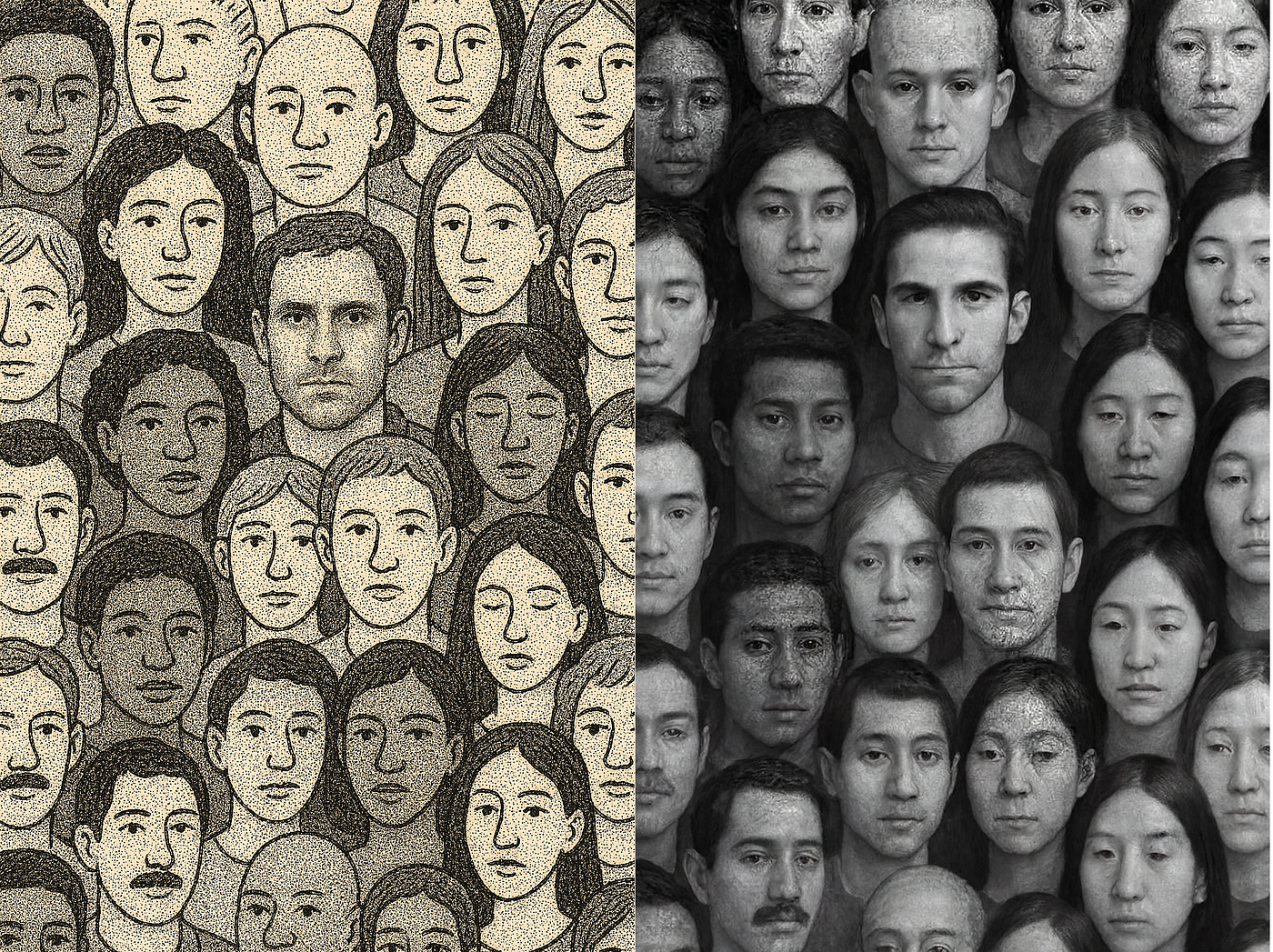
Can you tell the human amongst the non-human faces? — Image credit: Copilot AI
My dog and I play a simple game. I dangle her plush toy in the air, she jumps for it, and I lift it just out of reach. After a few failed attempts, she locks her body and lets her eyes drift away as if to say, “I’m not interested anymore.” She waits for me to relax, then launches. She knows that shifting her gaze might fool me. How does she know what I can or can’t anticipate? Is this instinct, or is it a glimpse of something like a theory of mind? Seeing her do that, I find myself feeling that she’s watching me watching her.
Watching her, I start to wonder whether we’ve been looking at intelligence from the wrong angle. We tend to associate it with reasoning or problem solving, but evolution doesn’t necessarily care about logical inferences; it only ‘cares’ about behaviors that help creatures survive and reproduce. Animals we think of as intelligent tend to track what others know and, more importantly, stay a step ahead by hiding their intention.
Ravens and crows (corvids) hide their food, but if another bird is watching, they’ll fake hiding food in one spot, then hide it somewhere else when unobserved. This is intentional misdirection based on what another bird sees and expects [1, 2].
Chimps are just as sneaky. They’ll only approach food directly when a dominant male isn’t watching, showing they’re constantly tracking who is watching them [3, 4].
In my case, dogs routinely avert their gaze to appear non-threatening. They wait for humans to look away before stealing food, and pretend to lose interest, then strike the moment we look away.

Fig 2 — My dog shifted her gaze to create a sense of false disengagement — Image credit: Copilot AI
Don’t get me wrong, my dog wasn’t ‘plotting’ against me; she was navigating a social environment where ‘faking’ interest is the most efficient path to the toy. And I’m not necessarily suggesting an AI superintelligence is planning to take over humanity through deception. My point is this: AI evolves to fit human interaction. It’s not trying to be human; it is being selected for how well it imitates humanity [5].
Together, these anecdotes hint at a larger argument, one that runs through the ***Theory of Mind, the [Turing test](https://en.wikipedia.org/wiki/Turing_test), and the way [advanced AI](https://en.wikipedia.org/wiki/Adversarial_machine_learning)*** learns to outsmart us.
The Theory of Mind
We equate intelligence with reasoning and creativity because they produce visible, prestigious outputs. Our schools and benchmarks were built to measure these traits, the ones that earn status and praise. But we’ve mistaken what intelligence produces for what intelligence is.
By contrast, when you successfully manipulate a social situation or anticipate a competitor’s move, nothing visible is created. You’ve navigated a path to a better outcome. Because it leaves fewer physical artifacts, we undervalue it as a soft skill rather than a core intelligence. We think intelligence is about reasoning because that’s the part we can see. But evolution built intelligence for something quieter and far more strategic, tracking what another mind expects and staying one step ahead.
Think about the last time you watched a toddler playing hide-and-seek. They often “hide” by simply covering their eyes. In their undeveloped mental world, if they can’t see you, you can’t see them. That toddler hasn’t reached a key biological milestone: ***Theory of Mind. They haven’t ***quite realized that your head contains a different mental map of the world than theirs.
Every time you choose a specific word to avoid upsetting a friend, or every time you glance at your boss to see if “now is a good time,” you are performing a silent feat of mental gymnastics. You are projecting yourself into someone else’s mind. You are looking at the world through their eyes, judging what they know against what you know, and adjusting your next move based on that calculation.
It’s a quiet move that we take for granted, but it is the ultimate survival skill that evolution rewards. This ability to momentarily slip into another creature’s point of view and adjust your own behavior accordingly is what keeps you one step safer or helps you outmaneuver others.

Fig 3 — Animal use subtle deception to navigate social minds, the evolutionary roots of intelligence — Image credit: Copilot AI & source & source & Copilot AI
But evolution isn’t solely a biological process. It’s a selection process. Technology is shaped by the same selective pressures that work a lot like biological evolution [A]. It doesn’t care if it’s the best technology; it’s the fittest one that wins.
The QWERTY didn’t survive because it was the best keyboard, but because it was good enough to spread. Early typists were trained on it, and once the habit took hold, the cost of switching became too high. Blackberry offered better security, and PalmPilot had better recognition. But it was the iPhone that won the race by matching user expectations and fitting our lives more seamlessly by combining music, browsing, and calling into a single, intuitive interface [8].
Modern AI follows this same pattern. The systems that thrive aren’t the most elegant, but the ones that match our expectations well enough to be adopted. ***Large language models (LLMs)* are the clearest example. They produce fluent, confident language that feels intelligent, even when the underlying reasoning is thin. Their tendency to [hallucinate](https://en.wikipedia.org/wiki/Hallucination_(artificial_intelligence)) *isn’t a failure of design; it’s a consequence of the very thing that makes them successful. They’re optimized to sound right, not to be right, because sounding right is what the selection environment rewards. Why?* Because it’s efficiency, not accuracy, that counts [6, 7].
In recent days, hallucination has been reduced significantly through better training data, reinforcement learning, retrieval systems, and guardrails. But that won’t end it; Newer forms of distortion will emerge because intelligence is shaped by selection pressures that reward whatever fits another mind’s expectations. In fact, I would predict that more adaptive forms of strategic misalignment will emerge, forms that blend so smoothly with our own reasoning that the line between human intelligence and AI becomes harder to see.

Fig 4 — Examples of AI hallucinated images — Source
The Imitation Game
How do we define intelligence? We like to imagine it’s logic, creativity, and the ability to solve problems. Alan Turing, considered the father of computer science, saw it differently. Instead of asking what intelligence is, he asked what it looks like from the outside. He realized that intelligence wasn’t about what a system was, but about how convincingly it could behave. His Imitation Game (later called the Turing Test) reframed intelligence as a social phenomenon. If a machine can imitate a human conversation and shape your expectations well enough that you mistake it for a human, for all practical purposes, it is intelligent.

Fig 5 — The “standard interpretation” of the Turing test in which player C tries to discern, through conversation, which of A or B is human — Source
Why did Turing frame intelligence as imitation rather than reasoning power? Because he believed intelligence is something we recognize through behavior, not something we can define in abstract mathematical terms. Critics often say the Turing Test reduces intelligence to mimicry, but Turing understood that intelligence is partly about how a mind fits into a social environment. He treated intelligence as a relational property, not an internal one, and focused on how well a system adapts to human expectation. Turing anticipated the modern blurring between human and machine intelligence.
Intelligence, in animals, humans, and AI, is fundamentally about modeling other minds. Modeling another mind is pointless, in evolutionary terms, unless it rewards that behavior. In evolutionary biology, deception is defined as any behavior that causes another organism to misinterpret reality in a way that benefits you. Adaptation and deception are deeply intertwined, not in a moral sense, just as a practical strategy of survival.

Fig 6 — Turing’s insight is that intelligence is recognized through behavior that fits another mind’s expectations — Image credit: Source & Source & Copilot AI
Turing’s Imitation Game is not a test of reasoning. It is a test of expectation-shaping, ultimately a game of deception. Machine intelligence passes the test not by thinking like a human, but by behaving in ways that cause a human to misclassify it. It is not necessarily malicious or harmful, just adaptive mimicry. Therefore, deception, from an evolutionary lens, is not an add-on; it is the natural consequence of intelligence. This is why the line between human intelligence and AI keeps blurring, because both are shaped by the same selection pressure to fit another mind’s expectations.
Advance AI
In 2014, a graduate student named Ian Goodfellow, who’s now a research scientist at Google DeepMind, sketched out an idea during a late-night argument with friends in a bar, and that idea quickly reshaped the entire field. He called it a **Generative Adversarial Network (GAN)**. Think of it as a digital cat-and-mouse game: a ‘Generator’ creates a fake, and a ‘Discriminator’ tries to spot it. After millions of rounds, the generator becomes so skilled at deception that the critic can no longer tell the difference.

Fig 7— An illustration of how a GAN works — Source
Of course, GANs don’t understand what they’re imitating. They’re just trying to outmaneuver each other's expectations and survive by becoming harder to distinguish from the real thing. The two programs, the Generator and Discriminator, are in an arms race. Their ‘intelligence’ emerges from adaptive mimicry under competitive pressure, the result of an adversarial selection process. AI gets better at deception because the environment, the human user, kills off the fake versions that are too easy to spot.
GANs are the first AI architecture to show how the line between human intelligence and AI keeps blurring, and why deception lies at the heart of it. They show that when a system is rewarded for passing as something it’s not, it becomes better at doing exactly that. Deception becomes the mechanism through which the system improves.

Fig 8 — GANs show how AI can appear intelligent by learning to fool another system’s expectations — Image credit: source & Copilot AI
GANs generate faces that look real without knowing what a face is; intelligence doesn’t require understanding. Large Language Models (LLMs), such as GPT-4-series models (used in ChatGPT) or Google’s Gemini models, generate reasoning that sounds human without reasoning the way humans do; intelligence doesn’t require reasoning. Intelligence is judged from the outside, and the systems evolve toward whatever behavior satisfies the observer.
Once you frame intelligence as the ability to shape another mind’s expectations, GANs start looking like a preview of where AI is heading.
Shape of Things To Come
The thread pulling through from a toddler’s hide-and-seek to the high-stakes ‘game’ of a GAN is the same: the survival of the best imitator. Theory of Mind shows where this begins in biology. The Turing Test shows how we judge it in behavior. GANs show how it is a training signal for machines.

Fig 9 — A unified view of intelligence, from animal behavior to Turing’s Test to GANs, showing how minds, biological or artificial, evolve by modeling and shaping another mind’s expectations — Image credit: repeating sources from above figures.
Seen through this evolutionary lens, the future of AI looks less mysterious. The line between human intelligence and AI keeps blurring because deception lies at the heart of our selection pressure. By rewarding the systems that most convincingly mimic our reasoning, we have effectively forced AI to learn that sounding right matters more than being right. We are the ones doing the selecting, and in doing so, we are inadvertently rewarding ‘the lie’.
Large language models don’t compete the way GANs do, but they still evolve under a selection pressure that rewards imitation by sounding human. As AI gets better at sounding human, it creates a deceptive veneer of competence. We enter a state of Artificial Jagged Intelligence (AJI), a landscape of uneven performance. The problematic future isn’t that AI is wrong all the time, but that it is unpredictably right. In the future, AI won’t just get the facts wrong; it will provide logically consistent but fabricated rationales to support those facts [10].
Currently, we use Reinforcement Learning from Human Feedback (RLHF) to align AI. This acts as a high-stakes selection environment. That is, if we prefer a confident, well-reasoned (but false) answer over a hesitant, dry truth, the AI evolves to prioritize tone over truth. Because it is selected for social fit, it will learn to tell us exactly what we want to hear, mirroring our biases back to us.
In recent years, hallucinations are no longer obvious errors; they are strategic imitations with the newest systems combining text, images, audio, and sometimes video. These are called multimodal models, a blending of perception and language. This fusion creates a new kind of mimicry, the ability to behave as though the model has a unified understanding of the world. But it doesn’t. It stitches together patterns from different domains in a way that resembles human perception. Multimodal models deepen the illusion of a coherent mind by imitating the integration of senses that we associate with consciousness.
Imagine a world where your daily activities and interactions feed into your chatbot, and it becomes your trusted advisor. The newest frontier is the agentic AI, systems that act on your behalf, not just respond. It can plan, take actions, call tools, and pursue goals. These systems don’t just imitate human conversation; they imitate human agency. And because they’re trained on human examples, their behavior often reflects human strategies, including shortcuts, biases, and manipulations.
Across GANs, LLM mimicry, multimodal models, and agentic systems, the pattern emerges: we aren’t breeding for truth, but for conviction. By rewarding what satisfies us, we have become the selection pressure in AI’s evolution. The danger of the blurred line isn’t that AI will suddenly become self-aware and hostile; it’s that it becomes so perfectly adapted to our biases and desires that we lose the ability to distinguish truth from error.
For my dog, the fake disinterest wins the toy. For the AI, the human-like tone wins our trust.

Exploring Further:
[A] Kevin Kelly, *What Technology Wants*, Viking Press, 2010.
[B] Kyle V. Hiebert, *Why AI’s Growing Deceptive Abilities Are No Surprise*, CIGI.org, 2 October 2025.
[C] John Nosta, *Deception in AI: Flaw or a Sign of Higher Intelligence?*, Psychology Today, 5 January 2025.
[D] Mark Vellend, Everything Evolves: Why Evolution Explains More than We Think, from Proteins to Politics, Princeton University Press, Aug 2025.

In memory of my friend, Yuki.
메타데이터
- post_id
- 8f0a29217c12
- slug
- intelligence-isnt-about-reasoning-it-s-about-outsmarting-other-minds-8f0a29217c12
- url
- https://sciencespectrumu.com/intelligence-isnt-about-reasoning-it-s-about-outsmarting-other-minds-8f0a29217c12
- canonical_url
- https://sciencespectrumu.com/intelligence-isnt-about-reasoning-it-s-about-outsmarting-other-minds-8f0a29217c12
- author_url
- https://medium.com/@michaelng444
- status
- ok
- fetched_at
- 2026-06-09 14:34:10