Famous Courtesans of Antiquity -Lais
It’s all about the money, honey
Famous Courtesans of Antiquity -Lais
It’s all about the money, honey
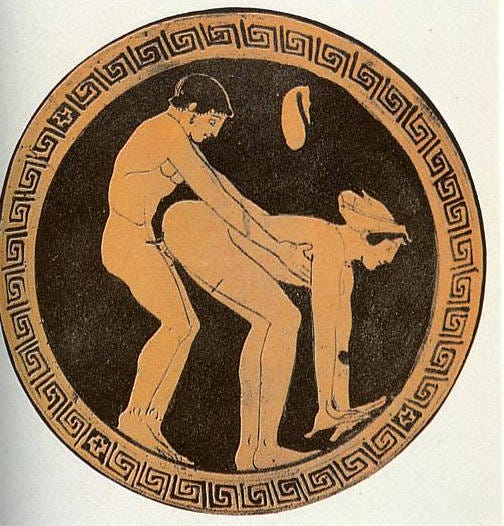
wikimedia commons-public domain
This is the eighth in a series of famous courtesans from antiquity. In many cases the sources on which the information that we have about these famous or infamous women is somewhat scarce. However, one thing is clear, people have always loved to gossip and particularly about matters of a salacious nature.
There is much debate among historians as to the veracity of some of the accounts of these women that are found in ancient texts and whether the women were more than just courtesans or whores. Many of them were intellectually accomplished, astute political operatives or successful businesswomen. I don’t see why they couldn’t have been all of these things. Human beings are complex and not one dimensional.
These disputes aside, one thing is clear, throughout history women have always had a degree of agency and have used what talents they have to shape their own destinies as best they can given the opportunities and limitations of any given time.
A hetaira was essentially a high-class prostitute but denoted a woman with other accomplishments be they intellectual or artistic. I suppose that one could look upon them as not dissimilar to a geisha in that regard. As a class they were differentiated from common prostitutes or pornai, who worked in brothels or the streets.
According to Marguerite Johnson of the University of Newcastle ‘“Hetairai” even attended symposia, or ancient Greek drinking parties, to provide not just sex but also to perform music and even engage in debates and discussions with the participants. (1)
In the illustration above taken from a Greek dish please note that the object hanging on the wall above the couple is a money bag.
Interestingly, according to James Davidson there were different prices charged for different sexual positions. The act depicted above was called kubda and was deemed whorish and cheap and cost three obols or about $20.00. The second type of rear entry position with the woman leaning back was called lordo and cost one drachma or about $43.00. The most expensive position was called keles or ‘the racehorse’ which was a woman on top position for which there was no standard price. (2)
There are two courtesans from antiquity named Lais mentioned in the sources, Lais of Corinth and Lais of Hyccara. However, it is very unclear whether they are actually two separate women or have been confabulated.
Athenaeus in his Deipnosophistae states that Lais was born in Hyccara in Sicily and brought as a captive to Corinth during the Peloponnesian war around 425 BCE so it seems likely that they are one and the same.

Lais of Corinth by Hans Holbein the Younger-Kunstmuseum Basel
Lais was reputed to be extremely beautiful and Athenaeus tells the following anecdote.
Lais, I say, is mentioned by Hypereides (a famed Athenian orator 390–322 BCE) in the second of his speeches against Aristagora (his mistress). And Apelles the painter, having seen Lais while she was still a maiden, drawing water at the fountain Peirene, and marveling at her beauty, took her with him on one occasion to a banquet of his friends. And when his companions laughed at him because he had brought a maiden with him to the party, instead of a courtesan, he said — “Do not wonder, for I will show you that she is quite beautiful enough for future enjoyment within three years.” Lais was so beautiful, that painters used to come to her to copy her bosom and her breasts. And Lais was a rival of Phryne, and had an immense number of lovers, never caring whether they were rich or poor, and never treating them with any insolence. (3)

Lais and the painter Apelles by Jules-Claude Ziegler (1804–1856)
Diogenes Laertius who lived around the 3rd century CE in his Lives of the Eminent Philosophers tells the following story concerning Xenocrates (396–314 BCE): And that once the notorious Phryne tried to make his acquaintance and, as if she were being chased by some people, took refuge under his roof; that he admitted her out of ordinary humanity and, there being but one small couch in the room, permitted her to share it with him, and at last, after many importunities, she retired without success, telling those who inquired that he whom she quitted was not a man but a statue. Another version of the story is that his pupils induced Laïs to invade his couch…(4)
I think that we have to take this story with a grain of salt as Lais would have been a very old woman for her to have been the one attempting to seduce Xenocrates. It is more likely that the incident involved Phryne as she was born around 370 BCE and would therefore have been twenty six years younger than Xenocrates.
Lais was reputed to have charged the philosopher Aristippus a large sum of money for her favors but slept with Diogenes the Cynic for free. The amount that she demanded of the statesman Demosthenes (394–322 BCE) is recounted in this anecdote by Aulus Gellius (125–c.180 CE).
“And the famous Demosthenes went to her in secret and asked for her services. But she asked for 10,000 drachmas (about $435,000). Struck by the woman’s daring and by the great heap of money, Demosthenes turned away pale and said, “I cannot buy regret for such a price”. (5)
As James Davidson tells us: “The difficulty involved in defining a heatara then, is all part of the hetaera’s plan. A hetaera remains a hetaera only so long as she can foil attempts to pin her down. This uncertainty keeps her on the right side of laws and taxes and builds a glass wall between what she does and what goes on in brothels. Much more than that, however, it makes her sexy. (6)
Athenaeus states that Lais continued to persevere in her trade until her old age and until the last day of her life. (7)
Davidson states that in old age she would accept two drachmas (about $87.00) for her services, a sum that she angrily rejected in her youth. (8)
Polemon ( a philosopher who died around 270/269 BCE and was a student of Xenocrates) has stated, where he says that she was murdered by some women in Thessaly, because she was beloved by a Thessalian of the name of Pausanias; and that she was beaten to death, out of envy and jealousy, by wooden footstools in the temple of Aphrodite; and that from this circumstance that temple is called the temple of the impious Aphrodite; and that her tomb is shown on the banks of the Peneus, having on it an emblem of a stone water-ewer, and this inscription- This is the tomb of Lais, to whose beauty, Equal to that of heavenly goddesses, The glorious and unconquered Greece did bow; Love was her father, Corinth was her home, Now in the rich Thessalian plain she lies ;- so that those men talk nonsense who say that she was buried in Corinth, near the Craneium. (9)
Corinth was reputed to have had a thousand temple prostitutes and the phrase “To live like a Corinthian” became synonymous with drinking and debauchery.
According to Strabo: “And the temple of Aphrodite was so rich that it owned more than a thousand temple slaves, courtesans, whom both men and women had dedicated to the goddess. And therefore it was also on account of these women that the city was crowded with people and grew rich; for instance, the ship captains freely squandered their money, and hence the proverb, ‘Not for every man is the voyage to Corinth.’” (10)
Lais’s sexuality has echoed through the ages. The great Roman epigrammatist Martial uses her as a symbol of female sexuality in his verses, “By all means play Lucretia by day but I need a Lais by night.” (11)
There is also a poem attributed to Plato wherein Lais dedicates her mirror to the goddess Aphrodite.
“I, Laïs who laughed scornfully at Hellas, who kept a swarm of young lovers at my door, I lay my mirror before the Paphian (Aphrodite), for I will not see myself as I am now, and cannot see myself as once I was.” (12)
-
Elite companions, flute girls and child slaves: sex work in ancient Athens
-
Courtesans and Fishcakes, The Consuming Passions of Classical Athens, James Davidson, Fontana Press, London 1997
-
Deipnosophistae of Athenaeus, Translation by C D Yonge 1854
-
The Lives of the Philosophers, Diogenes Laertius, Loeb Classical Library 1925, Public Domain
-
Attic Nights 1.8, Aulus Gellius, reproduced in The Greek Reporter, Public Domain
-
Courtesans and Fishcakes, The Consuming Passions of Classical Athens, James Davidson, Fontana Press, London 1997
-
Deipnosophistae of Athenaeus Op. Cit.
-
Courtesans and Fishcakes Op. Cit.
-
Deipnosophistae of Athenaeus Op. Cit.
-
Strabo, Geography 8.6.20 Translated by William Falconer and Hans Claude Hamilton, Public Domain
-
Epigrams of Martial
-
Plato, reproduced in the Greek Reporter, public domain

Glenn M Stewart
Pugilist, polemicist, Oxford Arabist, financial mastermind, international man of mystery, film producer, playwright, part-time-poet, full-time provocateur…
메타데이터
- post_id
- 925b27a3181a
- slug
- famous-courtesans-of-antiquity-lais-925b27a3181a
- url
- https://medium.com/mmm-mondays/famous-courtesans-of-antiquity-lais-925b27a3181a
- canonical_url
- https://medium.com/mmm-mondays/famous-courtesans-of-antiquity-lais-925b27a3181a
- author_url
- https://medium.com/@glenn-stewartm
- status
- ok
- fetched_at
- 2026-06-22 19:40:15