Foundry IQ and Fabric IQ — what are they and how can you benefit
Palantir was one of the first companies to that I’m aware of to popularize and make ontologies core to their business proposition. In the…
Foundry IQ and Fabric IQ — what are they and how can you benefit
Palantir was one of the first companies to that I’m aware of to popularize and make ontologies core to their business proposition. In the past 5 years they’ve grown (in market cap) by 1,890%. Ontologies are clearly not the core reason behind Palantir’s success, but the fundamental design principles helped shape to company into the frontier firm it is today.
Microsoft announced their first ontologies at Ignite a few months back: Work IQ, Foundry IQ and Fabric IQ. I’ve glazed over all three in my Ignite article to give you a high-level summary each, but this article will go into a bit more detail on Foundry IQ and Fabric IQ. I’ll go into why you should care, how each ontology is built, and how to properly leverage both technologies to achieve maximum business benefit.
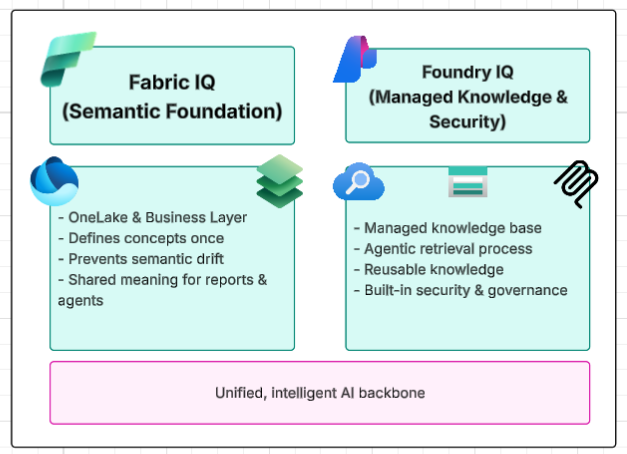
Foundry IQ & Fabric IQ
Foundry IQ
Azure AI Foundry is end‑to‑end platform for building intelligent AI agents and applications. It brings together models, agent orchestration, observability, knowledge, and tools on a trusted and secure Azure foundation. Think of Foundry as your “AI app & agent factory,” with the Foundry Agent Service, Foundry Tools, and the IQ layers as core building blocks.
AI Search is Azure’s enterprise retrieval engine that powers advanced Retrieval-Augmented Generation (RAG): hybrid keyword+vector search, semantic ranking, enrichment skillsets (PII detection, OCR), agentic retrieval, and security with Microsoft Entra ID. AI Search is a purpose‑built scalable enterprise vector store that helps ground agents on enterprise content.
Now putting it together, think of Foundry IQ as the agentic retrieval engine and unified knowledge layer that separates “what to ground on” from “how grounding is done.” It centralizes multi‑source access, plans queries, reasons across sources, and enforces compliance. This ensures agents pull the right context with fewer errors. Foundry IQ is built on Azure AI Search and works with our existing AI Search services, adds knowledge bases, and supports both indexed stores (SharePoint, OneLake, Blob) and remote sources (web, M365, MCP). Foundry IQ is designed to improve response relevance, automate RAG workflows and enable enterprise ready grounding.

Example KB in AI Foundry
Why should you care?
If we think about the financial services industry, key principles that must be maintained with every technology implementation are fast decisioning, customer service, operational efficiency, enterprise security and governance, and consideration for vast multi-source data environments. How does Foundry IQ help with this?
- Sharper answers without spaghetti pipelines: Dev teams stop hand‑assembling multiple RAG flows. Centralize multiple data sources in 1 knowledgebase to improve search results and reduce manual effort.
- FSI fit: Accelerate customer service, policy interpretation, and advisor workflows without copying sensitive data multiple times. (Entra‑backed RBAC + Search enrichment for PII.)
- Enterprise guardrails by default: Security, auth, and data classifications flow through the retrieval layer, and developers move faster.
- Multi‑source reality: Research notes in SharePoint, policy PDFs, product docs, wiki pages, intranet articles: agents can reason over it all as one knowledge space.
How Foundry IQ is built
Previously, AI Agents typically used one source as a knowledge source. If they needed multiple sources, then it was up to the developer to orchestrate these sources together. With Foundry IQ, the knowledge base (KB) is the encapsulation of one or more data sources that can live anywhere. It has its own AI models for retrieval against those sources. When a query comes in, then a planning step is run where the query is deconstructed, the sub-queries are attached to the right KB then a SLM performs a quick assessment to decide if we have enough information to generate a response. If the SLM has any doubt, then a LLM assesses the situation and if the response returned doesn’t meet the threshold, then the planning step is rerun. When the response is acceptable, the response is returned to the user with source information as citations.
Core components worth highlighting include:
- Knowledge Bases: Include sources + auth + representation (chunks, vectors, metadata), usable directly from AI Search in Azure Portal, Foundry & API.
- Agentic Retrieval: Query decomposition, source selection, semantic re‑ranking, reflection/iteration policies resulting in more accurate responses.
- Sources: Indexed (AI Search indexes, OneLake, SharePoint, Blob) and remote (web, M365, MCP servers), with unified semantic ranking.
How to best leverage Foundry IQ
How would you make Foundry IQ real in your organization?
- Pick a few use cases that will drive material value (time/$ saved): Some areas could include: Policy & claims Q&A, KYC/AML procedure lookup, Rates & product desk support.
- Create your Knowledge Bases: Group sources by task. Think claims ops KB (policy forms, adjudication SOPs, exceptions list), KYC KB (CDD checklist, sanctions workflow, regulatory FAQs), Advisor KB (product term sheets, fee schedules, research reports). Map authentication to Entra roles; enable skillsets for PII redaction where needed.
- Turn on agentic retrieval features. Use hybrid retrieval + semantic ranking; set reflection policies for deeper queries; add MCP tools only if a task needs an action beyond retrieval.
- Enhance observability. Tie agent telemetry to business KPIs (claim cycle time, KYC completion). Feed signals into Fabric IQ to get business‑aware observability and root‑cause insights with agents.
See this article for more details.
Fabric IQ
Microsoft Fabric is our unified SaaS data platform, which includes OneLake, Data Factory, Data Engineering, Data Science, Real‑Time Intelligence, and Power BI, with Purview tightly integrated for security and governance. It’s the data fabric and data mesh for analytics, ML, and becoming AI‑ready data.
Fabric IQ is an ontology layer combining together people, processes, systems, actions, rules, and data into a single semantic layer. This layer enables AI agents and users to better understand the business. Fabric IQ unifies analytical and real‑time data into a live, interconnected business context and powers trustworthy, agentic experiences to accelerate business value. See this article for more details.
Why should you care?
When your business users are able to analyze an ontology that connects real world data, instead of raw tables or events, decision making is much quicker and more precise, and it can be scales much more quickly.
Fabric IQ provides you with: unified business semantics across data, models, and systems, so everyone (and every agent) speaks the same language; live, context‑rich insight by combining BI & real‑time telemetry into the ontology; and agent‑ready grounding for Foundry, where agents “understand the business” via the ontology rather than raw tables or schemas.

Fabric IQ
How Fabric IQ is built and how to best leverage Fabric IQ
You will create your own ontology artifact from a semantic model. Before you go about creating your first Fabric ontology, review these prerequisites that must be set by the Fabric Admin to ensure a smooth creation of the artifact.
- Start from your Power BI semantic model (or directly on OneLake): Generate entities from the existing model (e.g., Customer, Account, Product, Claims, etc); verify keys in relationships (FK→PK across sources); verify static properties.
- Connect other data sources and streams to enrich the ontology a drive richer and more contexualized insights.
- Enrich the ontology by binding entity types, properties and relationships: add more domain context to enhance the semantic backbone for AI agents and automation, supporting reasoning, decision-making, and actions across the enterprise.
- Make it real: Connect operational metrics in your domain to entities. Think settlement delays, liquidity thresholds, fraud signals. Then activate real‑time queries and graph analytics.
- Connect the ontology to your agents: Expose the ontology to Foundry agents via MCP/knowledge base, so retrieval and reasoning align to business entities.
Here is a step-by-step tutorial to get you started on MS Learn.
Final Thoughts
To maximize business value from both Foundry IQ and Fabric IQ, treat them as complementary intelligence layers: use Fabric IQ to understand the business, and Foundry IQ to think with the business. One gives you live semantics; the other gives you agentic grounding.
From an observability standpoint, tie Foundry agent telemetry to Fabric IQ entities and KPIs to explain why an agent acted, whether it was compliant, and what changed in business outcomes.
Ultimately, together both Foundry IQ and Fabric IQ turn data into secure and governed decisions that accelerate business value with far less operational headache.
메타데이터
- post_id
- 93206d57f539
- slug
- foundry-iq-and-fabric-iq-what-are-they-and-how-can-you-benefit-93206d57f539
- url
- https://medium.com/@alipouw/foundry-iq-and-fabric-iq-what-are-they-and-how-can-you-benefit-93206d57f539
- canonical_url
- https://medium.com/@alipouw/foundry-iq-and-fabric-iq-what-are-they-and-how-can-you-benefit-93206d57f539
- author_url
- https://medium.com/@alipouw
- status
- ok
- fetched_at
- 2026-08-06 01:32:15