Beyond Traits: How to Use @Suite to Structure Swift Tests
In our previous post, we used traits to categorize and filter tests.
Beyond Traits: How to Use @Suite to Structure Swift Tests

In our previous post, we used traits to categorize and filter tests.
Now, we go a level deeper: grouping tests using@Suitemacro, adding setup/teardown logic, and creating maintainable test structures.
🧩 Introduction
Swift Testing introduces the @Suite macro allows you to group related tests, nest suites hierarchically, and share setup/teardown code between them. This is a huge leap forward from XCTest, which forced developers to organize tests via class inheritance or file-level separation.
🧠 What Is a Test Suite?
Swift Testing introduces the @Suite macro to group related tests.
Think of a suite as a container for logically grouped test functions or other suites.
@Suite
struct AuthTests {
    @Test
    func testLogin() { ... }

    @Test
    func testLogout() { ... }
}
💼 Nested Suites & Organization
Suites can contain:
- Test functions
- Other suites (nested)
- Shared setup/teardown logic
@Suite
struct UserFlowTests {
    @Suite
    struct LoginTests {
        @Test
        func testValidCredentials() { ... }
    }

    @Suite
    struct SignupTests {
        @Test
        func testWeakPassword() { ... }
    }
}
This helps mimic your app’s module boundaries or user flows.
🏗️ Setup & Teardown
Swift Testing provides macros for setup and teardown steps within suites:
@Suite
struct DatabaseTests {
    #setup
    func setupDB() {
        // Connect or prepare DB
    }

    #teardown
    func cleanupDB() {
        // Cleanup resources
    }

    @Test
    func testQueryExecution() { ... }
}
✖️ Use this to avoid duplication and handle test dependencies cleanly.
⚖️ Comparison: XCTest vs Swift Testing Suites
| Feature        | Swift Testing         | XCTest                   |
| -------------- | --------------------- | ------------------------ |
| Grouping       | `@Suite`              | Classes & Files          |
| Nesting        | ✅ Supported           | ❌ Not directly supported |
| Setup/Teardown | `#setup`, `#teardown` | `setUp()`, `tearDown()`  |
| Readability    | ✅ High                | ⚠️ Verbose/boilerplate   |
🙌 Best Practices for Test Suite Design
- ✅ Use
@Suiteper module or feature - ✅ Share common logic in
#setup - 🚫 Avoid deeply nested suites (>2 levels)
- ✅ Combine with traits for filtering within suites
📒 Conclusion
Test suites are how you bring structure to expressive, trait-tagged tests. With @Suite, #setup, and #teardown, Swift Testing makes it easy to build tests that scale.
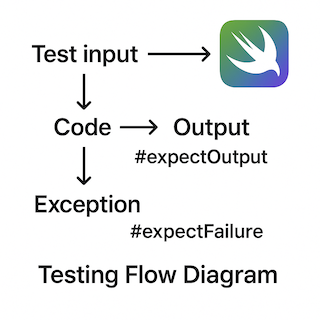
🧭 Next Up: Live Tests & Output Verification
In the next post, we’ll explore:
- How to validate test output
- Use
#expectOutputand#expectFailure - Strategies for testing logs, prints, and command-line tools
Session 5: Swift Testing Deep Dive:
#expectOutput,#expectFailureand More
References
메타데이터
- post_id
- 95f8155f2a3f
- slug
- beyond-traits-how-to-use-suite-to-structure-swift-tests-95f8155f2a3f
- url
- https://medium.com/@raj.anand09/beyond-traits-how-to-use-suite-to-structure-swift-tests-95f8155f2a3f
- canonical_url
- https://medium.com/@raj.anand09/beyond-traits-how-to-use-suite-to-structure-swift-tests-95f8155f2a3f
- author_url
- https://medium.com/@raj.anand09
- status
- ok
- fetched_at
- 2026-07-16 15:57:00