STOP USING A MULTIMETER TO CHECK CABLE INSULATION
A conductor and its insulation have completely opposite jobs. The conductor is supposed to carry current easily, while the insulation is…
STOP USING A MULTIMETER TO CHECK CABLE INSULATION
A conductor and its insulation have completely opposite jobs. The conductor is supposed to carry current easily, while the insulation is supposed to stop current from escaping where it shouldn't.
A standard multimeter is brilliant at checking the conductor, but it can't really check insulation because of how it tests.
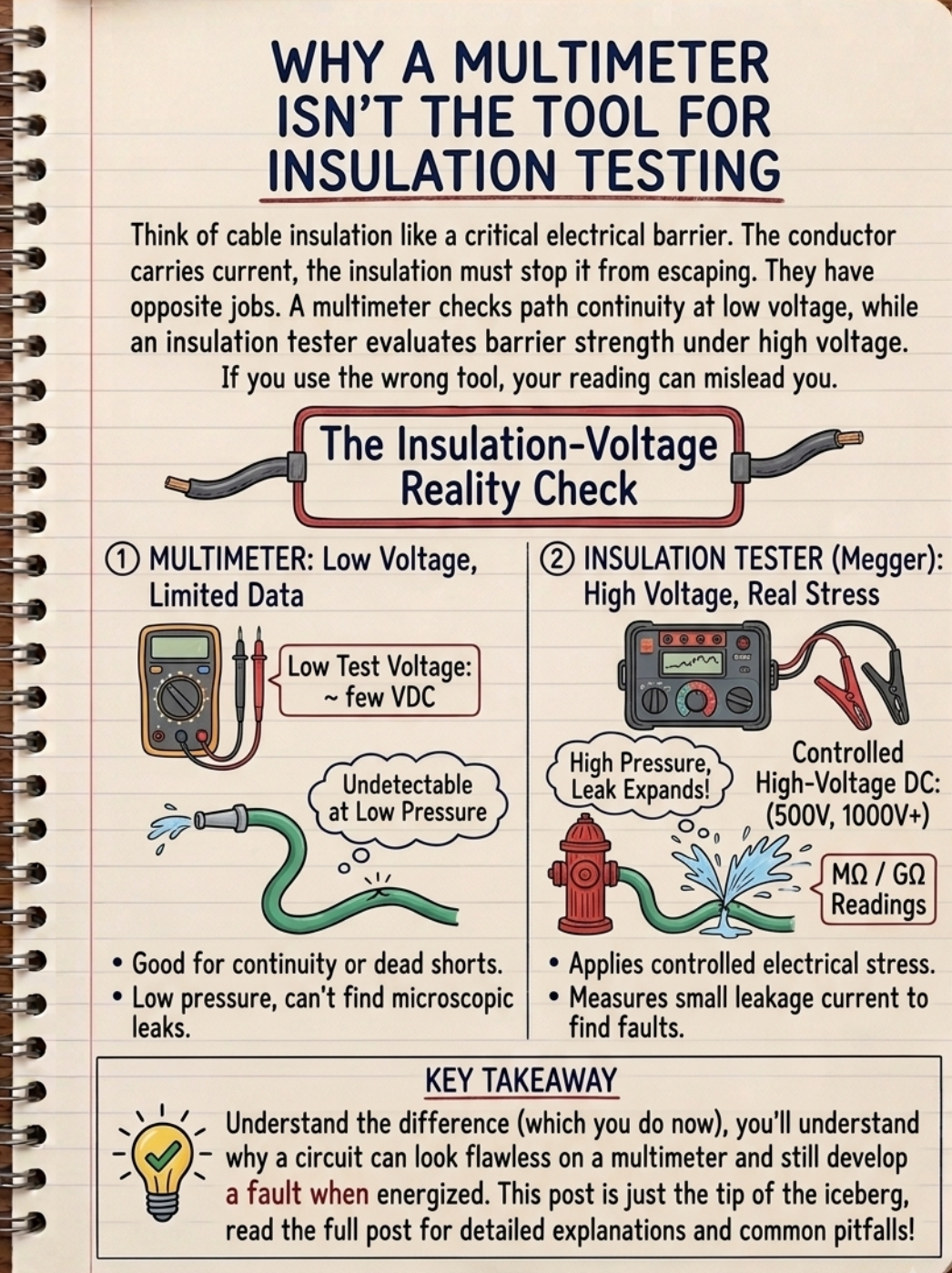
To measure resistance, a multimeter injects a gentle trickle of energy, a relatively low test voltage, typically only a few volts. That works great for finding a broken copper wire or an obvious short.
Insulation breaks down when subjected to real operational pressure, not necessarily at 9 volts.
Think of it like a thick rubber water hose with a microscopic crack inside its wall. If you run a gentle trickling stream through the hose, a tiny leak might be practically undetectable at low pressure but become much more apparent when the pressure increases. The hose will still look completely healthy.
Now, if you connect that hose to a high-pressure fire hydrant, that tiny crack will expand, forcing water to blast out the side.
An Insulation Resistance teste (commonly called a Megger) acts like that high-pressure pump.
Instead of 9 volts, an insulation tester applies controlled high-voltage DC, often 500V, 1000V or even 5000V+ depending on the asset being tested. This puts the insulation under a significantly higher electrical stress than a normal resistance test.
It measures the small leakage current that flows through or across the insulation under the applied test voltage. The meter then calculates the insulation resistance, giving you a reading in Megohms or Gigohms.
A multimeter basically checks if a path is connected, while an insulation tester checks if the barrier can withstand electrical pressure without leaking.
A multimeter checks path continuity at low voltage, while an insulation tester evaluates barrier strength under high voltage.
If you know the difference (which you do now), you'll understand why a circuit can look flawless on a multimeter and still develop a fault when the equipment is energized.
Multimeter vs. Insulation Tester (Megger)
메타데이터
- post_id
- 9830dc78c6fb
- slug
- stop-using-a-multimeter-to-check-cable-insulation-9830dc78c6fb
- url
- https://medium.com/@alexanderachuga/stop-using-a-multimeter-to-check-cable-insulation-9830dc78c6fb
- canonical_url
- https://medium.com/@alexanderachuga/stop-using-a-multimeter-to-check-cable-insulation-9830dc78c6fb
- author_url
- https://medium.com/@alexanderachuga
- status
- ok
- fetched_at
- 2026-08-18 22:43:10