Java 25 Features Explained
🌱 INTRODUCTION: WHY JAVA 25 MATTERS (READ THIS FIRST)
Java 25 Features Explained
🌱 INTRODUCTION: WHY JAVA 25 MATTERS (READ THIS FIRST)
Java has been around for more than 25 years.
It is trusted by banks, telecom companies, airlines, governments, and large enterprises because it is:
- Stable
- Secure
- Scalable
But there was one big problem.
👉 Java was powerful, but not friendly.
❌ The Old Java Problem
If you were a beginner:
- You had to write too much boilerplate
- You had to understand threads, synchronization, memory early
- Even a simple “Hello World” looked scary
If you were an experienced developer:
- Thread management was complex
- Context passing was unsafe
- Performance tuning required deep JVM knowledge
So Java slowly gained a reputation of being:
“Good for companies, but hard for humans”
🎯 WHAT JAVA 25 IS TRYING TO DO ?
Java 25 is part of a long-term transformation of Java (started around Java 17–21).
The goals are very clear:
✅ Make Java easy for beginners
✅ Make concurrency safe by default
✅ Improve performance without changing your code
✅ Reduce accidental complexity
✅ Let developers focus on business logic, not plumbing
Java 25 does NOT try to be a new language.
Instead, it removes pain from existing Java.
Think of Java 25 as:
“The same Java you trust — but finally friendly”
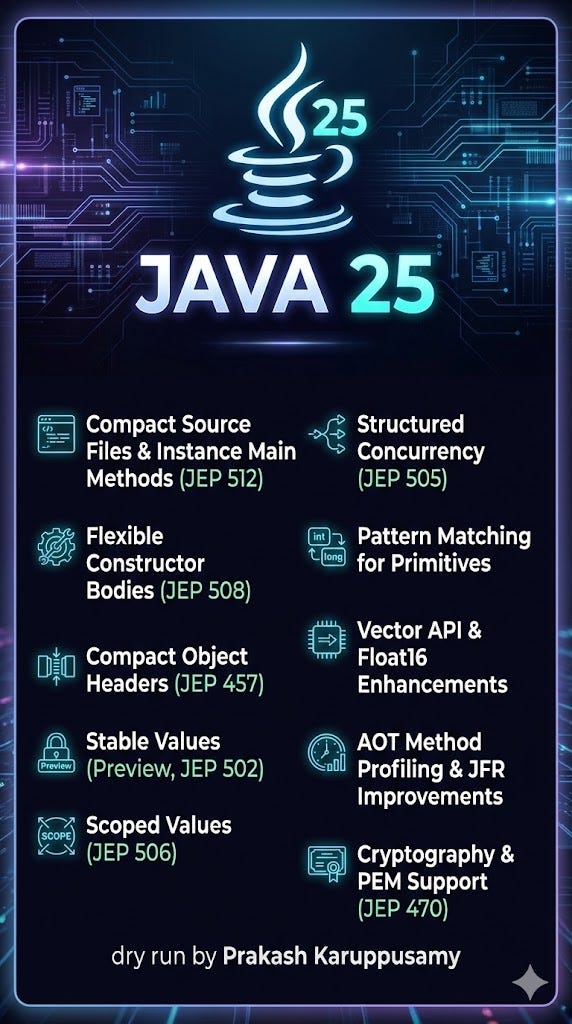
📋 JAVA 25 FEATURES EXPLAINED
1️⃣ Compact Source Files & Instance Main Methods (JEP 512)
2️⃣ Flexible Constructor Bodies (JEP 508)
3️⃣ Compact Object Headers (JEP 457)
4️⃣ Stable Values (Preview, JEP 502)
5️⃣ Scoped Values (JEP 506)
6️⃣ Structured Concurrency (JEP 505)
7️⃣ Pattern Matching for Primitives
8️⃣ Vector API & Float16 Enhancements
9️⃣ AOT Method Profiling & JFR Improvements
🔟 Cryptography & PEM Support (JEP 470)
1️⃣ Compact Source Files & Instance Main Methods (JEP 512)
Before Java 25, Java forced enterprise rules even for tiny programs.
You always needed:
- A public class
- A public static void main
- File name matching class name
This made sense for large systems,
but not for learning, demos, or interviews.
Java 25 introduces Compact Source Files:
- No class required
- No static main
- Compiler understands intent automatically
This makes Java feel modern and welcoming.
🧠 Analogy
Earlier Java:
You must fill a full passport form just to enter a local office.
Java 25:
Show your ID and walk in.
Before Java 25
// PROBLEM BEFORE JAVA 25:
// Too much boilerplate for simple logic

public class HelloWorld {
    public static void main(String[] args) {
        System.out.println("Hello Java");
    }
}
After Java 25
// JAVA 25 POWER:
// No class, no static main
// Focus only on logic

void main() {
    System.out.println("Hello Java 25");
}
🎯 Use cases
- Teaching Java to freshers
- Writing quick demos or interview programs
2️⃣ Flexible Constructor Bodies (JEP 508)
Constructors create objects.
Before Java 25, constructors had a dangerous limitation:
You had to assign fields before validating inputs
This could create invalid objects temporarily, which is bad design.
Java 25 allows:
- Validation
- Normalization
- Pre-processing
- before assigning fields
This makes object creation safe and clean.
🧠 Analogy
Earlier:
Pay first → then check product
Now:
Check product → then pay
Before Java 25
class User {

    String name;

    User(String name) {
        // PROBLEM:
        // Forced assignment before validation
        this.name = name;

        if (name == null || name.isBlank()) {
            throw new IllegalArgumentException("Invalid name");
        }
    }

    public static void main(String[] args) {
        new User(" ");
    }
}
After Java 25
class User {

    String name;

    User(String name) {
        // JAVA 25 POWER:
        // Validation before assignment
        name = name.strip();

        if (name.isEmpty()) {
            throw new IllegalArgumentException("Name cannot be empty");
        }

        this.name = name;
    }

    public static void main(String[] args) {
        new User(" Prakash ");
        System.out.println("User created safely");
    }
}
🎯 Use cases
- Domain model validation
- Clean object construction
3️⃣ Compact Object Headers (JEP 457)
Every Java object carries:
- Your fields
- Hidden JVM metadata (object header)
Earlier, headers were large, wasting memory.
Java 25 shrinks object headers internally:
- No code change
- Less memory
- Better cache usage
This is a silent but powerful improvement.
🧠 Analogy
Earlier:
Big labels on every parcel
Now:
Smaller labels → more parcels per truck
Before Java 25
// PROBLEM:
// Larger object headers = more memory usage

class Point {
    int x;
    int y;
}

void main() {
    Point[] points = new Point[1_000_000];
    for (int i = 0; i < points.length; i++) {
        points[i] = new Point();
    }
    System.out.println("Points created");
}
After Java 25
// JAVA 25 POWER:
// Same code, less memory, better performance

class Point {
    int x;
    int y;
}

void main() {
    Point[] points = new Point[1_000_000];
    for (int i = 0; i < points.length; i++) {
        points[i] = new Point();
    }
    System.out.println("Points created efficiently");
}
🎯 Use cases
- High-scale systems
- Memory-sensitive applications
4️⃣ Stable Values (Preview — JEP 502)
⚠️ Preview Feature
Run with: — enable-preview
Many values:
- Are expensive to compute
- Never change after first load
- Must be thread-safe
Earlier, developers wrote complex synchronization code.
Stable Values provide:
- Lazy initialization
- Thread safety
- JVM optimization
🧠 Analogy
First person sets Wi-Fi → everyone uses it
Before Java 25
class Config {

    static String region;

    static synchronized String region() {
        // PROBLEM:
        // Manual synchronization
        if (region == null) {
            region = "INDIA";
        }
        return region;
    }

    public static void main(String[] args) {
        System.out.println(region());
    }
}
After Java 25
import jdk.incubator.stablevalue.StableValue;

class Config {

    // JAVA 25 POWER:
    // Lazy + thread-safe + optimized
    static final StableValue<String> REGION =
            StableValue.of(() -> "INDIA");

    static String region() {
        return REGION.get();
    }

    public static void main(String[] args) {
        System.out.println(region());
    }
}
🎯 Use cases
- Application configuration
- Feature flags
5️⃣ SCOPED VALUES (JEP 506)
In real-world applications (web apps, microservices), we often need to pass context data such as:
- Request ID
- User ID
- Tenant ID
- Correlation ID
Before Java 25, developers used ThreadLocal for this.
❌ Problems with ThreadLocal:
- Data can leak across requests
- Must be manually cleaned
- Dangerous with virtual threads
- Hard to debug memory leaks
Java 25 introduces Scoped Values:
- Immutable (cannot be changed)
- Exists only inside a defined scope
- Automatically cleaned
- Safe with modern concurrency
This makes context passing safe by design.
🧠 Analogy
Earlier:
You borrow an office key and forget to return it.
Now:
You get a visitor badge that expires automatically when you leave.
Before Java 25
// PROBLEM BEFORE JAVA 25:
// ThreadLocal data can leak if not removed properly

class OldContext {

    static ThreadLocal<String> REQUEST_ID = new ThreadLocal<>();

    public static void main(String[] args) {

        REQUEST_ID.set("REQ-101");
        handleRequest();

        // If developer forgets remove(), data may leak
        // REQUEST_ID.remove();
    }

    static void handleRequest() {
        System.out.println("Handling request " + REQUEST_ID.get());
    }
}
After Java 25
import java.lang.scopedvalue.ScopedValue;

class NewContext {

    static final ScopedValue<String> REQUEST_ID =
            ScopedValue.newInstance();

    public static void main(String[] args) {

        // JAVA 25 POWER:
        // Value exists only inside this scope
        ScopedValue.where(REQUEST_ID, "REQ-101")
                .run(NewContext::handleRequest);
    }

    static void handleRequest() {
        System.out.println("Handling request " + REQUEST_ID.get());
    }
}
Benefit:
✔ No memory leaks
✔ Safe with virtual threads
✔ Automatic cleanup
🎯 Use cases
- Request tracing in microservices
- Security context propagation
6️⃣ STRUCTURED CONCURRENCY (JEP 505)
Modern applications often call multiple services in parallel:
- User service
- Order service
- Payment service
Before Java 25
- Threads were started independently
- Error handling was scattered
- Cancellation was manual
- Code became fragile
Structured Concurrency treats multiple threads as one unit of work:
- If one fails → others stop
- Errors propagate cleanly
- Code becomes readable and safe
🧠 Analogy
Earlier:
Tourists roam independently
Now:
A tour guide manages the entire group
Before Java 25
// PROBLEM BEFORE JAVA 25:
// Manual thread management and error handling

class OldConcurrency {

    public static void main(String[] args) throws Exception {

        Thread t1 = new Thread(() -> {
            System.out.println("Fetching user");
        });

        Thread t2 = new Thread(() -> {
            System.out.println("Fetching orders");
        });

        t1.start();
        t2.start();

        t1.join();
        t2.join();
    }
}
After Java 25
import java.util.concurrent.StructuredTaskScope;

class NewConcurrency {

    public static void main(String[] args) throws Exception {

        // JAVA 25 POWER:
        // Threads treated as one logical task
        try (var scope =
                     new StructuredTaskScope.ShutdownOnFailure()) {

            scope.fork(() -> {
                System.out.println("Fetching user");
                return null;
            });

            scope.fork(() -> {
                System.out.println("Fetching orders");
                return null;
            });

            scope.join();
            scope.throwIfFailed();
        }
    }
}
Benefit:
✔ Clean error handling
✔ Automatic cancellation
✔ Readable concurrency
🎯 Use cases
- API aggregation services
- Parallel database or service calls
7️⃣ PATTERN MATCHING FOR PRIMITIVES
Earlier, Java switch statements:
- Worked mainly with constants
- Became messy with conditions
- Required multiple if-else blocks
Java 25 extends pattern matching to primitive types, allowing:
- Conditions inside switch
- Cleaner and safer decision logic
- Less boilerplate
🧠 Analogy
Earlier:
You check items one by one manually
Now:.
Automatic sorting machine does it cleanly
Before Java 25
// PROBLEM BEFORE JAVA 25:
// Too many if-else conditions

class OldPattern {

    static String check(int n) {
        if (n == 0) return "Zero";
        if (n > 0) return "Positive";
        return "Negative";
    }

    public static void main(String[] args) {
        System.out.println(check(-10));
    }
}
After Java 25
class NewPattern {

    static String check(int n) {

        // JAVA 25 POWER:
        // Pattern matching with primitives
        return switch (n) {
            case 0 -> "Zero";
            case int i when i > 0 -> "Positive";
            default -> "Negative";
        };
    }

    void main() {
        System.out.println(check(-10));
    }
}
🎯 Use cases
- Validation logic
- Cleaner business rules
8️⃣ VECTOR API & FLOAT16 ENHANCEMENTS
Modern CPUs can process multiple numbers in a single instruction (SIMD).
Earlier Java:
- Processed numbers one-by-one
- Could not fully use CPU power
Java 25 improves Vector API and Float16 support:
- Enables bulk processing
- Improves math-heavy workloads
- Ideal for analytics and ML
🧠 Analogy
Earlier:
Calculator (one number at a time)
Now:
Spreadsheet (thousands at once)
Before Java 25
// PROBLEM BEFORE JAVA 25:
// One-by-one processing

class OldMath {

    public static void main(String[] args) {

        float[] values = {1, 2, 3, 4};

        for (int i = 0; i < values.length; i++) {
            values[i] *= 2;
        }

        System.out.println("Processed normally");
    }
}
After Java 25
import jdk.incubator.vector.*;

class VectorDemo {

    static final VectorSpecies<Float> SPECIES =
            FloatVector.SPECIES_PREFERRED;

    public static void main(String[] args) {

        float[] values = {1, 2, 3, 4};

        // JAVA 25 POWER:
        // Multiple values processed in one CPU instruction
        int i = 0;
        for (; i < SPECIES.loopBound(values.length); i += SPECIES.length()) {
            var v = FloatVector.fromArray(SPECIES, values, i);
            v.mul(2).intoArray(values, i);
        }

        System.out.println("Vector processing completed");
    }
}
🎯 Use cases
- Financial calculations
- Machine learning / analytics
9️⃣ AOT METHOD PROFILING & JFR IMPROVEMENTS
The JVM normally:
- Starts cold
- Learns performance slowly
Java 25 allows Ahead-Of-Time (AOT) profiling:
- JVM saves profiling data
- Reuses it in next runs
- Faster startup and stable performance
🧠 Analogy
Food app remembers your favorite order
Before Java 25
- Cold startup every time
- Slower warm-up
After Java 25
# JAVA 25 POWER:
# JVM reuses profiling data for faster startup

java -XX:+UnlockExperimentalVMOptions \
     -XX:+UseAOTProfiling \
     -jar app.jar
🎯 Use cases
- Faster microservice startup
- Production performance tuning
🔟 CRYPTOGRAPHY & PEM SUPPORT (JEP 470)
PEM is the standard format for:
- Private keys
- Certificates
- TLS configuration
Before Java 25:
- Manual parsing
- External libraries
- Error-prone code
Java 25 adds native PEM support, making security code:
- Simpler
- Safer
- More standard-compliant
🧠 Analogy
Earlier:
Everyone used different locks
Now:
One standard lock for all
Before Java 25
- Custom parsing
- Third-party dependencies
After Java 25
// JAVA 25 POWER:
// Native support for PEM encoding/decoding

Pem.encodePrivateKey(privateKey, outputStream);
Pem.encodeCertificate(certificate, outputStream);
🎯 Use cases
- TLS configuration in microservices
- Certificate management in DevOps
메타데이터
- post_id
- 9bde8425b396
- slug
- java-25-features-explained-9bde8425b396
- url
- https://medium.com/@prakashbtech87/java-25-features-explained-9bde8425b396
- canonical_url
- https://medium.com/@prakashbtech87/java-25-features-explained-9bde8425b396
- author_url
- https://medium.com/@prakashbtech87
- status
- ok
- fetched_at
- 2026-06-20 20:29:01