Achieving Continuous Audit Monitoring Across SAP and Oracle ERPs
Continuous audit monitoring is the only technical standard that allows a modern organization to transition from retrospective sampling to a…
Achieving Continuous Audit Monitoring Across SAP and Oracle ERPs
Continuous audit monitoring is the only technical standard that allows a modern organization to transition from retrospective sampling to a state of persistent, high-fidelity oversight within their primary ledgers.
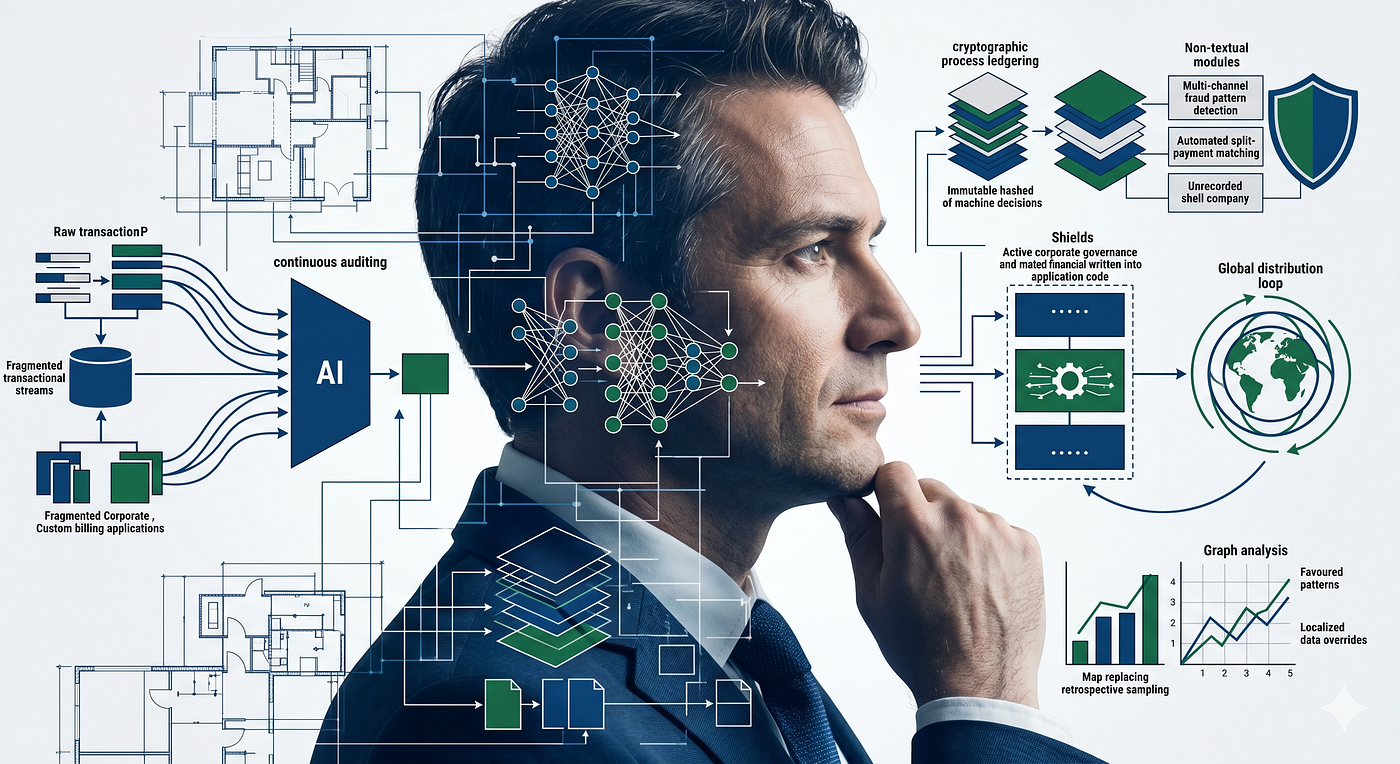
By integrating automated sensors directly into SAP and Oracle environments, businesses can identify control failures as they occur, ensuring that financial integrity is maintained through every transaction rather than being verified months after a financial leak. This shift relies on a real-time risk assessment engine that ingests data from disparate modules, effectively breaking down data silos to provide a unified view of corporate health.
Consequently, the reliance on traditional, labor-intensive manual reviews is replaced by a steady stream of verified evidence, allowing teams to act on anomalies before they compound into systemic failures.

Continuous Audit Monitoring
The Problem with Snapshot Auditing
I spent the better part of a decade watching audit teams chase paper trails that were already cold. The traditional approach relies on statistical sampling; picking twenty or fifty invoices out of thousands and hoping they represent the whole. It is a flawed methodology that creates a false sense of security. If a bad actor or a simple system error lives in the ninety percent of data you didn’t look at, your “reasonable assurance” is effectively a guess.
Modern infrastructure moves too fast for this retrospective style. When you have transactions occurring in milliseconds across global jurisdictions, waiting for a quarterly report to find a leak is a massive operational risk. I recently spoke with a treasurer who discovered a duplicate payment issue that had been running for fourteen months in a secondary SAP instance. The data was there, but it was buried in a silo that only got “sampled” once a year. By the time they found it, the money was gone and the recovery costs were higher than the original error.
Breaking the Wall of ERP Data Silos
Most organizations don’t have a data problem; they have a connectivity problem. Financial records live in the core ERP, travel expenses live in a third-party app, and procurement data stays with the vendors. Even within a single company, having an Oracle instance for North America and an SAP instance for Europe creates massive data silos. To achieve a state of persistent oversight, you have to build a data mesh that allows these systems to talk to each other in a common language.
- API Normalization: Forcing different software stacks to output data in a format that a central monitoring engine can understand.
- Master Data Hygiene: Ensuring that a vendor named “Inc.” in one system is recognized as the same entity as “Incorporated” in another.
- Cross-Platform Correlation: Linking a purchase order in Oracle to a bank transfer in SAP and a shipping manifest in the warehouse.
Once these connections are established, the monitoring engine doesn’t just see individual events; it sees the entire story. It can flag a payment that doesn’t have a matching shipping manifest or a vendor bank account change that happened five minutes before a large transfer. This is where the real value of automation lives; in the gaps between your departments.
Engineering Real-Time Risk Assessment
A persistent monitoring system needs to be more than a set of alerts. If you just flag everything that looks slightly odd, your team will drown in “false positive” noise. I’ve seen departments turn off their monitoring tools because they were getting five hundred emails a day about minor clerical errors. The goal is to build a system that understands context.
Real-time risk assessment involves assigning a weight to every anomaly based on its impact and the probability of it being a genuine threat. If a junior employee makes a ten-dollar error, the system might just log it for a monthly review. If a senior manager bypasses a procurement threshold for a hundred-thousand-dollar contract, the system should trigger an immediate investigation. This dynamic thresholding ensures that human experts are only spending their time on the “signal,” not the “noise.”
The Role of Automated Controls in Process Integrity
We often talk about “controls” as if they are static hurdles, but in a digital-first organization, they should be active components of the workflow. Automated controls act as a digital immune system. If a transaction violates a pre-defined policy; such as a conflict of interest or a missing approval, the system should be able to block the action before it is finalized.
- Pre-payment Verification: Running every invoice against a list of known “shell companies” and sanctioned entities before a check is cut.
- Threshold Policing: Automatically escalating any purchase that is split into multiple smaller amounts to avoid approval limits.
- Behavioral Baselines: Identifying when an employee’s access patterns change, such as downloading large amounts of financial data at midnight.
This move from “detect” to “prevent” is the ultimate goal. When the controls are baked into the code, you don’t have to worry about whether people are following the manual. The system physically prevents them from taking unauthorized shortcuts. It makes compliance a silent byproduct of the work rather than an extra task.
The Shift from Auditor to Strategic Adjudicator
I often get asked if this technology is going to put auditors out of a job. The reality is that it’s finally giving them a job that matters. Instead of spending eighty percent of their time gathering data and twenty percent analyzing it, we are flipping that ratio. The machine handles the gathering, the matching, and the basic verification.
The human expert becomes a strategic adjudicator. They are the ones who look at the complex cases that the AI couldn’t quite resolve. They are the ones who look at the trends across the organization and suggest structural changes to the business model. It’s a higher-value role that requires a deep understanding of both technology and ethics. According to research from the Institute of Internal Auditors, the profession is rapidly evolving toward this tech-heavy, insight-driven model.
Sustaining Financial Integrity Through Transparency
Trust is the most expensive thing you can buy, and it’s the easiest thing to lose. When a company has a major financial scandal, it’s rarely because of one giant heist; it’s usually because a thousand small leaks went unnoticed for years. Financial integrity is about ensuring that the records reflect reality at every moment, not just during an audit.
By maintaining a dashboard that shows the health of every control in real-time, leadership can demonstrate a level of transparency that builds massive confidence with shareholders and regulators. It shows that you aren’t just hoping for the best; you are actively managing the details. I’ve noticed that companies with high levels of audit automation often get better terms from lenders and insurers because they are viewed as lower-risk entities.
Overcoming the Implementation Friction
It’s tempting to want to automate everything at once, but that’s a recipe for a very expensive failure. I always suggest starting with the areas where you have the highest transaction volume and the clearest rules. Travel and expense is usually a great starting point, followed by accounts payable.
The biggest hurdle isn’t the technology; it’s the culture. People are used to the “fire drill” of an annual audit. They might view continuous monitoring as an intrusive “Big Brother” system. Overcoming this requires clear communication from the top. You have to show them that this isn’t about catching them in a mistake; it’s about protecting the company’s assets so there is more to invest in growth and innovation.
The Future of Governance as Code
As we move through 2026, the distinction between “the business” and “the technology” will continue to blur. We are heading toward a future where governance is managed as code. Your policies won’t live in a PDF on the company intranet; they will live in the deployment scripts of your financial applications.
This level of integration is the only way to stay resilient in an environment defined by volatility and complexity. Organizations that continue to rely on manual, snapshot-based oversight will find themselves at a disadvantage, struggling with higher compliance costs and slower response times. By contrast, those that embrace continuous audit monitoring will find that they have built a more robust, trustworthy, and efficient foundation for the long term.
Utilizing cloud-native platforms to power these monitoring engines allows for the scalability and processing speed required to handle global data streams. This is the new baseline for excellence. You can’t manage a 2026 organization with 1996 audit techniques. The tools are ready, the data is available, and the strategic case is clear. The only remaining variable is the decision to move.
메타데이터
- post_id
- 9ee1b26fe6c5
- slug
- achieving-continuous-audit-monitoring-across-sap-and-oracle-erps-9ee1b26fe6c5
- url
- https://medium.com/@sneha.patil2703/achieving-continuous-audit-monitoring-across-sap-and-oracle-erps-9ee1b26fe6c5
- canonical_url
- https://medium.com/@sneha.patil2703/achieving-continuous-audit-monitoring-across-sap-and-oracle-erps-9ee1b26fe6c5
- author_url
- https://medium.com/@sneha.patil2703
- status
- ok
- fetched_at
- 2026-06-09 15:37:30