Bath Royal Literary and Scientific Institute: Activating with Creative Technology
What happens when a 200-year-old institution meets creative computing students equipped with 3D scanners, game engines, and augmented…
Bath Royal Literary and Scientific Institute: Activating with Creative Technology
What happens when a 200-year-old institution meets creative computing students equipped with 3D scanners, game engines, and augmented reality?
From 2020 to 2023, BSc Creative Computing students from Bath Spa University partnered with the Bath Royal Literary and Scientific Institution (BRLSI) through the Creative Industry Challenge module, led by Dr Coral Manton. The collaboration explored how creative technology can open museum collections to new audiences - and how engaging with real heritage collections can transform student learning.
The results were immersive, experimental, and impactful.
As module leader, I developed the Creative Industry Challenge as a live, industry-facing module connecting students with cultural partners and public audiences. Informed by my wider work in immersive technologies and digital heritage, the module enabled students to build skills in photogrammetry, 3D modelling, AR, and digital storytelling, alongside project management and collaboration.
Across three years, this translated into tangible outcomes — including public exhibitions, commissioned projects, and international placements — demonstrating how student work can move beyond the classroom into real-world contexts.
A living brief: students inside a cultural institution
At the core of the collaboration was a simple shift: students worked not on hypothetical assignments, but within an active cultural institution.
Through direct access to BRLSI’s globally significant natural history and scientific collections, they engaged with the material realities of heritage — handling objects, interpreting collections, and responding to institutional contexts.
This led to a guiding question:
How can digital technologies make museum collections more accessible, engaging, and relevant to student audiences?
Students responded through a combination of research, experimentation, and public-facing digital production — developing projects across photogrammetry, 3D modelling, immersive environments, web platforms, and augmented reality.
Each cohort built on the work of the previous year, creating an evolving body of practice that deepened both technical ambition and critical engagement with the collections.
Year one: scanning collections and telling climate stories
The first cohort focused on climate change and the oceans.
Using photogrammetry, students created 3D scans of objects from BRLSI’s natural history collection — including coral, fossil specimens and a jurassic dolphin skull. These objects became the foundation for a web-based interactive experience where users travelled through a digital ocean environment, exploring specimens and environmental change across time.
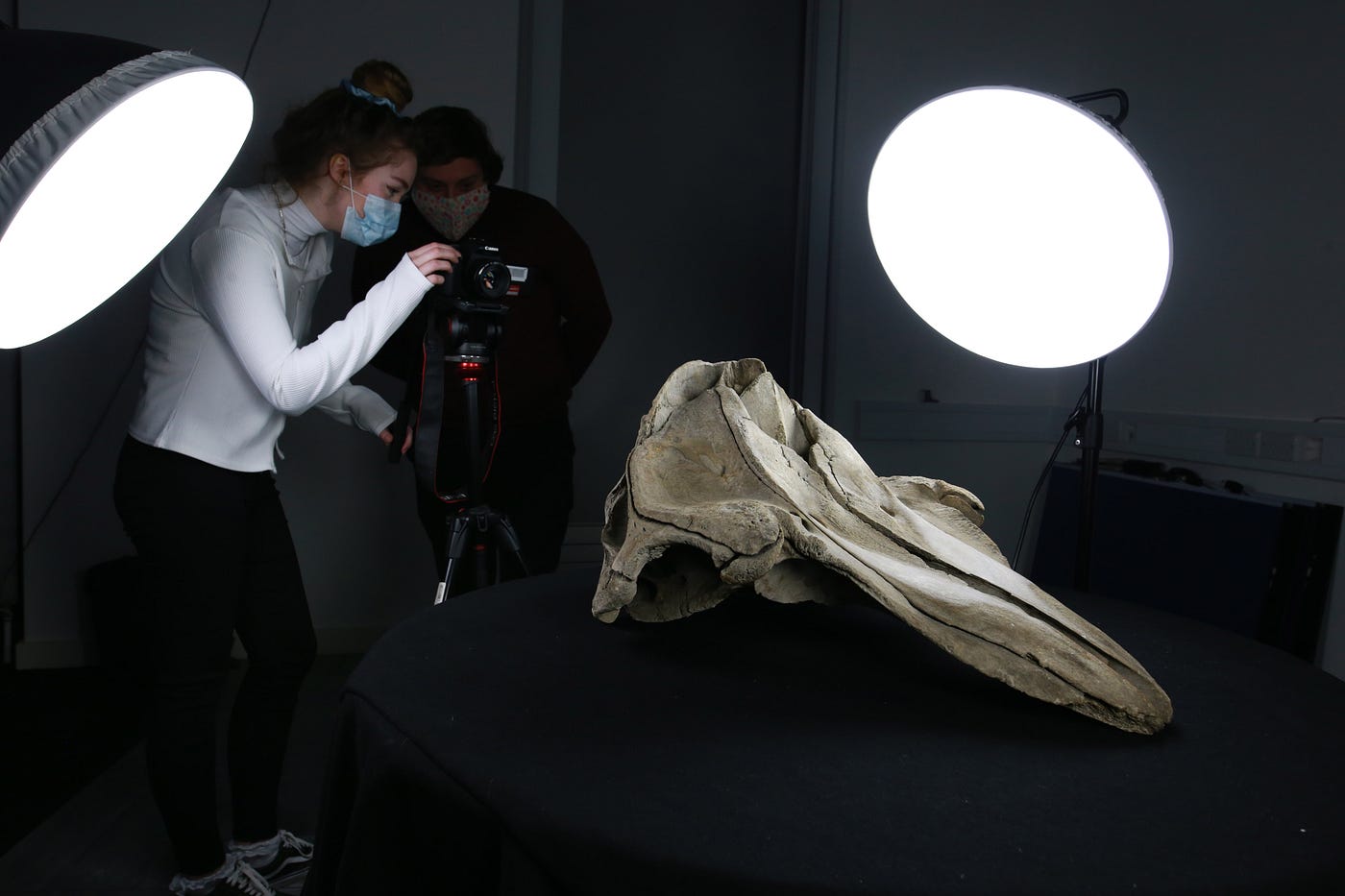
students taking images for photogrammetry 3D scan of the Jurassic Twerton Dolphin
The project showed how museum objects can move beyond display cases. Through web-based 3D and digital storytelling, collections became accessible to remote audiences and could be interpreted in new ways.
The project also became international. Through Bath Spa’s Global Academy of Liberal Arts (GALA), led by Prof Ian Gadd, students collaborated with peers at the University of Adelaide on similar briefs, sharing skills and feedback across continents. Two students later undertook funded placements in Adelaide, extending the project’s impact into immersive media research and professional development. The placements were funded by GALA and The Turing Scheme.
International placements with the University of Adelaide (funded by GALA and the Turing Scheme) ran for three years in total, supporting six students.
Project Video:
[embed]
**Experience the website here [Read the students’ project blog here](https://brlsiprojectsblog.wordpress.com/)**
Year two: rebuilding a lost museum in virtual space
The second year shifted from objects to architecture.
Students recreated BRLSI’s original building — destroyed during the Second World War — as an explorable virtual environment. Using archival research and 3D modelling workflows, they built a digital reconstruction that allowed visitors to walk through a lost heritage space and encounter collection objects inside it.

3D model of original BRLSI building, reconstructed based on BRLSI’s archival resources
Developed in the Unity game engine, the virtual museum demonstrated how immersive technologies can reconstruct places that no longer exist. It also opened up new possibilities for interpreting historical collections within their original spatial context.
For students, this meant working at the intersection of heritage research, technical production, and user experience design.
[embed]
Year three: augmented reality and public-facing outputs
By the third year, the collaboration expanded into multiple public outputs supported by interdisciplinary research.
Projects Included:
- A touchscreen 3D collection explorer for public use
- A mobile augmented-reality app placing historic photographs into present-day Bath
- An AR reconstruction of BRLSI’s original site, allowing visitors to experience the lost museum in situ

Touchscreen application for exploring 3D models of objects from BRLSI’s collection
One of these AR experiences was later commissioned by Bath & North East Somerset Council for a public event connected to the city’s Central Riverside development. Students were paid for their work — gaining professional experience while demonstrating the real-world value of their research and creative development.

Image from augmented reality map showing archival exhibition images and 3D model of the original museum

Image from augmented reality map showing archival exhibition images and 3D model of the original museum
BRLSI Bicentenary
In 2024, as BRLSI marked its bicentenary, the augmented-reality projects were showcased publicly during Bath Digital Festival.
What began as student coursework had become part of a wider cultural conversation about heritage, place, and digital interpretation.
The work demonstrated that student-led creative technology projects can meaningfully contribute to public engagement, exhibition development, and civic storytelling.
Skills, impact, and lasting partnerships
Across the three-year collaboration, students developed hands-on experience in:
- Photogrammetry and 3D scanning
- 3D modelling and game engines
- Immersive media and AR
- Web and app development
- Digital storytelling and heritage interpretation
Just as importantly, they worked directly with a cultural institution — learning how to translate research into public-facing outputs and how to collaborate across disciplines.
Key outcomes included:
- New digital interpretations of museum collections available online
- Paid commissions and professional opportunities for students
- International placements with the University of Adelaide funded by GALA and the Turing Scheme — which extended for a further two years — totaling 6 students on international placements.
- Ongoing collaboration between the university and BRLSI
- Public engagement through festivals and civic events
Why it matters
Projects like this sit at the intersection of education, heritage, and the creative industries. They show how universities and cultural institutions can work together to experiment, prototype, and test new ways of engaging audiences.
They also highlight something crucial: Creative technology isn’t just about tools — it’s about activating collections, stories, and spaces.
By giving students access to real collections and real partners, the collaboration turned a historic institution into a site of experimentation. In doing so, it opened up new ways of thinking about access, interpretation, and the future of museums.
Two hundred years after its founding, BRLSI became not just a repository of knowledge — but a platform for digital innovation and collaborative learning.
메타데이터
- post_id
- a26bf33dd750
- slug
- bath-royal-literary-and-scientific-institute-activating-with-creative-technology-a26bf33dd750
- url
- https://medium.com/@coralann.manton/bath-royal-literary-and-scientific-institute-activating-with-creative-technology-a26bf33dd750
- canonical_url
- https://medium.com/@coralann.manton/bath-royal-literary-and-scientific-institute-activating-with-creative-technology-a26bf33dd750
- author_url
- https://medium.com/@coralann.manton
- status
- ok
- fetched_at
- 2026-08-06 13:21:26




