The “Post-Phone” Era Why Spatial Computing is the Next Frontier
Introduction
The “Post-Phone” Era Why Spatial Computing is the Next Frontier
Introduction
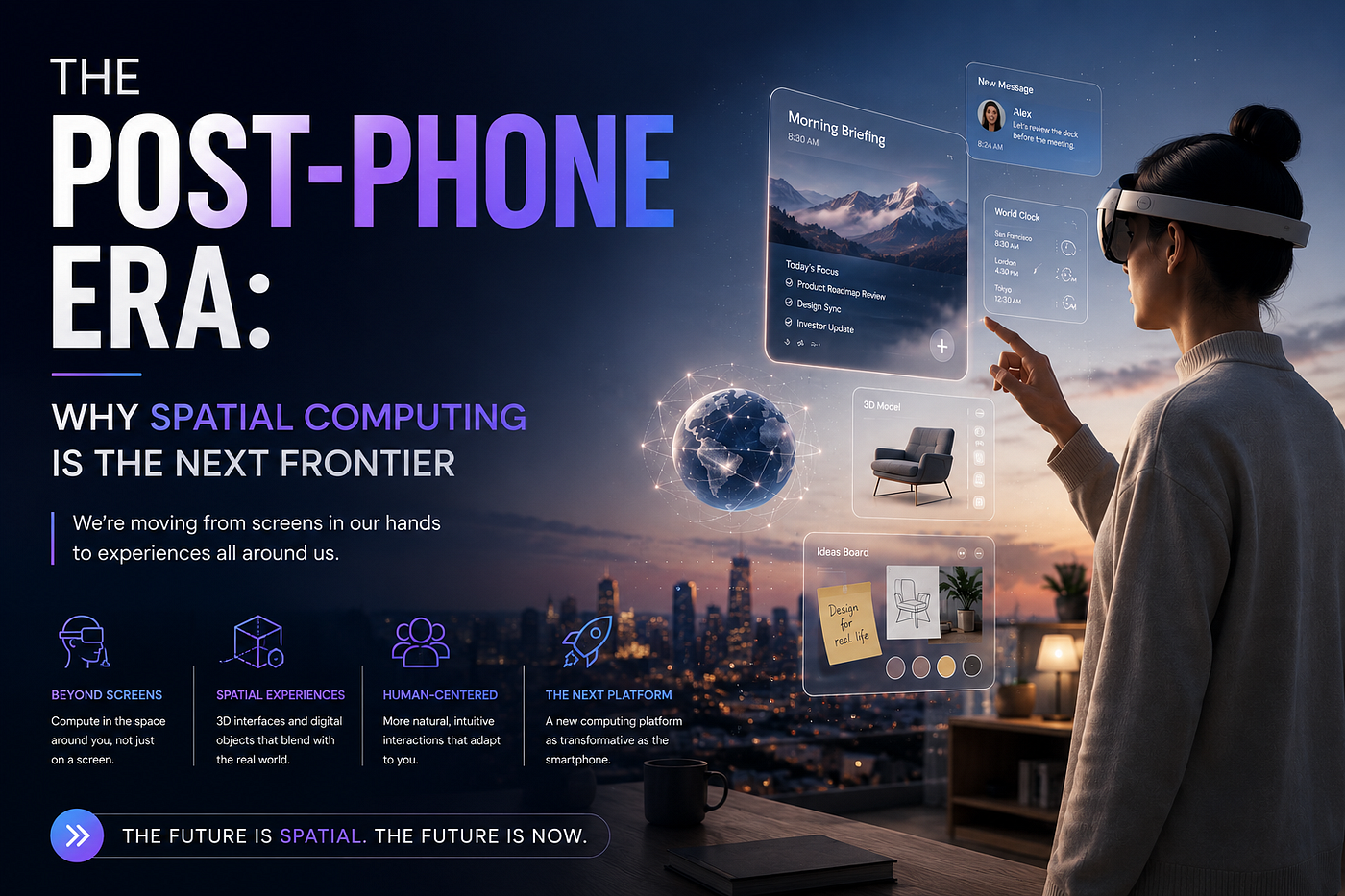
For over a decade, we have been “trapped” behind 2D screens. From the smartphone in our pocket to the laptop on our desk, our digital lives have been confined to flat rectangles of glass. But the landscape of technology is finally shifting. We are entering the era of Spatial Computing — a paradigm shift that transforms our physical environment into the primary digital interface.
The Shift from “Screens” to “Space”
Spatial computing isn’t just “Virtual Reality.” It’s the fusion of the digital and physical worlds. It allows us to anchor virtual data, 3D objects, and interactive interfaces directly into our physical surroundings, making technology feel more contextual, intuitive, and natural.
Why is this happening now? Because we have finally reached the “golden intersection” of three critical factors:
- Hardware Democratization: Lightweight, wearable smart glasses are replacing bulky headsets.
- Infrastructure Readiness: 5G and edge processing have eliminated the latency that once hampered high-fidelity 3D experiences.
- AI Integration: Multimodal AI now allows devices to “understand” your surroundings, turning static apps into active, environment-aware assistants.
What This Means for Developers
If you are a builder or a developer, the game is changing. The skills we used to build mobile apps are evolving:
- From Flat UI to Spatial UI: You are no longer designing for a 6-inch screen. You are designing for depth, scale, and gesture-based interaction. The challenge isn’t just “how it looks,” but “how it exists in the user’s space.”
- The Rise of WebXR: You don’t necessarily need to learn heavy 3D game engines (like Unity or Unreal) to get started. The WebXR Device API has matured, allowing developers to ship immersive experiences directly through the browser. It is becoming the “HTML” of the spatial web.
- Persistent Anchors: We are moving toward a web that remembers where you placed it. Applications can now “anchor” digital objects to the real world, turning your office into a persistent, shared digital workspace.
The Privacy Paradox
As our devices become “always-on” sensors, privacy is becoming the most important feature. The industry is rapidly moving toward “Privacy-by-Design.” Raw visual data from your environment is increasingly processed locally on the device, ensuring that your private surroundings remain yours, with only anonymized data hitting the cloud.
Conclusion
Spatial computing isn’t here to replace the smartphone overnight; it is here to extend it. We are moving from a world where we “look at” our devices to a world where we “interact with” our environment through technology.
The tools are ready, the hardware is maturing, and the canvas is now the entire world around us. For those of us building the future, the question isn’t “if” this shift will happen, but how we will build for it.
What do you think? Is spatial computing the final stage of the smartphone, or will it replace the screen entirely? Let me know in the comments!
메타데이터
- post_id
- a3563c99cafd
- slug
- the-post-phone-era-why-spatial-computing-is-the-next-frontier-a3563c99cafd
- url
- https://medium.com/@verasaravana/the-post-phone-era-why-spatial-computing-is-the-next-frontier-a3563c99cafd
- canonical_url
- https://medium.com/@verasaravana/the-post-phone-era-why-spatial-computing-is-the-next-frontier-a3563c99cafd
- author_url
- https://medium.com/@verasaravana
- status
- ok
- fetched_at
- 2026-07-08 23:38:59
