How HashMaps Work Internally (With Examples) — A Complete Beginner-to-Pro Guide
🧩 A Story to Start With…
How HashMaps Work Internally (With Examples) — A Complete Beginner-to-Pro Guide
🧩 A Story to Start With…
Imagine you walk into a massive library 📚.
Instead of searching every shelf, you go to a catalog system, type a book name, and instantly get its location.
👉 That’s exactly how a HashMap works.
It doesn’t search everything. It jumps directly to where your data is stored.
🧠 What is a HashMap?
A HashMap is a data structure that stores data in key–value pairs.
map.put(“apple”, 10);
- Key → “apple”
- Value → 10
💡 Think of it like:
- Dictionary → word → meaning
- Phonebook → name → number
⚙️ How HashMaps Work Internally
🔑 Step 1: Hashing the Key
Every key is converted into a number using a hash function.
“apple” → hashCode() → 93029210
👉 This number is NOT random — it’s deterministic.
📍 Step 2: Finding the Index
The hash is compressed into an array index:
index = hashCode % capacity
If capacity = 8:
93029210 % 8 = 2
👉 So data goes into bucket 2
📦 Step 3: Buckets (Where Data Lives)
Internally, HashMap uses:
Array of buckets
- Each bucket can store:
- One element
- Or multiple elements
⚠️ What Happens When Collisions Occur?
A collision happens when two different keys map to the same bucket index.
👉 Example:
“apple” → index 3 “banana” → index 3 // collision!
🔄 How Retrieval Works (get operation)?
When you call:
map.get(“apple”);
Steps:
- Generate hashCode
- Find index
- Go to bucket
- Compare keys using
.equals() - Return value
👉 This is why lookup is super fast ⚡
🧪 Real Example (Step-by-Step)
HashMap<String, Integer> map = new HashMap<>();
map.put(“apple”, 10); map.put(“banana”, 20); map.put(“grapes”, 30);
🚀 Time Complexity
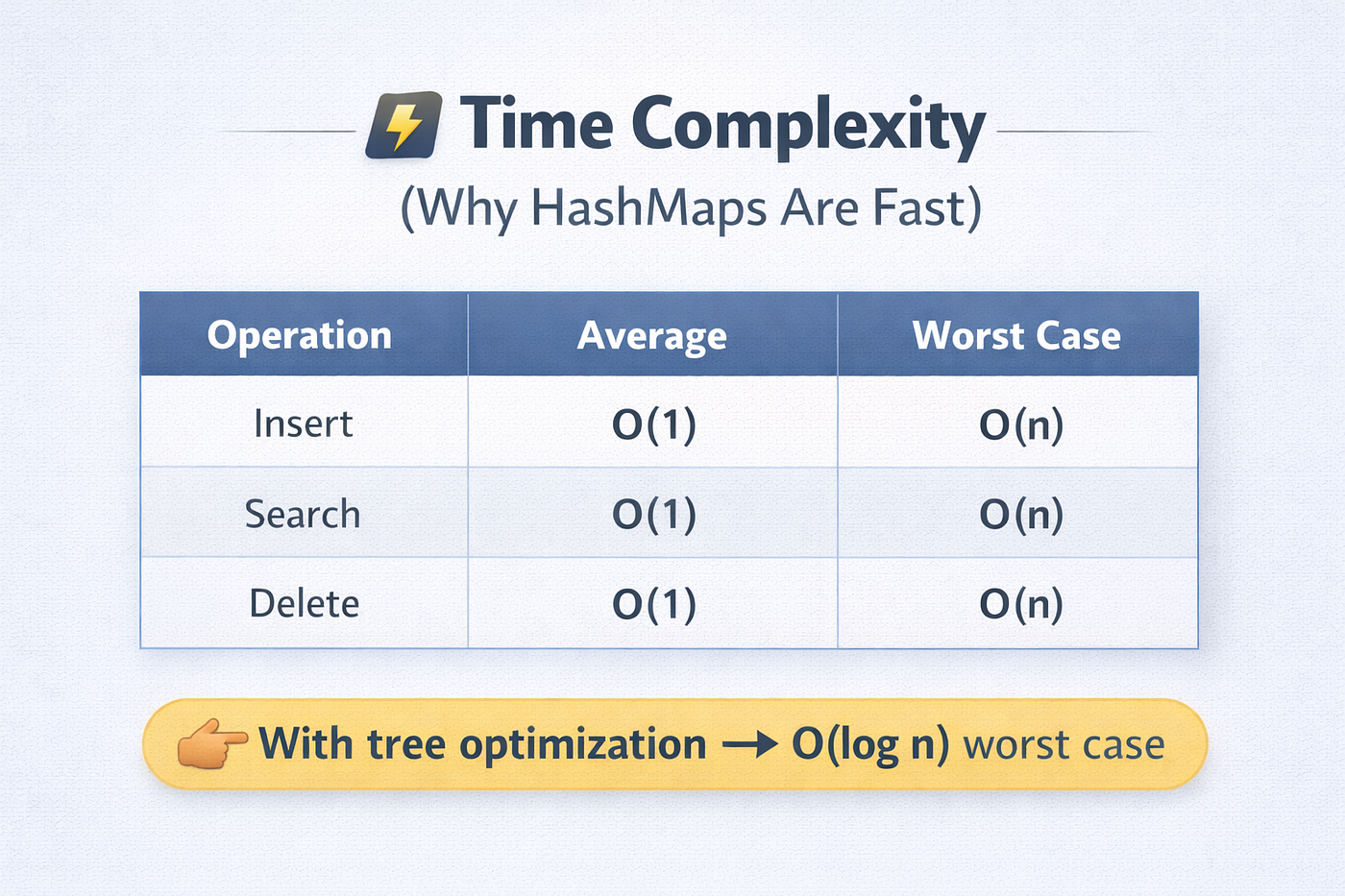
📊 Load Factor & Rehashing
📌 Load Factor Default = 0.75 When exceeded → resize
🔄 Rehashing Array size doubles All keys are rehashed New positions assigned
👉 This keeps performance stable 🚀
💡 Real-World Applications
🔥 Caching (LRU Cache) 📊 Data counting (word frequency) 🗄️ Database indexing 🌐 Backend systems (sessions, APIs)
FINAL THOUGHTS

메타데이터
- post_id
- a4dafe0609be
- slug
- how-hashmaps-work-internally-with-examples-a-complete-beginner-to-pro-guide-a4dafe0609be
- url
- https://medium.com/@rpstrainings05/how-hashmaps-work-internally-with-examples-a-complete-beginner-to-pro-guide-a4dafe0609be
- canonical_url
- https://medium.com/@rpstrainings05/how-hashmaps-work-internally-with-examples-a-complete-beginner-to-pro-guide-a4dafe0609be
- author_url
- https://medium.com/@rpstrainings05
- status
- ok
- fetched_at
- 2026-08-10 04:10:21