Polygon Token Launches Need a User Onboarding Map Before the First Announcement
A practical guide for token teams preparing network instructions, bridge paths, token addresses, gas wallets, DEX routes, explorer links…
Polygon Token Launches Need a User Onboarding Map Before the First Announcement
A practical guide for token teams preparing network instructions, bridge paths, token addresses, gas wallets, DEX routes, explorer links, and support notes before users arrive.
Polygon can be a practical place to launch a token: low transaction costs, familiar EVM tooling, active DeFi infrastructure, and broad wallet support. For builders, that makes the deployment path feel approachable. Create the token, publish the address, add liquidity, announce the launch, and the community can start interacting.
But a token launch is not only a contract or token address. It is also a user journey.
If a new holder has to switch networks, bridge funds, find the correct DEX route, identify the right token, understand gas requirements, and avoid fake links inside the same five minutes, the launch can become confusing even when the token itself was configured correctly. The problem is not always the chain. It is the absence of a clear onboarding map.
This article is a practical framework for Polygon token teams that want to reduce avoidable confusion before the first announcement. It is not financial advice, legal advice, or a claim that any launch will succeed. It is a builder checklist for making the first user path easier to understand.
Start with the user’s starting point
Teams often write launch instructions from the perspective of the deployer. The deployer already knows the network, token address, pool route, wallet setup, and official links. New users do not.
Before writing the announcement, define the three most likely starting points:
A user who already uses Polygon and only needs the token address and swap route.
A user who uses Ethereum or another EVM chain but has never switched to Polygon.
A user who follows the community but has little experience with bridging, gas tokens, or DEX interfaces.
Those three users need different levels of explanation. A single “contract is live” message may be enough for the first group, but it is not enough for the second or third. A better launch note separates quick links from beginner guidance so experienced users are not slowed down and newer users are not left guessing.
Publish one canonical token identity block
Every Polygon launch should have one canonical identity block that the team can reuse across the website, Medium post, pinned community message, Telegram/Discord announcement, and support page.
At minimum, include the token name, symbol, decimals, official token address, chain, explorer link, official website, and the preferred DEX route if liquidity exists. If the token has not launched trading yet, say that clearly instead of letting users search for unofficial pairs.
This block is not marketing copy. It is a reference object. The goal is to make it easy for users, moderators, scanners, partners, and community members to compare any link or address against the official source.
Be careful with formatting. Long addresses should be copyable in plain text, not only embedded in screenshots. Explorer links should go directly to the token or contract page, not to a generic homepage.
Explain the network switch before the swap
Polygon is EVM-compatible, but that does not mean every user understands network switching. A launch message that assumes “everyone knows how to add Polygon” can create support noise immediately.
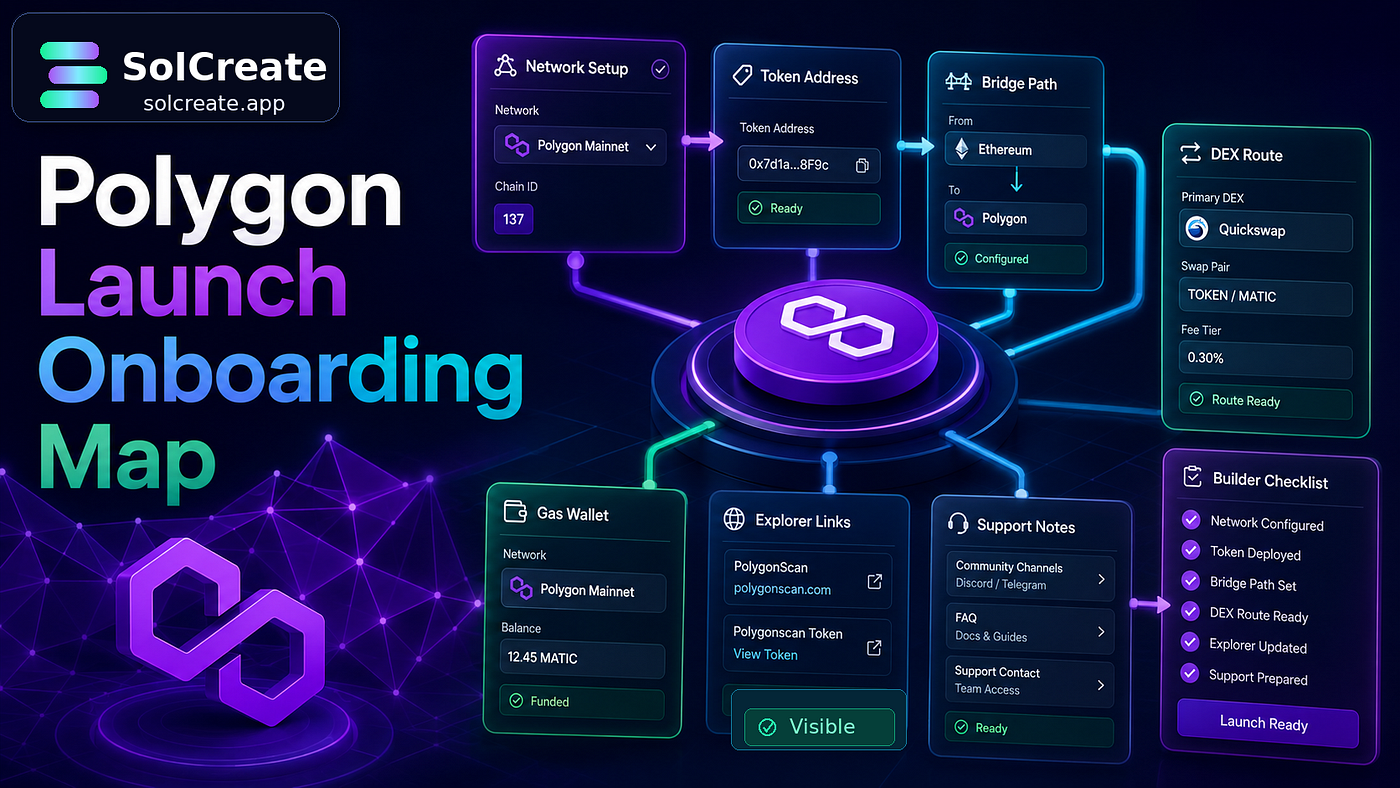
A simple onboarding map should explain which network users need, what wallet network label they should expect, what native gas token is required, and where users should verify network details if their wallet asks for manual configuration.
This is especially important for users arriving from Ethereum. They may have the correct wallet but no MATIC for gas on Polygon. They may also mistake a bridged token route for a direct swap route. If the project expects users to bridge before participating, the instructions should say so plainly and link only to official or widely recognized routes the team is comfortable referencing.
Separate the bridge path from the trading path
A bridge route and a DEX route are not the same thing. Many launch pages blur them together.
The bridge path answers: how does a user move assets to Polygon if they are starting somewhere else?
The trading path answers: once the user is on Polygon, where can they find the token pair or pool?
Mixing these instructions can lead users into the wrong interface, the wrong asset, or the wrong order of operations. A cleaner launch map separates the two with short labels:
Step 1: Get onto Polygon.
Step 2: Confirm the official token address.
Step 3: Use the published DEX route or pool link.
Step 4: Check the explorer link after the transaction.
If the team has not created liquidity yet, do not imply that the trading route is live. If liquidity is planned but not added, say when users should expect the official route to appear and warn them not to rely on unofficial pairs.
Prepare gas and failed-transaction notes
Low fees do not mean zero friction. Users can still fail transactions because they lack gas, approve the wrong asset, use a stale route, interact during high congestion, or copy an address incorrectly.
A useful support note explains the most common failure cases before they happen. For example: “If the swap fails, check that your wallet is on Polygon, that you have enough MATIC for gas, that you are using the official token address, and that the DEX route has not changed.”
Avoid turning this into a guarantee. A support note should not promise perfect outcomes or imply that every issue can be fixed. It should simply give users a calm first diagnostic path.
For builders using no-code launch tools such as SolCreate, this is where token creation connects to launch operations. The token may be deployed through a clean interface, but the team still needs public instructions that help users interpret wallet prompts, route links, and explorer results.
Make explorer links part of the launch story
Explorer links are not only for technical users. They are also part of public launch evidence.
A Polygon onboarding map should include a direct token explorer link, a liquidity or pair link when applicable, and any relevant transaction references the team wants users to review. If the token has authority or ownership settings that matter to the launch narrative, explain where users can inspect them without making broad safety claims.
A good explorer note might say: “Use this page to confirm the official token address and view token activity.” A weak note says: “Everything is handled, trust us.” The first statement helps users check evidence. The second creates expectations the team cannot responsibly support.
Keep public claims narrower than public evidence
Polygon launches often happen in fast-moving communities. That speed can pressure teams into broad claims: “official,” “ready,” “audited,” “locked,” “renounced,” “community-owned,” or “risk removed.” Some of those words may be accurate in a specific context, but they become risky when the public evidence is incomplete.
A better rule: every public claim should point to a visible source.
If liquidity is locked, link the lock and explain what it covers. If ownership changed, link the transaction and explain what control moved. If the team says the token address is official, make sure every channel repeats the same address. If a claim cannot be shown, narrow the wording until it matches what users can verify.
Build a support page before users need support
The best time to create support content is before launch day, not while moderators are answering the same question in three chats.
A lightweight support page can include the official token identity block, network instructions, bridge notes, DEX route, explorer links, common wallet issues, and a short “what we will never ask for” section. It should also define the official support channels and warn users not to trust random DMs.
Final takeaway
Polygon token launches are easier when the team treats onboarding as launch infrastructure. The token address, network switch, bridge path, gas wallet, DEX route, explorer link, and support notes should tell one consistent story before users arrive.
A clear onboarding map will not make a weak project strong. It will not remove market risk, contract risk, or user responsibility. But it can reduce avoidable confusion, make public evidence easier to find, and help a team look more prepared during the moments when first impressions matter most.
메타데이터
- post_id
- af886a2c0a09
- slug
- polygon-token-launches-need-a-user-onboarding-map-before-the-first-announcement-af886a2c0a09
- url
- https://medium.com/@SolCreateApp/polygon-token-launches-need-a-user-onboarding-map-before-the-first-announcement-af886a2c0a09
- canonical_url
- https://medium.com/@SolCreateApp/polygon-token-launches-need-a-user-onboarding-map-before-the-first-announcement-af886a2c0a09
- author_url
- https://medium.com/@SolCreateApp
- status
- ok
- fetched_at
- 2026-07-08 10:09:58