The Case Conversion Debate: Server-Side vs. Client-Side
Case Conversion: Frontend vs. Backend Architecture
The Case Conversion Debate: Server-Side vs. Client-Side
Case Conversion: Frontend vs. Backend Architecture

Reference: https://en.wikipedia.org/wiki/Camel_case
Background
In development, case conversion (e.g., converting a database’s snake_case to a frontend’s camelCase) is a small technical task that has a significant impact on app’s architecture.
Deciding where this happens, Frontend or Backend is a classic debate about Separation of Concerns and System Performance.
Why this Architectural Choice Matters
The choice between snake_case (Database standard) and camelCase (Frontend standard) comes down to where you want the "mental load" to live.
System Decoupling:
- Handling conversion at the frontend allows the backend to stay “pure” to Python standards.
- The API essentially says, “I’ll give you the raw data, you format it how you like.”
- This makes the backend faster to develop since it doesn’t need custom logic for every UI preference.
Scalability & Cost:
- Modern frontend conversion is virtually “free” because it’s distributed across thousands of user devices.
- Doing it on the backend adds a small CPU tax to your central server for every single API call.
- For a high-traffic library, moving this work to the client side is a smarter resource play.
Developer Experience (DX):
- Frontend developers live in a
camelCaseworld. - By using an interceptor to auto-convert data as it arrives, they can write clean, idiomatic code without manually renaming variables like
user_idtouserIdevery time they fetch data.
Comparison
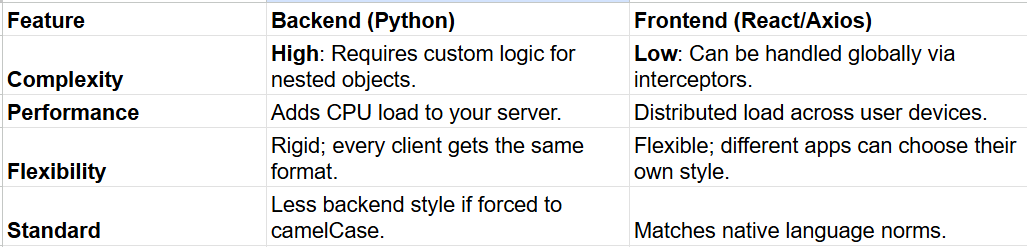
Recommendation
- When choosing between backend or frontend for case conversion, the decision usually comes down to system performance and architectural flexibility.
- While backend conversion provides a single source of truth, handling this at the frontend is often considered a more scalable and cleaner approach for a few core reasons.
Reference
- https://codebrahma.com/intercepting-the-case-battle-between-snakes-and-camels-in-front-end-javascript/
- Gemini
- StackOverflow
- A little bit of my own mind 😉
메타데이터
- post_id
- b6c1fdb29438
- slug
- the-case-conversion-debate-server-side-vs-client-side-b6c1fdb29438
- url
- https://medium.com/@trivediniki94/the-case-conversion-debate-server-side-vs-client-side-b6c1fdb29438
- canonical_url
- https://medium.com/@trivediniki94/the-case-conversion-debate-server-side-vs-client-side-b6c1fdb29438
- author_url
- https://medium.com/@trivediniki94
- status
- ok
- fetched_at
- 2026-07-16 07:17:41




