Embrace Imperfection: 6 Powerful Benefits of Messy Sketchnotes That Create Deeper Connection Than…
In a world obsessed with Instagram-perfect visuals and flawless presentations, something remarkable happens when you dare to be messy…
Embrace Imperfection: 6 Powerful Benefits of Messy Sketchnotes That Create Deeper Connection Than Perfect Graphics
In a world obsessed with Instagram-perfect visuals and flawless presentations, something remarkable happens when you dare to be messy: people actually connect with you. While everyone else polishes their graphics to sterile perfection, authentic communicators are discovering that strategic imperfection creates deeper human connections than any professionally designed slide deck ever could. Your wobbly lines aren’t weaknesses — they’re superpowers waiting to be unleashed.
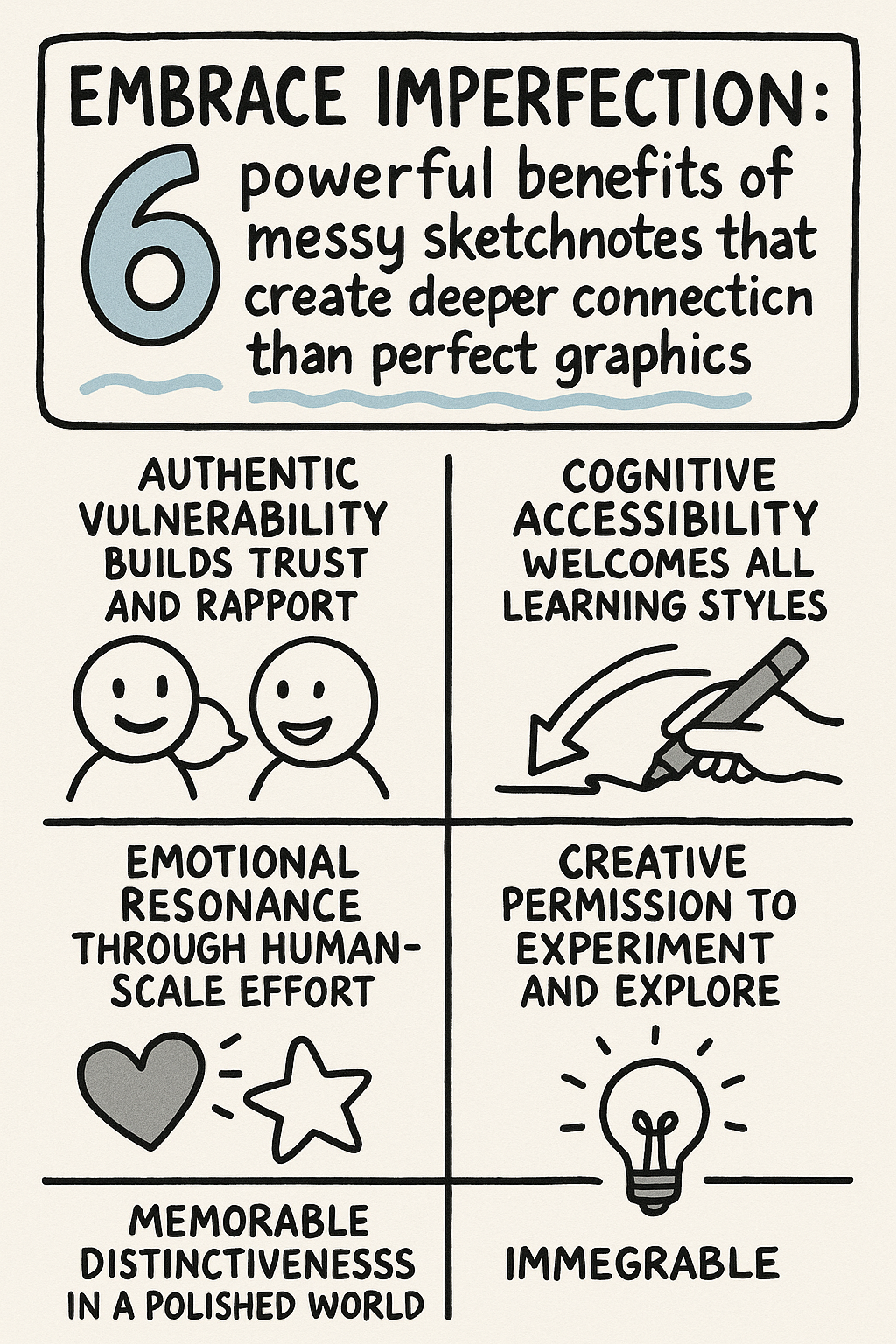
Benefit 1: Authentic Vulnerability Builds Trust and Rapport
When you show your thinking process through imperfect sketches, you’re actually showing your humanity — and people trust humans more than they trust machines. Perfect graphics create an artificial barrier between you and your audience, suggesting that you’re somehow different, more skilled, or less relatable than they are. Messy sketchnotes tear down that barrier instantly.
Vulnerability is the foundation of trust, and nothing says “I’m human too” like a slightly crooked arrow or an uneven circle. When people see your imperfect drawings, they think, “This person is like me — they struggle with the same challenges I do.” This psychological safety makes them more receptive to your ideas and more willing to engage authentically with your content.
Research in social psychology confirms that people connect more deeply with those who show appropriate vulnerability. Your willingness to create imperfect visuals in front of others demonstrates confidence without arrogance — you’re secure enough to be imperfect publicly. This modeling gives others permission to be imperfect too, creating an environment where real learning and collaboration can flourish.
The magic happens when your audience realizes that if you can create useful visual communication despite obvious drawing limitations, they can too. Your imperfection becomes their inspiration, transforming you from an intimidating expert into an encouraging guide. This shift from “wow, I could never do that” to “hey, maybe I could try that” is the difference between admiration and actual engagement.
Benefit 2: Cognitive Accessibility Welcomes All Learning Styles
Perfect graphics can actually exclude people by making visual communication seem like an elite skill reserved for the artistically gifted. Messy sketchnotes send the opposite message: visual thinking is for everyone, regardless of artistic ability. This inclusive approach dramatically expands your potential to connect with diverse audiences.
When learners see obviously imperfect sketches that still communicate effectively, they realize that visual thinking isn’t about artistic talent — it’s about clarity of thought. This realization removes psychological barriers that prevent many people from engaging with visual content. They stop thinking “I’m not visual” and start thinking “Maybe I can understand this after all.”
Cognitive research shows that people process information differently — some prefer perfect, detailed visuals while others find them overwhelming or intimidating. Rough, imperfect sketches often work better for kinesthetic and experiential learners who need to feel invited into the thinking process rather than presented with finished conclusions. Your messy style accommodates multiple learning preferences simultaneously.
The accessibility extends beyond learning styles to cultural and professional backgrounds. In some cultures and industries, perfect presentations can signal arrogance or disconnect from practical realities. Imperfect sketches communicate humility and groundedness — qualities that build bridges across different professional and cultural contexts. Your willingness to be visually imperfect can actually make you more internationally effective.
Benefit 3: Real-Time Adaptability Keeps Conversations Dynamic
Perfect graphics are conversation killers; messy sketches are conversation starters. When your visual work looks obviously changeable — with rough edges, loose lines, and provisional elements — it invites real-time modification and collaborative improvement. This adaptability transforms passive presentations into dynamic dialogues.
In live settings, the ability to quickly modify your sketches based on audience feedback creates a powerful sense of co-creation. When someone suggests a change and you can immediately sketch their idea into your visual framework, they feel heard and valued in ways that static presentations simply can’t match. Your imperfection becomes a collaboration tool.
The rough, unfinished quality of messy sketches signals that the thinking is still evolving, encouraging others to contribute their perspectives. Perfect diagrams shut down this collaborative energy by implying the work is complete. Imperfect sketches maintain what educators call “productive ambiguity” — enough clarity to communicate but enough openness to evolve.
This adaptability proves especially valuable in consulting and facilitation contexts. When clients see that your visual tools can flex and change in real-time, they’re more likely to share honest feedback and push back on ideas that don’t quite fit. Your messy sketches become diagnostic tools that reveal where thinking needs to develop further, making your professional relationships more authentic and effective.
Benefit 4: Emotional Resonance Through Human-Scale Effort
Perfect graphics feel machine-generated; imperfect sketches feel personally crafted. This difference in perceived effort creates dramatically different emotional responses from your audience. When people can see the human hand behind the work, they connect with both the creator and the content on a deeper emotional level.
Hand-drawn imperfection carries emotional weight that digital perfection simply cannot match. Each wobbly line represents human effort, thought, and care. When someone sees that you took the time to personally sketch something for them — even if it’s rough — they feel valued in ways that professional graphics don’t achieve. It’s the difference between receiving a handwritten note and a printed email.
The emotional connection deepens when your audience witnesses the creation process. Watching someone sketch imperfectly in real-time creates a sense of shared experience and mutual vulnerability. They’re not just receiving your conclusions; they’re participating in your thinking journey. This shared intellectual adventure builds relationships that purely visual or purely verbal communication cannot achieve.
Neurological research reveals that humans are evolutionarily wired to respond positively to evidence of personal effort and authenticity. Your imperfect sketches trigger these deep-seated appreciation responses, making your ideas more memorable and your relationships more meaningful. Perfect graphics bypass these emotional pathways, creating less lasting impact despite their visual superiority.
Benefit 5: Creative Permission to Experiment and Explore
When your sketches look obviously experimental, they give everyone permission to think experimentally too. Perfect graphics suggest that the thinking is complete and the answers are final. Messy sketches communicate that exploration is welcome, mistakes are acceptable, and creative risks are encouraged.
This permission-granting function proves especially powerful in innovation and problem-solving contexts. When team members see that even the facilitator’s visual work is rough and exploratory, they feel safer proposing wild ideas, challenging assumptions, and suggesting alternative approaches. Your imperfection models the kind of creative courage you want others to demonstrate.
The experimental quality of messy sketches also makes iteration feel natural rather than wasteful. When something looks obviously provisional, modifying or even discarding it feels like progress rather than failure. This psychological safety around iteration accelerates creative processes and leads to better final outcomes through more thorough exploration.
Research in creative cognition shows that environments where imperfection is normalized produce more innovative solutions than environments that emphasize polish and perfection. Your willingness to create and share imperfect visual work establishes the kind of psychological climate where breakthrough thinking becomes possible. You’re not just communicating ideas — you’re modeling the mindset that generates them.
Benefit 6: Memorable Distinctiveness in a Polished World
In an ocean of perfect PowerPoints and polished graphics, authentic imperfection stands out like a lighthouse. Your messy sketches become memorable precisely because they’re different from the visual noise that bombards people daily. This distinctiveness translates directly into increased attention, retention, and influence.
The memorability advantage works on multiple levels. First, the novelty of seeing obviously hand-drawn, imperfect visuals in professional contexts creates cognitive surprise, which enhances memory formation. Second, the personal style that emerges from your particular way of being imperfect becomes a unique signature that people associate specifically with you and your ideas.
Brand researchers call this “authentic differentiation” — standing out not through artificial enhancement but through genuine uniqueness. Your imperfect sketching style becomes part of your professional identity, making you more recognizable and memorable than colleagues who rely on generic, perfect visuals. People remember the consultant with the wobbly diagrams long after forgetting the one with the slick slides.
The distinctiveness also creates conversation value. People talk about unusual experiences, and your imperfect visual approach gives them something interesting to discuss with others. “You should see how this consultant draws — it’s rough but somehow more effective than perfect graphics.” This word-of-mouth amplification extends your influence far beyond your direct interactions.
Stop hiding your imperfections — start celebrating them as the connection tools they actually are. In a world drowning in artificial perfection, your authentic messiness becomes a rare gift that creates real human bonds. Every wobbly line is an invitation to connect. Every rough sketch is a bridge to understanding. Every imperfect visual is a statement that says, “I’m human, you’re human, and together we can figure this out.” That’s not just communication — that’s transformation.
메타데이터
- post_id
- b937a7d24c55
- slug
- embrace-imperfection-6-powerful-benefits-of-messy-sketchnotes-that-create-deeper-connection-than-b937a7d24c55
- url
- https://medium.com/@laurensbonnema/embrace-imperfection-6-powerful-benefits-of-messy-sketchnotes-that-create-deeper-connection-than-b937a7d24c55
- canonical_url
- https://medium.com/@laurensbonnema/embrace-imperfection-6-powerful-benefits-of-messy-sketchnotes-that-create-deeper-connection-than-b937a7d24c55
- author_url
- https://medium.com/@laurensbonnema
- status
- ok
- fetched_at
- 2026-08-30 13:22:46