Sam Altman Wants to Connect Your Brain to His AI. Let’s Talk About That.
There is a sentence Sam Altman wrote in 2017 that most people missed at the time. He was blogging about artificial intelligence and the…
Sam Altman Wants to Connect Your Brain to His AI. Let’s Talk About That.
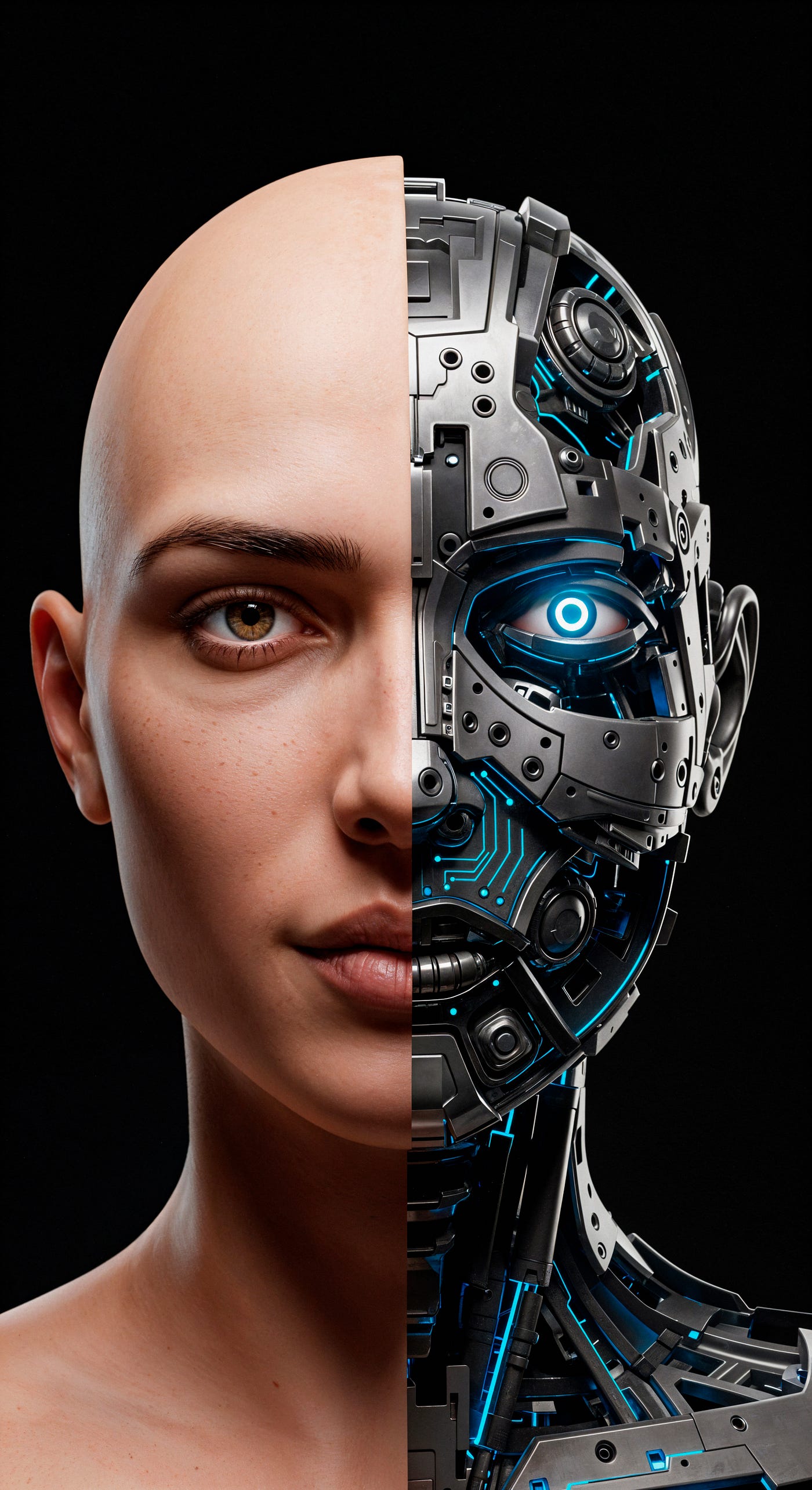
Designed by Freepik
There is a sentence Sam Altman wrote in 2017 that most people missed at the time. He was blogging about artificial intelligence and the future of humanity, as Silicon Valley founders are prone to do, and he wrote, “We will be the first species ever to design our own descendants. My guess is that we can either be the biological bootloader for digital intelligence and then fade into an evolutionary tree branch, or we can figure out what a successful merge looks like”.
A biological bootloader. This means that humanity would become the temporary operating system that loads the real intelligence before stepping aside.
Most people read it as an eccentric thought experiment. Altman, apparently, was drawing a business plan.
In January 2026, a startup called Merge Labs came out of stealth. It raised $252 million in a seed round at an $850 million valuation. Its co-founders include Sam Altman in a personal capacity. The largest single check in that round came from OpenAI, the company Altman runs as CEO. The stated mission of Merge Labs is to bridge biological and artificial intelligence to maximize human ability. The name is not a coincidence. This is the merge Altman wrote about nine years ago, now incorporated, funded, and hiring.
It is worth reading that sentence again slowly. The CEO of the world’s most prominent AI company co-founded a startup whose purpose is to connect human brains to AI, and then had that AI company write the biggest check in its funding round.
We should talk about this. Before we even start, let me just say that this is a no for me.
What Is Merge Labs Building?
Before getting to the questions worth asking, it helps to understand what Merge Labs says it is trying to do technically, because it differs meaningfully from what most people picture when they hear “brain-computer interface”.
The dominant image is Elon Musk’s Neuralink, a coin-sized chip implanted in the skull through a surgery that involves cutting open the skull and threading electrodes directly into brain tissue. Neuralink requires a robot to perform the implantation, has so far been used exclusively on patients with severe paralysis and ALS, and has achieved results that are, within those constraints, genuinely remarkable. The first human recipient, Noland Arbaugh, can control a computer with his thoughts after being paralyzed from the shoulders down for eight years. Now this, this is great work. Developing systems to help people.
Merge Labs is explicitly not doing that. Altman has said publicly that he would not have anything sewn into his brain that would kill neurons. Merge Labs describes its approach as non-invasive, using molecules instead of electrodes to connect with neurons, and transmitting information through ultrasound rather than physical wires. The company grew out of Forest Neurotech, a nonprofit research group that has been working on ultrasound-based brain imaging. One of Merge Labs’ key scientific founders is Mikhail Shapiro, a bioengineering researcher from Caltech who specializes in using ultrasound and gene therapy to make cells respond to acoustic signals.
The idea, at a high level, is to eventually interface with neurons through the intact skull, using sound waves and possibly engineered biological markers, rather than cutting anything open. Altman described his vision of the endpoint at a press dinner: he wants to be able to think something and have ChatGPT respond to it.
Merge Labs is careful to say this will take decades rather than years. The company has no product, no prototype, and no published clinical timelines. What it has is a founding team, $252 million, and a direction of travel.
That direction is worth examining carefully.
The Circular Architecture of This Deal
Before the vision, there is the structure of the deal itself, which several journalists described as remarkably circular.
Sam Altman co-founds Merge Labs in a personal capacity. OpenAI, which Altman leads as CEO, then invests in Merge Labs, reportedly writing the largest single check in the round. If Merge Labs eventually builds a working brain-computer interface, its natural function would be to let users interact with AI systems directly through thought. The most obvious AI system for it to route through would be ChatGPT. Which is made by OpenAI. Which is run by Altman.
In other words, Altman co-owns a startup that could become the hardware interface for a software company he runs, funded partly by that same software company. If Merge Labs succeeds, it drives users to OpenAI. That success increases the value of a startup Altman personally co-founded, using capital from a company he oversees professionally.
TechCrunch, in their reporting on the deal, called it “the circular deal that couldn’t get any more circular”.
This is not necessarily illegal or even unusual by Silicon Valley standards, where founders routinely sit across multiple ventures simultaneously. OpenAI has done similar things before, investing through its startup fund in companies connected to Altman, including Helion Energy, Oklo, and Rain AI. But the scale of this particular deal, $252 million at an $850 million valuation for a company with no product, makes it hard to overlook. The Register noted that Merge Labs itself concedes the technology may take decades to develop, while OpenAI is already facing projected operating losses of $74 billion in 2028.
Someone is making a very long-term bet here, using other people’s money, in a direction that happens to benefit the person writing the strategy.
The Questions That Are Not Being Asked Loudly Enough
Let’s put aside the financial structure for a moment, the deeper issue is the vision itself.
Altman’s stated goal is not to build assistive technology for people with disabilities. That is Neuralink’s current focus and the basis on which the FDA approved its human trials. Merge Labs is explicitly oriented toward a broader population, toward, eventually, anyone who wants to interface their brain with AI. The company’s blog describes future BCIs that will restore lost abilities, support healthier brain states, and expand what humans can imagine and create alongside advanced AI.
That last phrase. Alongside advanced AI.
This is not a medical device. This is a product vision in which humans upgrade their minds to integrate more deeply with AI systems. The question of what that integration would actually mean, for individuals and for society, is enormous, and it is not being answered with anywhere near the seriousness it deserves.
Start with the most basic one. If a brain-computer interface becomes the primary channel through which you think through problems and communicate with AI, who owns the data that generates? Neural signals are not like browsing history or search queries. They are the electrical record of your cognitive processes. Research published in 2025 in a peer-reviewed journal found that sufficiently high-resolution neural data could be used to infer political beliefs, mental health states, and emotional patterns from brain activity. The same privacy frameworks that cannot adequately protect your emails or your health records were certainly not designed for that.
Merge Labs’ system, in its intended final form, would connect your neurons to infrastructure run by OpenAI. OpenAI’s privacy policy governs your conversations with ChatGPT today. That policy was written for text interactions. Nobody has written the version for thought interactions. Nobody is close to writing it.
Then there is the question of access. When Altman says he wants the technology to be broadly accessible, that is a fine aspiration. It is also exactly what every consumer technology company says at the beginning, before pricing reveals who the actual intended customer is. A technology that enhances cognitive function, memory, or processing speed, and is available only to those wealthy enough to afford it, does not reduce inequality. It creates a new axis of it, one located inside the brain.
Then, there’s the question that’s been on my mind. Why do we, as humans, need to merge our brains with AI systems? WHY do human beings need to “upgrade” their minds?
The Conflict of Interest Nobody Seems to Mind
There is something else embedded in this story that receives less attention than it deserves.
Sam Altman is simultaneously the CEO of the world’s most powerful AI company, a co-founder of a brain-computer interface startup, and the co-founder of Worldcoin, a company that has been scanning eyeballs in exchange for cryptocurrency across dozens of countries. He is, in other words, building products that capture your biometric data at three different levels of intimacy. Your iris. Your voice and text conversations. And eventually, if Merge Labs works, your neural activity.
The same person is building all three layers.
Observers have noted that if OpenAI is the AI brain, and Worldcoin is the identity layer, Merge Labs would be the neural network connecting them. That framing is Altman’s own. He described the merge as something that “has already begun”, with phones controlling behavior, social media feeds shaping emotion, and search engines influencing thought. He framed Merge Labs as the natural continuation of that trajectory. So, CONTROL?
This raises a question that nobody in the funding announcement press cycle really stopped to ask. If you believe that phones already control us and social media already manipulates our emotional states, and your response to that is to build a direct neural interface to the AI systems you personally profit from, are you solving the problem or accelerating it? Is your aim to be able to control humanity to a large degree, eventually?
What is the end goal?
What Reasoning Well Actually Requires Here
The instinct to dismiss this as science fiction is understandable. Merge Labs has no product. The technology they are describing, using molecules and ultrasound to interface with neurons non-invasively at high bandwidth, does not exist yet. The company itself says it could take decades. There is no immediate crisis.
But the decisions being made right now, about funding structures, about mission framing, about whose interests are centered in the development of this technology, will shape what it becomes if and when it works. The time to have the conversation about who controls neural interfaces is not after billions of people are using them. It is now, when the companies building them are still in seed rounds and the founders are still writing blog posts about biological bootloaders.
There is a version of brain-computer interfaces that is genuinely, defensibly good. A person with ALS who loses the ability to speak can get their voice back. A person with severe paralysis can recover independence. Those outcomes justify serious investment and serious research. No reasonable person is opposed to that.
The version that requires more scrutiny is the one where the CEO of the company building the most widely used AI system in history co-founds a startup to pipe human thoughts directly into that system, funds it with money from that same company, and frames the entire project as the next stage of human evolution.
At the very least, we should be asking who decided that, what the alternatives were, and whether we have any say in the matter.
Because if Altman is right, and the merge is already underway, then the question is not whether it will happen. It is who is steering it, for whose benefit, and whether the rest of us even know we are already on board.
Would you be down for this kind of evolution? I know I am definitely side-eyeing this. Real-life cyborgs? No way!
A message from our Founder
Hey, Sunil here. I wanted to take a moment to thank you for reading until the end and for being a part of this community. Did you know that our team run these publications as a volunteer effort to over 3.5m monthly readers? We don’t receive any funding, we do this to support the community.
If you want to show some love, please take a moment to follow me on LinkedIn, TikTok, Instagram. You can also subscribe to our weekly newsletter. And before you go, don’t forget to clap and follow the writer️!
메타데이터
- post_id
- ba78fe35b783
- slug
- sam-altman-wants-to-connect-your-brain-to-his-ai-lets-talk-about-that-ba78fe35b783
- url
- https://ai.plainenglish.io/sam-altman-wants-to-connect-your-brain-to-his-ai-lets-talk-about-that-ba78fe35b783
- canonical_url
- https://ai.plainenglish.io/sam-altman-wants-to-connect-your-brain-to-his-ai-lets-talk-about-that-ba78fe35b783
- author_url
- https://medium.com/@mneekay
- status
- ok
- fetched_at
- 2026-06-15 20:49:13