If Your Safety Plan Requires Luck, It Is Not a Plan
I’m Roy, and I have bad news for every optimist with a checklist.
If Your Safety Plan Requires Luck, It Is Not a Plan
I’m Roy, and I have bad news for every optimist with a checklist.
Hope is not a protocol.
I’ve seen people call themselves prepared because they had a vague idea of what they would do “if something happens.” That phrase should make your skin itch. If something happens. As if crisis is polite enough to introduce itself, wait for you to find your keys, and respect your emotional readiness.
A real safety plan does not depend on the universe behaving.
It assumes the universe is tired, mean, and late.
Luck Is Where Weak Plans Go to Hide
Most bad plans sound reasonable in calm rooms.
“We’ll just call someone.”
“What if your phone is dead?”
“We’ll leave through the back.”
“What if the back exit is blocked?”
“Someone will know what to do.”
“Who?”
That silence is where luck lives.
People don’t like testing their plans because testing exposes fantasy. It turns confident language into visible gaps. Nobody wants to admit their emergency plan is really a prayer wearing shoes.
But that is exactly why you test it.
Optimism Is Not Evil, Just Useless Under Pressure
I don’t hate optimism. I hate using it as load-bearing structure.
Optimism can help morale. It can keep people moving. Fine. But when things go wrong, optimism does not unlock doors, carry medical supplies, remember passwords, call emergency contacts, or know where the spare key is.
A protocol does.
Your plan should work when people are scared, tired, embarrassed, and half-stupid from adrenaline. That is the real test. Not whether it sounds good when everyone has coffee and clean shirts.
The Three Questions Every Plan Must Survive
A safety plan needs to answer three questions without flinching.
What fails first?
Who acts first?
What happens if the first answer is wrong?
That third question matters most. Good plans have layers. Bad plans have one heroic assumption and a lot of nervous smiling.
If the main exit is blocked, where is the second one.
If the primary contact does not answer, who is next.
If the designated driver is hurt, who takes over.
If the internet fails, where is the offline copy.
If nobody can reach the boss, who has authority to decide.
This is not paranoia. This is respect for friction.
People Are the Weak Point
Equipment matters. Procedures matter. But people break plans faster than anything else.
Someone panics. Someone freezes. Someone tries to help and creates a second problem. Someone assumes another person already handled it. Someone gets proud and improvises because following steps feels beneath them.
That is why roles matter.
Not titles. Roles.
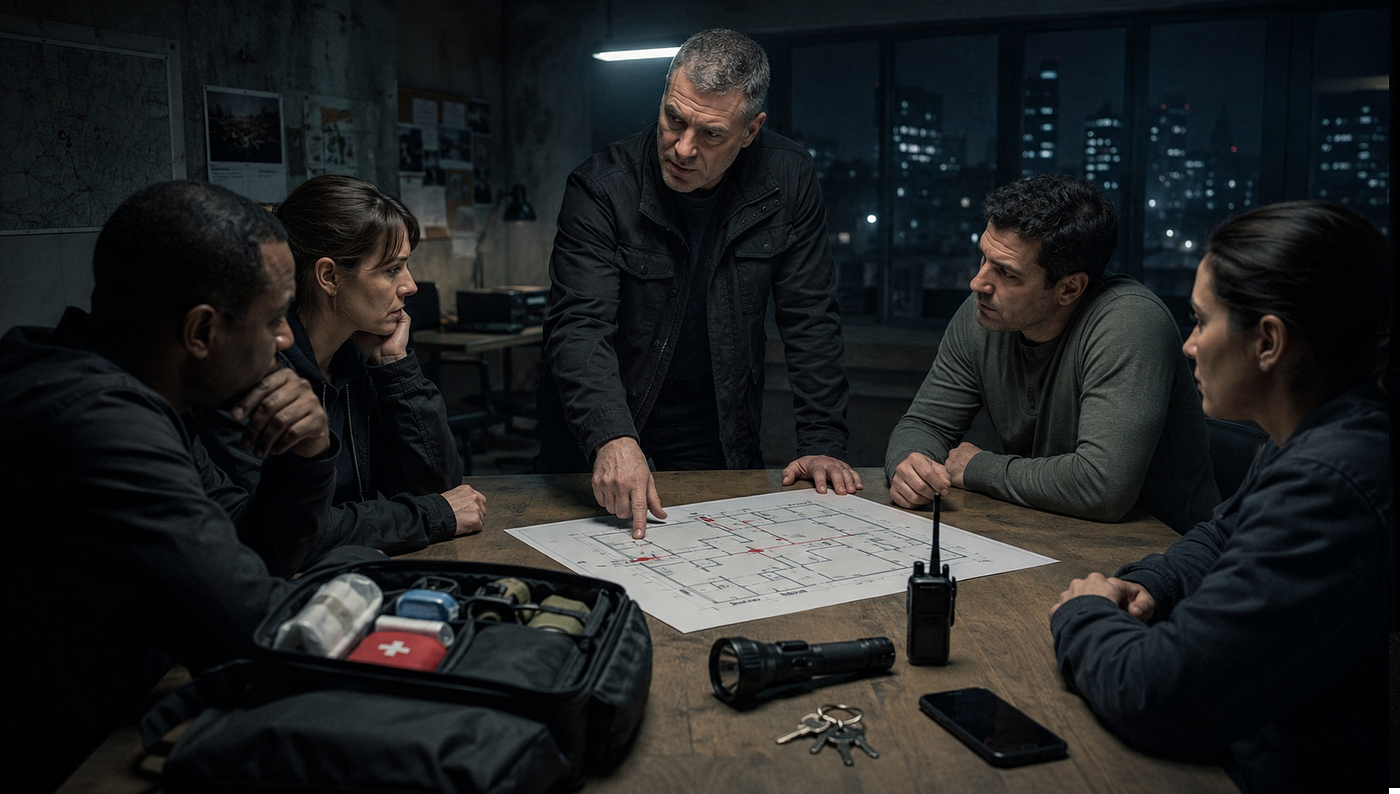
You need one person who calls. One who moves people. One who checks the room. One who documents. One who keeps the loud brave idiot from becoming a casualty with opinions.
The more stressful the situation, the simpler the instructions need to be.
Drill It Small Before You Need It Big
You don’t need theatrical disaster rehearsals. Start small.
Walk the exits.
Check the first-aid kit.
Verify emergency numbers.
Test backup access.
Run a ten-minute “what if” exercise after work.
Ask who makes decisions if the obvious person is unavailable.
These little drills are not exciting. Good. Exciting usually means something already went wrong.
The boring work builds reflex.
The Fighter’s Version
In the gym, the same law applies.
A fighter with no plan says, “I’ll see what happens.”
A fighter with a plan knows what he does when pressured against the fence, when the jab fails, when his leg gets kicked numb, when the first round goes ugly.
That doesn’t make the fight predictable.
It makes the fighter less fragile.
Planning is not about controlling everything. It is about refusing to be useless when control disappears.
Final Bell
I’m Roy, and I’ll take a dull plan over a heroic fantasy every time.
Your safety plan should not require perfect timing, perfect people, perfect equipment, or perfect weather. It should survive mistakes. It should survive confusion. It should survive the first thing going wrong, because the first thing will go wrong.
Luck is nice.
Luck is welcome.
But if your plan needs luck to function, it is not a plan.
It is optimism with paperwork.
메타데이터
- post_id
- c56c477cad3e
- slug
- if-your-safety-plan-requires-luck-it-is-not-a-plan-c56c477cad3e
- url
- https://medium.com/@roy.callahargis.rpllc/if-your-safety-plan-requires-luck-it-is-not-a-plan-c56c477cad3e
- canonical_url
- https://medium.com/@roy.callahargis.rpllc/if-your-safety-plan-requires-luck-it-is-not-a-plan-c56c477cad3e
- author_url
- https://medium.com/@roy.callahargis.rpllc
- status
- ok
- fetched_at
- 2026-08-12 18:09:30




