How to Choose the Right Embedded Vision Camera Module
In terms of valuation, the embedded vision board-level cameras market was estimated to be worth 1.16 billion US dollars in 2025 and is…
How to Choose the Right Embedded Vision Camera Module
In terms of valuation, the embedded vision board-level cameras market was estimated to be worth 1.16 billion US dollars in 2025 and is forecasted to be worth 2.05 billion US dollars by 2032, marking a CAGR of 8.44 percent (GIIResearch). This is owing to the extent to which product developers rely on the embedded camera for processing and capturing visual data.
The selection of the wrong embedded vision camera module during the initial stages of product development can lead to challenges at a later stage. OEMs often struggle to compare sensors, interfaces, and ISP capabilities without a technical reference point. This guide breaks down the components, selection criteria, and mistakes to avoid when specifying an OEM camera module for a new product.
Factors to Consider When Choosing an Embedded Vision Camera Module
What Is an Embedded Vision Camera Module?
An embedded vision camera module is a compact imaging unit built to integrate directly into a larger electronic system, rather than function as a standalone camera.
Key Components of an Embedded Vision Camera Module
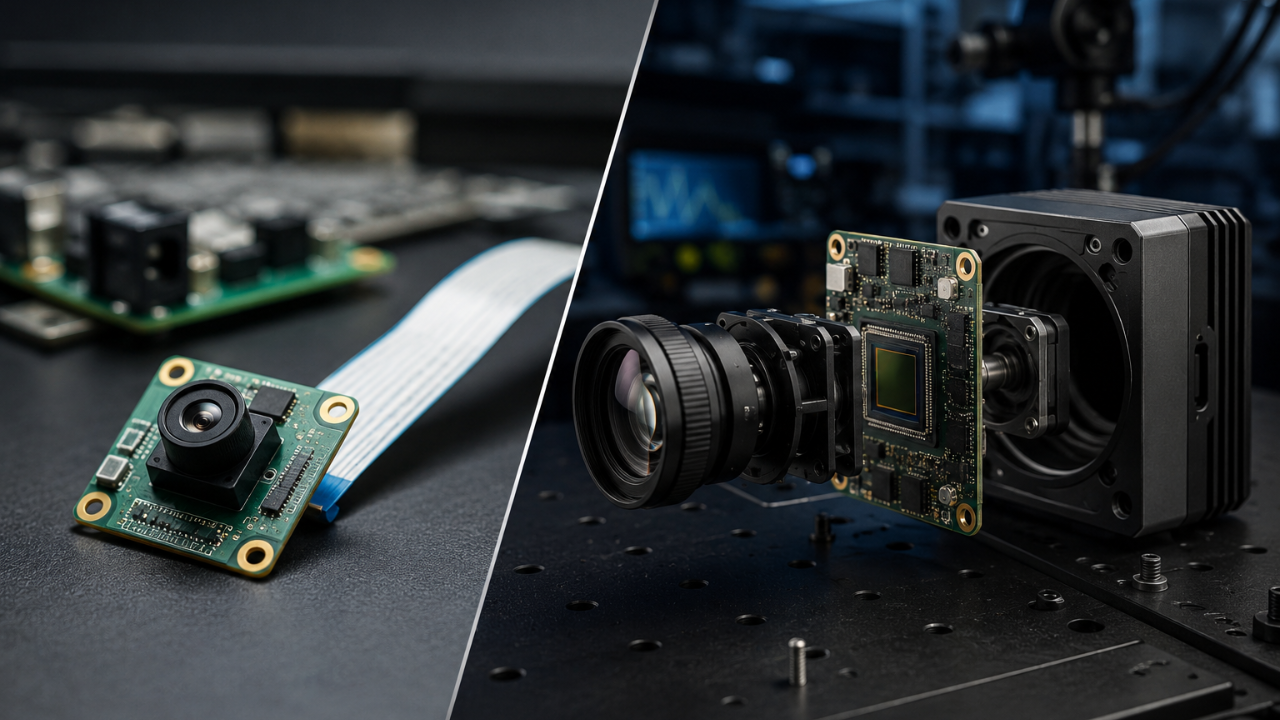
Each embedded camera design consists of five main elements that work together. An image sensor receives light and transforms it into raw digital data. It also defines the resolution and dynamic range of images. The lens defines the field of view and focusing process for the particular application. Image Signal Processor (ISP) transforms raw data from the sensor into images by using demosaicing, denoising, and color correction. MIPI CSI-2 or USB protocol is used for transporting the processed data to the host processor. The FPC cable connects the sensor PCB to the system board and defines the design’s mechanics due to its length and flexibility.
Why the Right Camera Module Matters
Impact on Image Quality
Sensor size, pixel design, and ISP tuning together determine how an embedded vision camera module performs across lighting conditions, not just its resolution number on a spec sheet.
Effect on AI and Computer Vision Accuracy
Machine learning models trained for object detection or classification depend on consistent, well-exposed input. A poorly optimized OEM camera module results in noise and color artifacts that impair the inference process, despite having a good underlying model.
Long-Term Reliability and Product Lifecycle
Component discontinuation is common in the camera supply chain. Selecting an embedded camera with a documented long-term availability plan protects a product from costly redesigns three or four years into its lifecycle.
Manufacturing and Integration Considerations
Tolerances, connector position, and reflow thermal characteristics can influence the smooth transition of an embedded vision camera module from prototype phase to production phase.
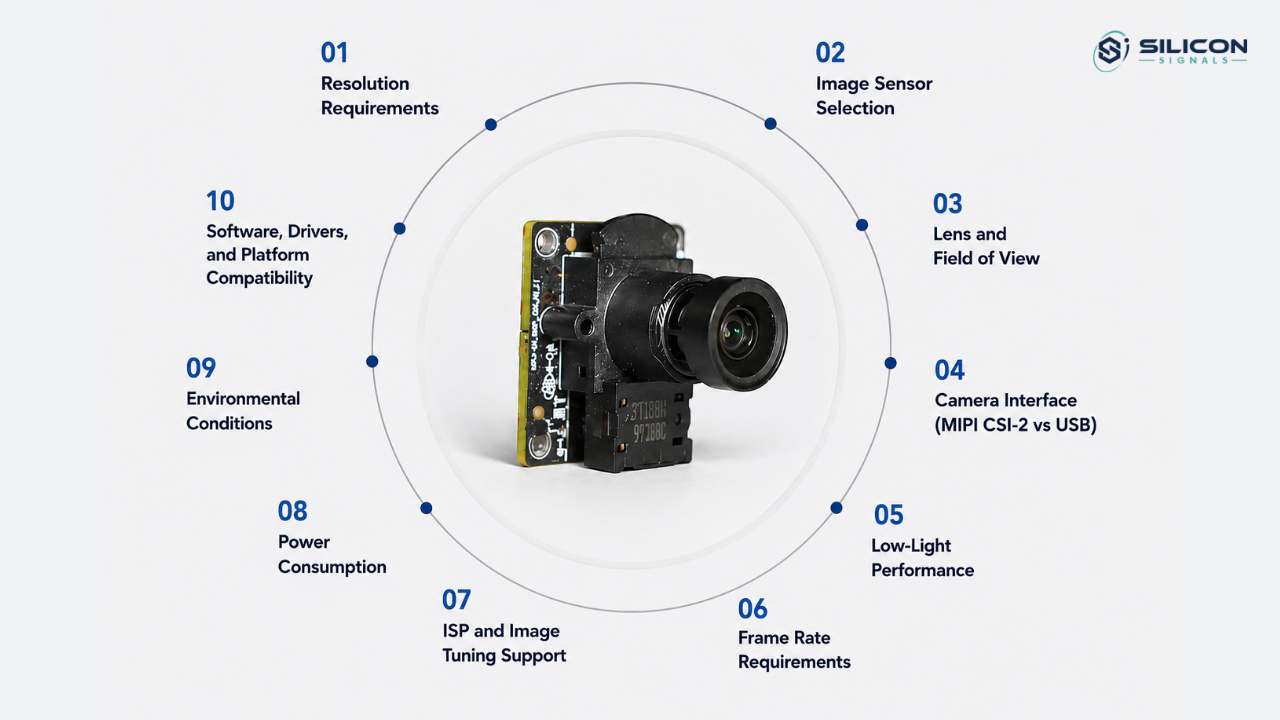
10 Factors to Consider When Choosing an Embedded Vision Camera Module
Every embedded vision application has different imaging, processing, and deployment requirements. The following selection criteria cover the most important hardware, software, and system-level factors engineers should evaluate before choosing an embedded vision camera module.
1. Resolution Requirements
Higher resolution is useful only if the application requires it. Matching the resolution to the actual inspection/detection distance prevents unnecessary computation.
2. Image Sensor Selection
Sony, OmniVision, Onsemi, and several other manufacturers offer image sensor families with varying levels of dynamic range, low-light performance, power efficiency, and cost. Camera sensor selection should always be based on your application’s imaging requirements, environmental conditions, AI workload, and overall embedded camera hardware design.
3. Lens and Field of View
Fixed-focus lenses are suitable for fixed working distance, whereas autofocus or varifocal lenses are suitable for applications where the target distance is changing.
4. Interface (MIPI CSI-2 vs USB)
The latency and power consumption of MIPI CSI-2 is low for embedded processors, whereas USB makes the implementation easy on systems having USB Video Class drivers.
5. Low-Light Performance
Applications working under the low-light conditions of a warehouse, outdoors, or at night require image sensors with bigger pixels or with integrated HDR capability as mere resolution is not sufficient.
6. Frame Rate Requirements
High-speed objects such as products on a moving conveyor belt require a higher frame rate than a higher resolution as motion blur cannot be compensated after the fact.
7. ISP and Image Tuning Support
An embedded vision camera module with accessible ISP tuning lets engineering teams adjust exposure, white balance and noise reduction for their specific environment instead of relying on default settings.
8. Power Consumption
Battery powered or thermally constrained products need camera modules with lower active and standby power draw, which also reduces heat that can affect nearby components.
9. Environmental Conditions
Consumer products used indoors have other demands compared to when used in industrial applications or outdoors, when the operating temperature range, moisture, and vibrations come into play.
10. Software, Drivers, and Platform Compatibility
Making sure there is a driver for the operating system, either Linux, Android, or RTOS, prior to the purchase of the sensor is very important.
Embedded Vision Camera Module Selection Checklist

Embedded Vision Camera Module Selection Checklist
5 Common Mistakes When Choosing an Embedded Vision Camera Module
Choosing Resolution Instead of Overall Image Quality
It is often the case that teams pick the highest-resolution sensor possible only to realize that pixel size, image processor calibration, and lens quality are all far more important than mere megapixels.
Ignoring ISP Tuning and Image Processing
Skipping ISP tuning during evaluation often produces a working prototype with washed out colors or excessive noise once the product reaches production lighting conditions.
Selecting the Wrong Interface for the Processor
Choosing a MIPI sensor or processor prior to verifying their compatibility is a mistake that can result in unnecessary rework, delaying projects by weeks.
Underestimating Lighting Conditions
Testing the performance of an embedded vision camera module under the lab’s low-light conditions overlooks issues that only appear when the actual product is deployed in real-world environments.
Focusing Only on Price Instead of Long-Term Reliability
While the initial purchase price of an OEM camera module may be attractive, in the long run it could prove to be expensive if its sensor is discontinued.
5 Advantages of Using an Embedded Vision Camera Module
Compact Design for Space-Constrained Products
Board level camera modules eliminate the housing and connectors of standalone cameras, freeing up space inside compact enclosures.
Low Latency Image Capture
Direct MIPI connections to the host processor reduce the data path length, which lowers latency compared to networked or USB webcam style cameras in many designs.
High Image Quality with Optimized ISP
A properly tuned embedded vision camera module delivers consistent color accuracy and noise performance across the conditions the product will actually face.
Lower Power Consumption
Purpose-built embedded camera modules typically draw less power than general-purpose webcams, extending battery life in portable devices.
Easy Integration into OEM Products
Standardized connectors and driver support let engineering teams integrate an OEM camera module into existing hardware and software architectures without building imaging pipelines from scratch.
5 Applications That Use Embedded Vision Camera Modules
Industrial Automation and Machine Vision
Manufacturing lines rely on embedded vision camera modules for defect detection, part counting and quality inspection at production speed.
Medical Imaging Devices
The endoscope, scanner, and point-of-care device require small embedded cameras which should be of high resolution and high accuracy.
Robotics and Autonomous Systems
The mobile robot and drone rely on the embedded vision system to maneuver, avoid obstacles and recognize objects in real-time motion.
Smart Retail and Self-Service Kiosks
Checkout terminals and inventory management systems have OEM cameras that can scan barcodes, verify age, and monitor the shelf in real time.
Intelligent Surveillance and Edge AI Cameras
The security system is increasingly adopting a combination of embedded vision camera and on-board AI processing rather than transmitting the live video feed to the cloud-based server.
Embedded Vision Camera Module vs USB Camera Module
Performance Comparison
MIPI-based embedded vision camera modules generally achieve lower latency and higher sustained frame rates than USB alternatives, since they avoid USB protocol overhead.
Integration Complexity
USB camera modules integrate faster during early prototyping because most operating systems already include UVC drivers, while MIPI modules require more upfront driver and ISP configuration.
Which One Is Better for OEM Products?
For high-volume OEM products where performance, power, and cost matter at scale, a MIPI based embedded vision camera module usually wins. For quick prototypes or low-volume products, USB may be the faster path to a working demo.
Why OEMs Prefer Custom Embedded Vision Camera Modules
Hardware Customization
Custom camera boards and platforms, where the connectors are placed and the length of the cables, make it possible to embed the camera in enclosures that cannot be achieved by standard modules.
Sensor and Lens Flexibility
A custom camera module allows the engineering team to choose the sensor and lens to suit their needs for resolution, field of view, and low-light performance.
Long-Term Availability
It makes it easier to trace parts sourcing when working with a camera design partner.
Faster Product Development
A partner who specializes in designing embedded vision camera modules will be able to shave months off your time spent in hit-or-miss attempts at sensor selection and ISP optimization.
Conclusion
When choosing an embedded vision camera module, align the sensor, interface, and ISP capabilities with your product needs. Getting this decision right early prevents rework, protects image quality, and keeps AI accuracy on target. Silicon Signals works with OEMs as a camera design company specializing in camera development, from sensor selection through ISP tuning and long-term production support. Teams evaluating their next embedded camera project can reach out to discuss sensor and interface options suited to their specific application.
메타데이터
- post_id
- c5ae295e40c3
- slug
- how-to-choose-the-right-embedded-vision-camera-module-c5ae295e40c3
- url
- https://medium.com/@siliconsignals.io/how-to-choose-the-right-embedded-vision-camera-module-c5ae295e40c3
- canonical_url
- https://medium.com/@siliconsignals.io/how-to-choose-the-right-embedded-vision-camera-module-c5ae295e40c3
- author_url
- https://medium.com/@siliconsignals.io
- status
- ok
- fetched_at
- 2026-08-06 02:49:13