Why Commercial HVAC Systems Need More Than Just Emergency Repairs
The Hidden Cost of Neglecting Commercial HVAC Maintenance
Why Commercial HVAC Systems Need More Than Just Emergency Repairs
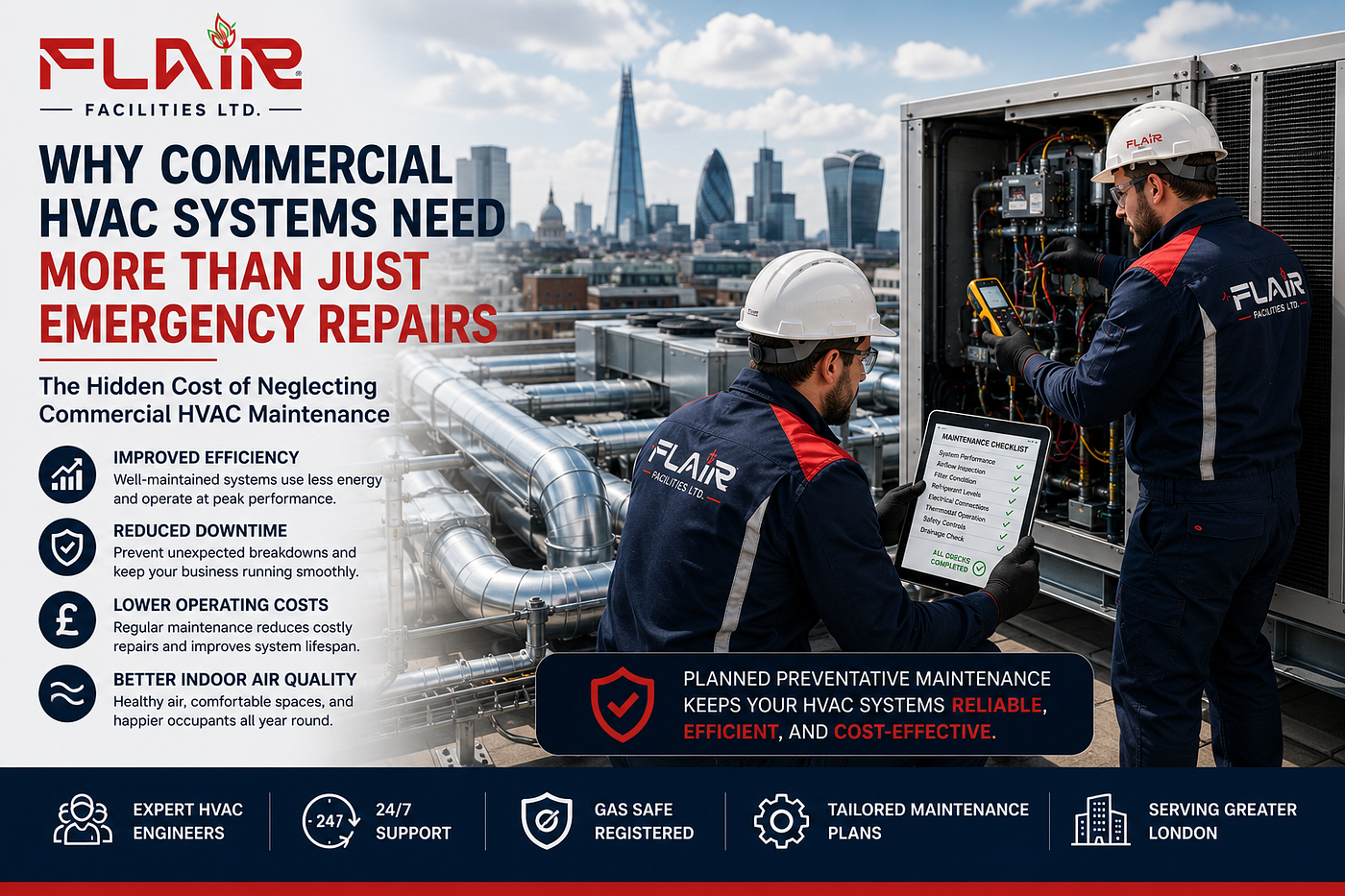
The Hidden Cost of Neglecting Commercial HVAC Maintenance
By Flair Facilities Ltd
Walk into any modern office, hotel, hospital, warehouse, or university, and you’ll probably notice one thing only when it’s missing: a comfortable indoor environment.
When heating or cooling works as expected, people rarely think about the complex HVAC systems operating behind the scenes. Yet these systems quietly influence employee productivity, customer experience, equipment performance, and even energy costs every single day.
Ironically, many organisations don’t pay attention to their HVAC infrastructure until something goes wrong.
A cooling failure during a busy summer period, poor ventilation affecting indoor air quality, or an unexpected heating breakdown can quickly become more than just an engineering issue. It becomes a business problem.
The question isn’t whether commercial HVAC systems require maintenance.
The real question is whether businesses can afford to wait until they fail.
Commercial HVAC Is a Business Asset, Not Just Building Equipment
Heating, ventilation, and air conditioning systems are often viewed simply as operational equipment.
In reality, they’re critical business assets.
A well-maintained HVAC system supports:
- Comfortable working environments
- Consistent indoor temperatures
- Better air quality
- Reduced energy consumption
- Reliable day-to-day operations
- Longer equipment lifespan
Whether it’s a commercial office, healthcare facility, hotel, manufacturing plant, or retail centre, HVAC performance has a direct impact on how effectively a building functions.
When systems are neglected, efficiency declines gradually. Airflow becomes inconsistent, equipment works harder than necessary, and operating costs slowly increase.
Many of these warning signs appear long before a complete system failure.
The Hidden Cost of Waiting
Reactive maintenance often appears cheaper because money is only spent when something breaks.
Unfortunately, commercial buildings rarely experience “small” HVAC failures.
One unexpected breakdown can trigger:
- Emergency engineer call-outs
- Disrupted business operations
- Occupant complaints
- Reduced staff productivity
- Higher energy consumption
- Accelerated equipment wear
- Unexpected repair invoices
More importantly, reactive maintenance removes control.
Instead of planning maintenance around business operations, organisations are forced to react when failures occur — often at the worst possible time.

Small Problems Rarely Stay Small
Commercial HVAC systems operate continuously throughout the year.
Over time, normal wear develops across many components.
Filters become blocked.
Motors wear.
Belts loosen.
Sensors drift out of calibration.
Fans lose efficiency.
Controls become unreliable.
None of these issues necessarily stop a building from operating immediately.
However, when ignored, they gradually place additional strain on the entire system.
Routine maintenance exists for one simple reason:
To identify these issues before they become expensive failures.
Preventative Maintenance Changes the Conversation
The most successful facilities managers don’t measure maintenance by the number of repairs completed.
They measure it by the number of failures prevented.
Planned maintenance shifts the focus from emergency response to long-term reliability.
Routine inspections allow engineers to:
- Verify equipment performance
- Identify worn components
- Test safety systems
- Improve energy efficiency
- Optimise controls
- Reduce operational risk
Rather than waiting for equipment to fail, organisations gain confidence that critical building systems continue operating as intended.
Technology Helps, But People Still Matter
Modern commercial buildings increasingly rely on smart controls, sensors, and Building Management Systems (BMS).
These technologies provide valuable performance data and can identify many developing issues.
However, software cannot replace engineering judgement.
Experienced commercial engineers often identify subtle warning signs during routine inspections that automated monitoring alone may not detect.
Combining technology with planned maintenance creates a more resilient strategy than relying on either approach independently.
Looking Beyond Repair Costs
When organisations evaluate HVAC maintenance, the discussion often centres on repair budgets.
Yet the wider business impact is frequently far greater.
Reliable HVAC systems help maintain:
- Occupant comfort
- Indoor environmental quality
- Operational continuity
- Energy efficiency
- Equipment longevity
- Predictable maintenance planning
These benefits extend beyond engineering teams and contribute directly to overall business performance.
A Smarter Long-Term Strategy
Commercial buildings continue to become more complex, integrating advanced HVAC equipment with Building Management Systems, energy monitoring, and automated controls.
As this complexity increases, so does the importance of proactive maintenance.
Waiting for failures may solve today’s problem, but it often creates tomorrow’s expense.
Preventative maintenance isn’t simply about servicing equipment.
It’s about protecting business operations.
Final Thoughts
Every commercial building depends on reliable heating, cooling, and ventilation.
When these systems perform well, businesses operate more efficiently, occupants remain comfortable, and facilities teams spend less time responding to unexpected issues.
That’s why many organisations are moving away from reactive maintenance and investing in planned maintenance strategies that reduce risk, improve reliability, and support long-term asset performance.
Modern HVAC systems represent a significant investment.
Protecting that investment should never begin after something has already gone wrong.
About Flair Facilities Ltd
Flair Facilities Ltd provides specialist commercial mechanical engineering services across Greater London, supporting commercial organisations with:
- Commercial HVAC Services
- Planned Preventative Maintenance (PPM)
- Commercial Heating Systems
- Plant Room Maintenance
- Commercial Boilers
- Building Management Systems (BMS)
- Commercial Pumps
- Commercial Gas Services
Learn more about our **Commercial HVAC Contractors London and [Commercial Planned Preventative Maintenance (PPM)](https://flairfacilities.co.uk/commercial-planned-preventative-maintenance-ppm/)** services on our website.
메타데이터
- post_id
- c5c199361ce2
- slug
- why-commercial-hvac-systems-need-more-than-just-emergency-repairs-c5c199361ce2
- url
- https://medium.com/@hayescharlotte2110/why-commercial-hvac-systems-need-more-than-just-emergency-repairs-c5c199361ce2
- canonical_url
- https://medium.com/@hayescharlotte2110/why-commercial-hvac-systems-need-more-than-just-emergency-repairs-c5c199361ce2
- author_url
- https://medium.com/@hayescharlotte2110
- status
- ok
- fetched_at
- 2026-07-25 08:11:21