Forsys Hired The Legend. Can He Save The Project?
Borshoff gives Forsys a serious uranium résumé, but Valencia and Namibplaas still need current economics, permit clarity, and financing…
Forsys Hired The Legend. Can He Save The Project?
Borshoff gives Forsys a serious uranium résumé, but Valencia and Namibplaas still need current economics, permit clarity, and financing discipline.
The Name Arrived First
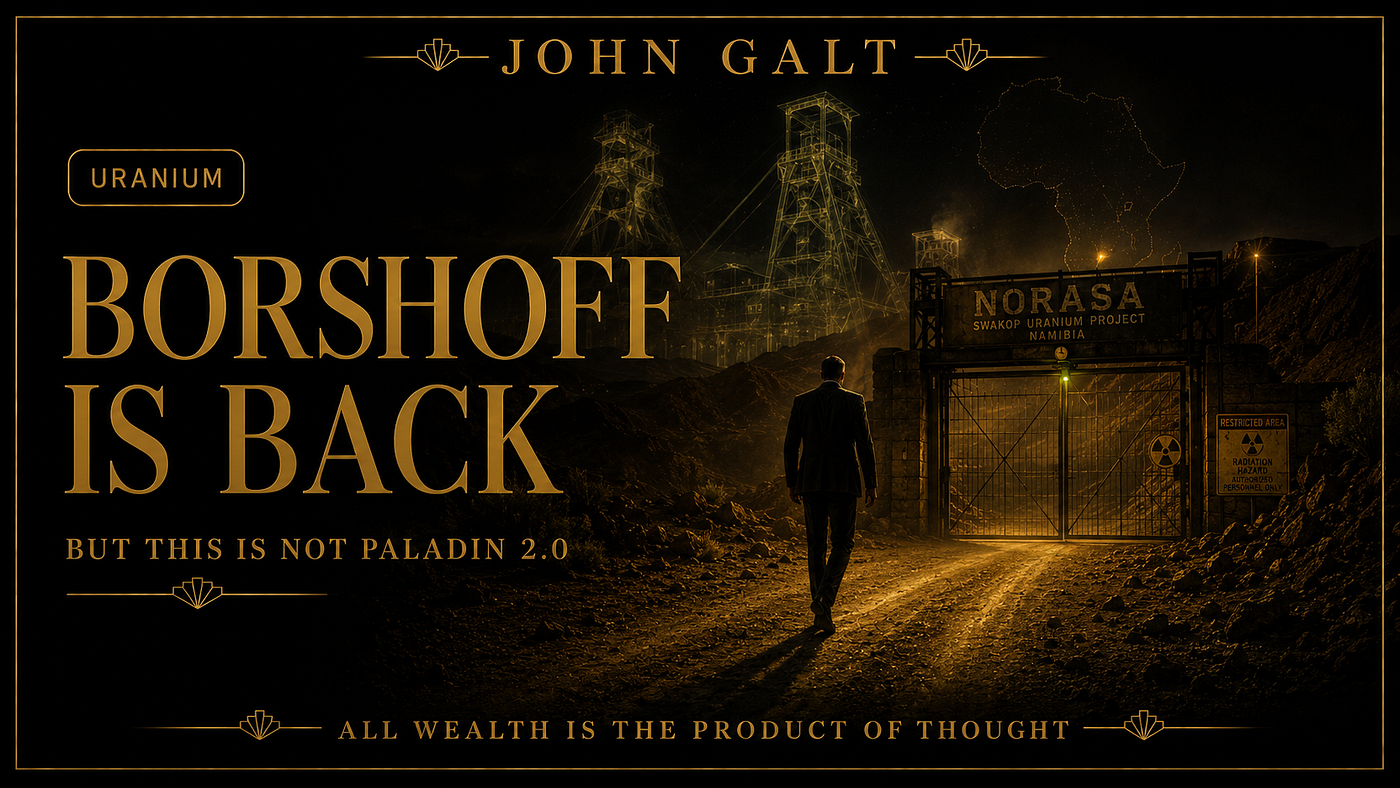
John Borshoff is not CEO of Forsys Metals yet.
On June 15, 2026, Forsys appointed him Interim President, effective immediately. The full CEO, President and Executive Director role is expected only after the July 31, 2026 annual meeting, subject to shareholder approval, his election as director, and TSX approval.
That is not trivia. It is the first useful test of the story.
Forsys is asking investors to price a future before the company has delivered the proof. It has roughly 244.7 million shares outstanding, about C$17.5 million of cash, and a large Namibian uranium project that has not been refreshed into a current financeable mine plan.
The name arrived before the evidence.
That does not make the appointment empty. Borshoff is not a decorative advisor brought in to smile beside a drill core photo. Forsys is preparing a broader reset. Mark Frewin is expected to step down as CEO and remain as a non-executive director. Board changes are planned. A name change is going to shareholders. Borshoff’s compensation package still needs approval. The company is talking about optimization, M&A, and transformational growth.
That is a lot of movement for a small uranium company.
It is also where the investor work begins.
The easy story is obvious: Paladin founder joins Forsys, Namibia uranium asset gets credibility, uranium cycle does the rest.
The better story is less comfortable.
Borshoff can change who takes Forsys seriously. He cannot change the grade. He cannot update the capex by reputation. He cannot solve water, acid, permits, recovery, strip ratio, dilution, or financing terms by biography.
Forsys owns the Norasa uranium project in Namibia, built around Valencia and Namibplaas. Valencia Main is reported at 152 million tonnes grading 136 ppm eU3O8 in measured and indicated resources, containing 45 million pounds U3O8. Namibplaas adds 41.1 million pounds in inferred resources at 85 ppm eU3O8. The resource is reported inside US$120/lb uranium pit shells.
There is enough uranium here to deserve attention.
There is also enough uncertainty to bankrupt lazy thinking.
Mining investors love the moment when a forgotten asset gets a famous operator. It is clean, simple, and easy to share. Paladin. Langer Heinrich. Namibia. Uranium cycle. Done.
Except the mine does not care who is on the letterhead.
The public story is that Forsys hired a uranium builder. The shareholder story is whether Norasa can survive the bill.
This Is A Deep Yellow Bet
Paladin is the credential that sells the appointment.
It should. Borshoff founded Paladin Energy in 1993 and helped build it from a junior into a multi-mine uranium producer. Under his leadership, Paladin advanced Langer Heinrich in Namibia and Kayelekera in Malawi through the hard parts of the business: feasibility, financing, construction, commissioning, and production.
Most junior mining executives never reach that part of the story. They live permanently in the future tense.
Borshoff did not.
That gives him credibility. More important, it gives him scars. A mine is a conspiracy between geology, metallurgy, politics, capital markets, contractors, lenders, utilities, and time. One weak conspirator can ruin the plan. Borshoff has lived that reality in uranium, in Africa, and in Namibia specifically.
But Paladin is not the whole map.
Deep Yellow is the better clue.
After Paladin, Borshoff returned through Deep Yellow and helped build another Namibia-centered uranium development story during a colder part of the cycle. That matters because Forsys does not look like Paladin at the point of production. It looks more like a development vehicle trying to become relevant before the capital markets fully reopen.
That is the pattern.
Find uranium pounds the market is ignoring. Add technical credibility. Wait for the cycle to improve. Rebuild the story until institutions and strategic investors are forced to look.
Forsys is not selling Paladin 2.0. It is attempting something closer to a Deep Yellow-style rebuild.
That is more interesting than nostalgia. It is also more demanding.
A rebuild only works if the asset deserves rebuilding. Otherwise the company does not become a platform. It becomes a filing cabinet with a famous name on the label.
Before Borshoff’s appointment, Forsys had the usual ingredients of a uranium optionality vehicle: a big resource, historical studies, some cash, a weak market price, and a project that still needed to be made current. The October 2025 financing was done at C$0.56 per unit. The pre-announcement market data in the research base showed the stock around C$0.33–C$0.345, well below that financing price.
The market was not valuing Forsys as a clean near-build winner. It was charging a discount for doubt.
Borshoff can reduce part of that discount. He can attract better technical people. He can bring more serious investors into the room. He can speak to strategic capital without sounding like another junior CEO who discovered uranium last Thursday.
Useful.
But credibility is only the cover charge. Norasa still has to pay for dinner.
Low Grade Sends Invoices
Norasa is large enough to matter.
That is the attraction.
Norasa is low grade.
That is the catch.
Forsys owns 100% of Norasa, which includes Valencia and Namibplaas. Valencia is the more advanced asset and holds Mining Licence ML149, valid until 2033. Namibplaas is less advanced and remains weaker from a development standpoint.
The combined pound count looks attractive if treated casually. Valencia Main has 45 million pounds in measured and indicated resources. Namibplaas adds 41.1 million pounds, but in the inferred category.
That distinction matters. A measured and indicated pound is not the same thing as an inferred pound. A resource is not a reserve. A reserve is not a mine. A mine is not automatically a good stock.
That is the ladder shareholders still have to climb.
Valencia Main’s measured and indicated resource is reported at 136 ppm eU3O8. Namibplaas is reported at 85 ppm eU3O8. This is not a high-grade uranium discovery where the rock itself does most of the selling. It is a large, low-grade, mass-tonnage project in Namibia.
Low-grade mines can work. Namibia has proved that uranium mining can work at scale. But low grade makes the spreadsheet unforgiving.
Recovery sends a bill. Acid sends a bill. Water sends a bill. Power sends a bill. Haulage sends a bill. Strip ratio sends a bill. Processing sends a bill. Inflation sends a bill. The financing market sends the largest one.
At high grade, mistakes are unpleasant. At low grade, mistakes become the business model.
The US$120/lb pit shell is the number investors should not rush past. It does not prove Norasa needs US$120/lb uranium to work. It does prove that the resource framing is using a high uranium price assumption. That pushes the analysis back where it belongs: not to headline pounds, but to the mine plan.
A large uranium inventory can make a stock interesting.
Only margin can make it valuable.
The Old Study Is Not The Cash Register
Forsys is not starting from zero. That is important.
Norasa has historical technical work. It has a known asset base. It sits in a real uranium jurisdiction. Valencia is not an exploration fantasy stitched together from adjectives.
But the company’s current work program tells investors what the old work cannot.
Forsys is still reviewing pit design, geotechnical assumptions, production scenarios, 7.5 Mtpa versus 15 Mtpa scale options, heap leach versus tank leach, ore sorting, HPGR, water balance, acid supply, plant layout, bulk sampling, and leach testing. It has also discussed a roughly 20,000-tonne bulk sampling program.
This is not a project walking straight into a construction decision.
This is a project being re-underwritten.
That could create value. Optimization is not decoration at a low-grade uranium project. A better flowsheet, lower capex, improved recovery, higher effective feed grade, cheaper processing route, or cleaner water and acid solution could change Norasa’s economics materially.
But current optimization is also an admission. The old study package is not enough.
Old capex numbers age badly. Old operating costs age quietly. Old uranium assumptions look clean until inflation, reagents, power, equipment, labor, financing rates, and permitting conditions show up with a baseball bat.
This is where retail investors often fool themselves. They treat a historical economic study like an asset. It is not. It is a weather report from another season.
A fresh study has to tell investors what Norasa looks like now.
What is the realistic capex? What is the operating cost per pound? How much of the plan depends on inferred material? What recovery is being assumed? What uranium price is needed to justify construction? What happens if acid costs rise? What happens if water costs are higher than expected? What if financing terms are normal rather than heroic?
Until those answers are current, Norasa is not a mine-development conclusion.
It is an expensive question with a uranium label.
Namibia Helps. It Does Not Solve Norasa.
Namibia helps Forsys.
It does not rescue Forsys.
The distinction matters because uranium investors are rightly attracted to the jurisdiction. Namibia has Rössing, Husab, Langer Heinrich, and Etango. It has uranium infrastructure, uranium labor, uranium regulators, and uranium memory. It is one of the few countries where a uranium development story can point to nearby operating examples instead of theoretical precedent.
For Borshoff, Namibia is not a marketing slide. Langer Heinrich made his Paladin reputation real. Deep Yellow kept him active in the same uranium neighborhood. That gives Forsys a stronger jurisdictional fit than many juniors chasing pounds in places where permitting is half geology and half religion.
Still, Namibia is not a blanket permit.
Valencia is the cleaner part of the story. ML149 runs to 2033. Forsys describes Valencia as strongly advanced from a licensing perspective. There are land and infrastructure agreements. Accessory works have been approved.
Norasa as a combined project is less finished.
Namibplaas still requires more work before it can be treated like a fully mine-licensed development component. Forsys has referred to the need for more drilling and additional permitting work. The broader project concept also includes environmental and infrastructure changes involving Namibplaas, Valencia East, and relocated processing infrastructure.
The environmental clearance language needs careful reading. The clean conclusion is that Valencia has meaningful permitting progress. The risky conclusion is that every Norasa-wide issue is finished. The evidence does not support that.
At a low-grade uranium project, permitting is not just paperwork. It shapes layout. It shapes tailings. It shapes water. It shapes timing. Timing shapes financing. Financing shapes dilution.
That is how a permit issue becomes a shareholder issue.
The Real Question Is Who Pays
Forsys has enough cash to keep moving.
At March 31, 2026, the company had about C$17.54 million in cash and C$17.53 million in working capital. It had no major conventional financial debt, apart from a small deferred payment obligation. Operating cash burn in Q1 2026 was about C$0.72 million, with another C$0.85 million of investing cash outflow. Corporate G&A was about C$0.84 million for the quarter.
That treasury can fund studies, technical work, and corporate survival.
It is not mine money.
The development capital for Norasa would be many times the current cash balance. Forsys has acknowledged that far more capital would be required for mine development. That is the moment when every junior mining story becomes honest.
Who pays?
Equity can pay. Shareholders pay through dilution.
Debt can pay. The project pays through covenants, repayment schedules, and interest.
Strategic capital can pay. Shareholders may pay by giving away part of the future.
Offtake can pay. The upside may pay.
Royalties and streams can pay. Every pound pays forever.
There is no free money in mine finance. There are only different ways to hide the invoice.
Forsys already issued paper in 2025. In February, it completed an insider-supported private placement of 10.01 million units at C$0.50, with warrants at C$0.75. In October, it completed a larger bought-deal LIFE financing of 33.796 million units at C$0.56, with half warrants exercisable at C$0.80.
That financing strengthened the treasury. It also increased the claims on the upside.
At year-end 2025, Forsys had 28.9 million warrants, 7.7 million options, and 2.4 million PSUs outstanding, though some option data may need updating after May 2026.
This is where Borshoff could create real value.
If his presence leads to a better study, a stronger partner, cleaner financing, and less dilutive capital, shareholders win twice: the asset gets a lower discount and owners keep more of it.
If his presence mainly supports a higher profile, broader M&A talk, richer incentives, and more paper before Norasa is proven, shareholders may discover the oldest joke in mining: the project got bigger while their piece got smaller.
The company does not need applause. It needs sequencing.
Proof before promotion. Study before scale. Capital after discipline.
The First Proof Cannot Be A Logo
Borshoff’s record deserves respect.
It also deserves adult supervision.
Paladin proved he could build. Deep Yellow showed he could rebuild. The broader Paladin arc also reminds investors what happens when a capital-hungry uranium company meets debt, commodity volatility, and operating stress.
Kayelekera faced operational and market challenges and later went into care and maintenance during a weak uranium market. Paladin entered administration in 2017 after debt and restructuring pressure became too much. Borshoff had already left Paladin before that administration, so blaming him for every later event would be lazy.
Ignoring the lesson would be worse.
Capital-hungry uranium companies are beautiful when the cycle is rising and merciless when the cycle turns. They are not powered by uranium prices alone. They are powered by timing, financing, technical accuracy, cost control, and balance-sheet restraint.
Forsys is now attaching Borshoff’s credibility to a project that will need all of those things.
The bull case is credible enough to take seriously. A large Namibian uranium project sat inside a small company through the wrong part of the cycle. Forsys raised money. Uranium sentiment improved. Borshoff arrived with Paladin history, Deep Yellow relevance, Namibia credibility, and a skill set suited to rebuilding neglected uranium stories.
That combination can create value.
But only if it turns into evidence.
The evidence must come in specific forms: updated economics, disciplined mine scale, credible processing route, water and acid clarity, permitting progress, resource conversion, insider alignment, and a financing structure that does not hand too much value away before shareholders see the prize.
The bear case is equally simple.
Norasa may remain a big, low-grade project with stale economics, unfinished optimization, uneven combined-project permitting, and a future capital need far beyond Forsys’ treasury. Borshoff’s name would make the story easier to market, but not easier to mine.
That is the divide.
Forsys is no longer just a forgotten uranium optionality vehicle. It has become a test of whether Borshoff’s post-Paladin playbook can turn neglected Namibian pounds into a financeable development case.
The first serious proof will not be the corporate name. It will not be the AGM. It will not be another line about transformational growth. M&A can wait. The platform can wait. The orebody is first in line.
Forsys has improved the people part of the equation. The company has become harder to dismiss. But Norasa still has to prove it is not merely a large Namibian uranium inventory waiting for a bull market; it has to prove it is a mine plan worth financing before shareholders are handed the bill.

메타데이터
- post_id
- c5dfdb77b70c
- slug
- forsys-hired-the-legend-can-he-save-the-project-c5dfdb77b70c
- url
- https://medium.com/areas-producers/forsys-hired-the-legend-can-he-save-the-project-c5dfdb77b70c
- canonical_url
- https://medium.com/areas-producers/forsys-hired-the-legend-can-he-save-the-project-c5dfdb77b70c
- author_url
- https://medium.com/@johngalt88
- status
- ok
- fetched_at
- 2026-07-09 10:29:04