NUnit vs xUnit vs MSTest vs TUnit: Which .NET Testing Framework Should You Choose in 2026?
When starting unit testing in .NET, one question comes up again and again:
NUnit vs xUnit vs MSTest vs TUnit: Which .NET Testing Framework Should You Choose in 2026?
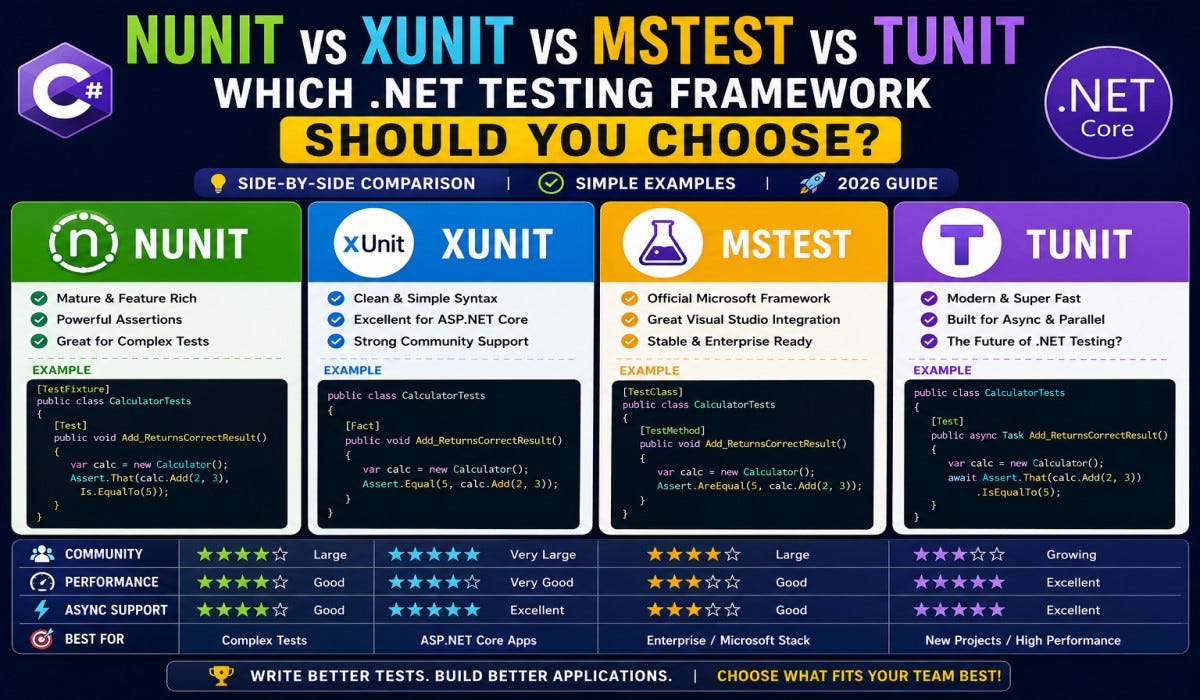
When starting unit testing in .NET, one question comes up again and again:
“Should I use NUnit, xUnit, MSTest, or the new TUnit?”
The short answer?
They all help you write tests — but they differ in philosophy, features, performance, and developer experience.
In this newsletter, we’ll compare all four frameworks using simple examples and help you decide which one best fits your next .NET project.
Why Do We Need Unit Testing?
Imagine changing a single line of code and accidentally breaking your login system.
Unit tests catch these issues before your users do.
A good unit test should be:
- Fast ⚡
- Independent
- Repeatable
- Easy to read
Our Sample Code
We’ll use the same Calculator class for every example.
public class Calculator
{
    public int Add(int a, int b)
    {
        return a + b;
    }
}
1. MSTest
MSTest is Microsoft’s official testing framework and has been part of Visual Studio for many years.
Example
[TestClass]
public class CalculatorTests
{
    [TestMethod]
    public void Add_ReturnsCorrectResult()
    {
        var calculator = new Calculator();
Assert.AreEqual(5, calculator.Add(2, 3));
}
}Pros
✅ Official Microsoft framework
✅ Great Visual Studio integration
✅ Stable and mature
Cons
❌ More verbose
❌ Smaller ecosystem compared to xUnit
2. NUnit
NUnit has been one of the most popular .NET testing frameworks for years.
Example
[TestFixture]
public class CalculatorTests
{
    [Test]
    public void Add_ReturnsCorrectResult()
    {
        var calculator = new Calculator();
Assert.That(calculator.Add(2, 3), Is.EqualTo(5));
}
}Pros
✅ Rich assertion library
✅ Parameterized tests
✅ Large community
Cons
❌ More attributes to remember
❌ Slightly older design philosophy
3. xUnit
Today, xUnit is the default choice for many ASP.NET Core projects.
Microsoft itself uses xUnit extensively across many .NET repositories.
Example
public class CalculatorTests
{
    [Fact]
    public void Add_ReturnsCorrectResult()
    {
        var calculator = new Calculator();
Assert.Equal(5, calculator.Add(2, 3));
}
}Pros
✅ Clean syntax
✅ Constructor-based setup
✅ Excellent Dependency Injection support
✅ Widely used in ASP.NET Core
Cons
❌ Slight learning curve if coming from NUnit
4. TUnit
TUnit is the newest testing framework in the .NET ecosystem.
It was designed with modern .NET, performance, async support, and parallel execution in mind.
Example
public class CalculatorTests
{
    [Test]
    public async Task Add_ReturnsCorrectResult()
    {
        var calculator = new Calculator();
await Assert.That(calculator.Add(2,3))
.IsEqualTo(5);
}
}Pros
✅ Extremely fast
✅ Built for async
✅ Excellent parallel execution
✅ Modern syntax
Cons
❌ Still relatively new
❌ Smaller community
❌ Fewer learning resources
Side-by-Side Comparison


Assertions
MSTest
Assert.AreEqual(5, result);NUnit
Assert.That(result, Is.EqualTo(5))xUnit
Assert.Equal(5, result); TUnit
await Assert.That(result).IsEqualTo(5);Which Framework Should You Choose?
Choose MSTest if
✔ You work in enterprise environments
✔ Your organization already uses MSTest
Choose NUnit if
✔ You love expressive assertions
✔ You use many parameterized tests
Choose xUnit if
✔ You’re building ASP.NET Core applications
✔ You want strong community support
✔ You follow Microsoft’s modern development practices
Choose TUnit if
✔ You’re starting a brand-new project
✔ You want maximum performance
✔ Your tests are highly asynchronous
✔ You want to experiment with the future of .NET testing
My Recommendation
For most developers in 2026, here’s what I’d recommend:
🥇 xUnit — Best overall choice for modern ASP.NET Core applications, thanks to its simplicity, maturity, and broad ecosystem.
🥈 TUnit — A promising option if you’re building new projects and want cutting-edge features like excellent async and parallel test support.
🥉 NUnit — Still a fantastic framework, especially if your team already uses it or relies heavily on its rich assertion model.
🏅 MSTest — A solid choice for organizations standardized on Microsoft’s testing tools or maintaining existing enterprise applications.
Final Thoughts
The “best” testing framework isn’t necessarily the one with the most features — it’s the one that fits your team’s needs.
Regardless of which framework you choose, the most important thing is to:
- Write meaningful tests.
- Keep them small and focused.
- Run them often.
- Treat them as part of your production code.
A well-tested application is easier to maintain, safer to refactor, and more reliable in production.
💬 Let’s Discuss
Which testing framework do you use most in your .NET projects — MSTest, NUnit, xUnit, or TUnit?
Share your experience in the comments. I’d love to hear what works best for your team!
If you enjoy practical content on C#, .NET, ASP.NET Core, Azure, Clean Architecture, Testing, and Software Architecture, follow me on Linkedin. I regularly publish hands-on tutorials, comparisons, and real-world development guides — all in one place.
dotnet
csharp
unittesting
xunit
nunit
mstest
tunit
aspnetcore
softwaretesting
softwaredevelopment
backenddevelopment
developers
메타데이터
- post_id
- c87dd2c00ae4
- slug
- nunit-vs-xunit-vs-mstest-vs-tunit-which-net-testing-framework-should-you-choose-in-2026-c87dd2c00ae4
- url
- https://medium.com/@sachinghadi/nunit-vs-xunit-vs-mstest-vs-tunit-which-net-testing-framework-should-you-choose-in-2026-c87dd2c00ae4
- canonical_url
- https://medium.com/@sachinghadi/nunit-vs-xunit-vs-mstest-vs-tunit-which-net-testing-framework-should-you-choose-in-2026-c87dd2c00ae4
- author_url
- https://medium.com/@sachinghadi
- status
- ok
- fetched_at
- 2026-07-09 05:26:43