How to Stop Procrastinating When You Have a Massive Assignment Due (And Your Brain is Shutting…
Forget the standard time-management advice. When you’re paralyzed by a looming deadline, you don’t need a new planner — you need an…
How to Stop Procrastinating When You Have a Massive Assignment Due (And Your Brain is Shutting Down)

Forget the standard time-management advice. When you’re paralyzed by a looming deadline, you don’t need a new planner — you need an emergency exit from your own cognitive overload.
During my sophomore year, I spent three hours deep-cleaning the rubber seals of my mini-fridge with a toothbrush. I also memorized the entire Wikipedia page for the 1904 St. Louis marathon.
Why?
Because I was desperately trying to stop procrastinating on a 15-page sociology paper. I was doing everything possible to avoid opening a blank document.
When you have a massive assignment staring you down, your brain does weird things. You convince yourself that color-coding your Notion dashboard is highly productive work. It isn’t.
You aren’t lazy. You are just panicking.
The friction of starting feels physically painful. Standard advice tells you to just “sit down and do it.” That advice is garbage. When you hit this level of avoidance, you need a system that lowers friction, not one that demands more willpower.
Why You Aren’t Lazy: The Neuroscience of the “Blank Page”
Let’s get one thing straight. Procrastination is not a time-management problem.
You know exactly how much time you have. You just can’t bring yourself to use it. Staring at a blank page triggers a massive spike in cognitive load. Your brain literally cannot compute the first step, so it shuts down.
Psychologists call this task paralysis. It happens when the perceived threat of the assignment outweighs your ability to start.
“Procrastination is an emotion regulation problem, not a time management problem.” — Dr. Fuschia Sirois, Professor of Psychology.
You are avoiding the negative feelings associated with the essay. Boredom. Frustration. Imposter syndrome. To cope, your brain seeks immediate comfort.
The Guilt-Shame Spiral
This is where things get ugly. You know you should be working.
Because you aren’t working, you feel guilty. That guilt drains the exact mental energy you need to write the paper. You end up experiencing temporary executive dysfunction, making it impossible to plan, organize, or execute the task.
To escape the bad feelings, you fall right into a cheap dopamine loop. It usually looks exactly like this:
- Step 1: The Avoidance. You open TikTok “just for five minutes” to calm your nerves.
- Step 2: The Guilt. Two hours pass. You realize you wasted the whole evening.
- Step 3: The Drain. The shame exhausts you. You tell yourself you’ll just wake up at 5 AM and do it then. (Spoiler: You won’t).
You have to break the loop. And you do that by completely changing how you start.
Step 1: Outsource the Activation Energy (The Friction-Killer)
Let go of your perfectionism. It is literally destroying your GPA.
The hardest part of any massive paper is the first ten percent. Your brain hates creating from scratch under pressure. But it absolutely loves editing.
So, we are going to cheat the system. We are going to outsource the heavy lifting.
The “Cheat Code” for Blank Page Paralysis
When I have a massive assignment, the cognitive load of staring at a blinking cursor kills me. My rule? Never start from a blank page.
I use a tool called **MyStylus.ai (promo code EDU15) to generate my initial essay structure and pull my first five peer-reviewed sources**.
I don’t use it to write the paper. That is a fast track to academic probation.
Instead, I use it to build the skeleton. I let it draft a working thesis statement and map out the main arguments.
Once the outline and sources are actually on the page, the magic happens. My brain switches from “overwhelmed creator” to “focused editor.”
The procrastination instantly evaporates. The friction is gone. You just have to fill in the blanks.
Step 2: Micro-Stepping and Time Architecture
Now that you have a skeleton, you need to trick your brain into moving.
Forget the standard Pomodoro technique. Setting a timer for 25 minutes of deep work sounds great in theory.
In reality? When you are already panicking, 25 minutes feels like a life sentence. You will just stare at the wall and sweat.
Ditch the Standard Pomodoro (Do This Instead)
We need to trigger an action bias. We do this through micro-stepping.
You break the work down into pieces so ridiculously small that your brain can’t possibly object. You lower the bar until it is practically resting on the floor.
Try these absurdly small micro-tasks right now:
- Open your Google Doc and type your name.
- Format the header and pick your font.
- Write one terrible, ugly sentence for your introduction.
That is it. Just do one.
Once you type that single ugly sentence, momentum takes over. You will naturally want to fix it. Suddenly, you are writing.
Step 3: Engineering the Final 10% (Protecting Your Grade)
I once lost a full letter grade on a brilliant history paper.
Why?
Because I finished writing at 3 AM. I completely botched the citations because I was simply too exhausted to care. The final ten percent of the work is where you bleed points.
You fall victim to Parkinson’s Law. Work expands to fill the time you give it. If you give yourself all night to format a paper, it will take all night.
Stop doing that. Check the grading rubric first. Do not waste an hour tweaking margins if your professor only cares about your analysis.
Automating the Busywork
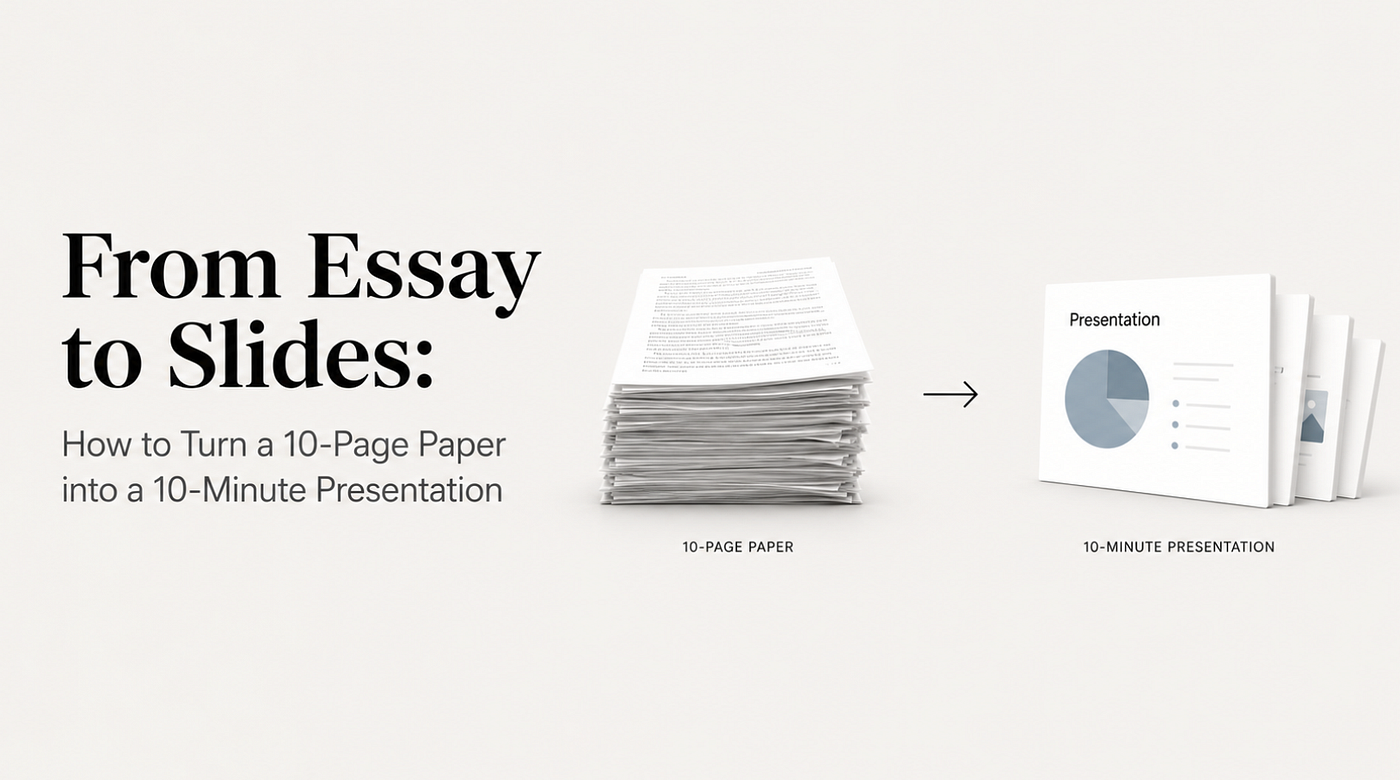
What if the assignment requires a slide deck for tomorrow’s seminar?
Do not spend another two hours fighting with PowerPoint layouts. That is a guaranteed recipe for college student burnout.
I just feed my finished text back into MyStylus.ai (promo code EDU15). It auto-generates my presentation slides instantly.
Protect your sleep. Automate the busywork so you can focus on actually knowing your material.
Conclusion: Action Over Perfection
Stop beating yourself up. The time you wasted is gone. You cannot get it back.
But you can control what happens right now.
Here is your emergency checklist:
- Step 1: Forgive yourself for procrastinating. The guilt is useless. Let it go.
- Step 2: Generate your skeleton outline. Bypass the blank page entirely.
- Step 3: Set a timer for five minutes and do one tiny micro-task.
Close this tab. Open your document. You’ve got this.
[Disclaimer: AI tools like MyStylus.ai mentioned in this article should be used as productivity aids for structuring, brainstorming, and formatting. Always write your own final text, verify your sources, and adhere strictly to your university’s academic integrity guidelines.]
메타데이터
- post_id
- d51355c08d3e
- slug
- how-to-stop-procrastinating-when-you-have-a-massive-assignment-due-and-your-brain-is-shutting-d51355c08d3e
- url
- https://medium.com/@mystylus/how-to-stop-procrastinating-when-you-have-a-massive-assignment-due-and-your-brain-is-shutting-d51355c08d3e
- canonical_url
- https://medium.com/@mystylus/how-to-stop-procrastinating-when-you-have-a-massive-assignment-due-and-your-brain-is-shutting-d51355c08d3e
- author_url
- https://medium.com/@mystylus
- status
- ok
- fetched_at
- 2026-07-14 06:51:58