How Government Compliance Impacts Your Retail POS Choice in UAE
Selecting a point of sale system for your retail business in the UAE is rarely just a technology decision. For most business owners, the…
How Government Compliance Impacts Your Retail POS Choice in UAE

Selecting a point of sale system for your retail business in the UAE is rarely just a technology decision. For most business owners, the conversation starts with features, pricing, and ease of use. But it should start somewhere else entirely: compliance.
The UAE operates one of the most structured regulatory environments for commerce in the Middle East. Federal mandates, emirate-level licensing bodies, and evolving digital tax infrastructure collectively determine what your retail POS software must be capable of doing before it ever rings up a single sale. Retailers who overlook this dimension during evaluation often discover the cost of that oversight later, during an audit, a system migration, or a rushed software upgrade.
The UAE Regulatory Stack Is Broader Than Most Retailers Expect

When business owners think about compliance and point of sale software, VAT is usually the first regulation that comes to mind. But the regulatory framework governing retail transactions in the UAE is considerably wider.
At the federal level, the Federal Tax Authority (FTA) sets the rules for VAT registration, tax invoice formatting, and return filing. The UAE Central Bank governs payment processing, digital transactions, and licensed payment gateway operations. At the emirate level, bodies such as Dubai’s Department of Economy and Tourism and Abu Dhabi’s ADDED enforce trade licensing, consumer protection standards, and in some cases, language requirements on official documents. Free zone retailers face an additional layer, with their respective free zone authorities maintaining separate compliance obligations.
Each of these bodies has touch points with your point of sale infrastructure, whether through invoice logic, payment terminal certification, language output requirements, or audit trail standards. A POS solution that satisfies one layer but ignores another is a liability, not an asset.
VAT Compliance Remains the Most Immediate Pressure Point

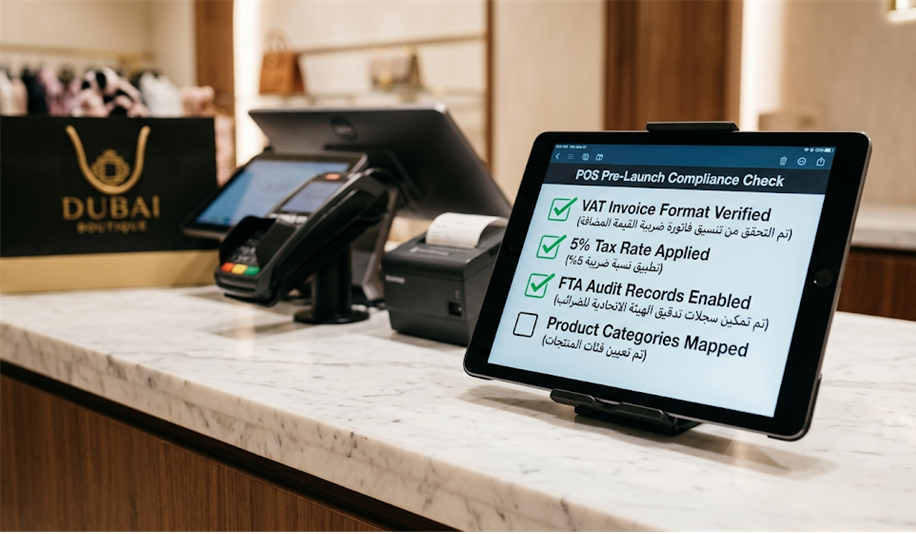
Since its introduction in 2018, UAE VAT has undergone progressive tightening in how the FTA defines a valid tax invoice. Today, a compliant tax invoice must include the supplier’s Tax Registration Number, a unique sequential invoice number, the date of supply, a line-by-line breakdown of taxable and exempt items, and the VAT amount expressed in AED.
Your retail point of sale system must generate these invoices automatically, consistently, and correctly across every terminal, every cashier, and every transaction type. Manual workarounds are not sustainable at scale and introduce audit risk that no retailer can afford.
The mechanics of how modern POS platforms handle VAT logic, from tax category mapping to FTA-aligned report generation, are covered in detail in our earlier article on POS Systems and VAT Compliance. If you are currently evaluating POS software, that piece provides essential groundwork for understanding what compliant invoice architecture actually looks like in practice.
E-Invoicing Reform Is Coming and It Will Expose Weak POS Infrastructure

The UAE is actively developing a mandatory e-invoicing framework, following the trajectory established by Saudi Arabia’s ZATCA implementation. While the precise rollout timeline continues to be refined, the policy direction is settled: businesses will be required to submit structured digital invoices to a government portal, likely in real time or near-real time.
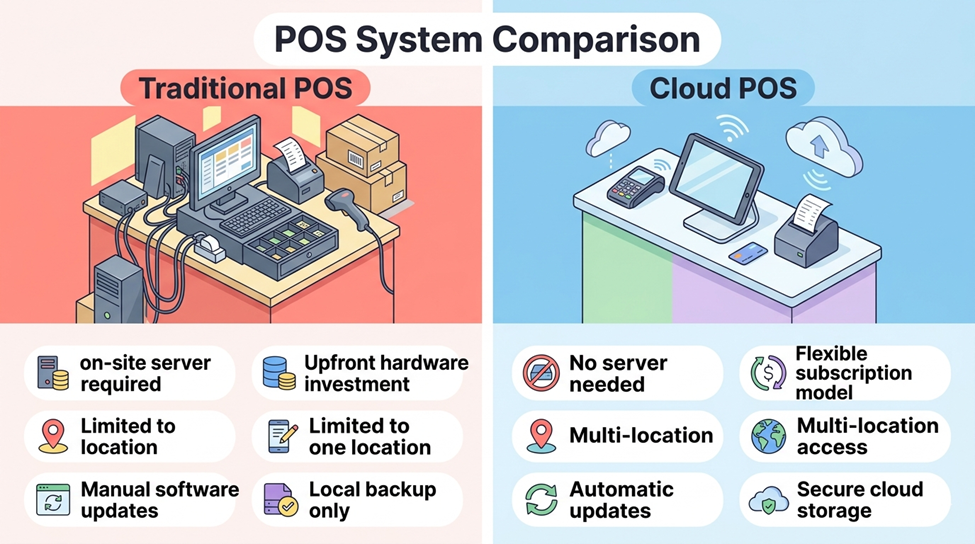
For retailers, this has significant implications for how they choose their POS infrastructure today. Systems built on closed architectures, on-premise databases, or legacy software stacks will face serious integration challenges when e-invoicing mandates take effect. Cloud-based point of sale platforms, designed around open APIs and continuous update cycles, are considerably better positioned to connect with government portals without requiring a full system replacement.
This compliance dimension is one of the strongest arguments for cloud adoption, beyond the operational advantages of remote access, automatic updates, and centralised data management. Our comparison of Cloud POS vs Traditional POS examines this infrastructure question in depth, including how each model handles the kind of regulatory adaptability the UAE market now demands.
Payment Compliance Extends Beyond the Software
A frequently overlooked dimension of retail POS compliance in the UAE involves the payment ecosystem connected to your POS software. Any terminal processing card transactions must comply with PCI-DSS standards. Payment gateways must hold active licensing from the UAE Central Bank. Hardware that has not been certified for UAE operation creates both legal exposure and practical risk, including potential transaction disputes and processing outages.
Evaluating a POS solution in isolation from its payment integrations is a mistake. The full ecosystem, including software, hardware, network configuration, and payment gateway, must be assessed together. Vendors with a genuine UAE market presence will typically have established relationships with certified local payment processors. Those without may present unforeseen compliance gaps that only surface after go-live.
Compliance Logic Is Embedded in Every Core Feature
One of the more instructive ways to understand government compliance’s role in POS selection is to examine the features that UAE retailers prioritise and trace each one back to its regulatory origin.
Audit trails and transaction logs exist because tax authorities and trade licensing bodies can demand them. Role-based staff access and permission controls reflect accountability standards in regulated retail environments. Multi-currency display capability must still anchor all tax calculations in AED for FTA reporting. Discount and promotional pricing logic must be structured so that reductions do not misrepresent taxable value on invoices.
In our article on Retail POS Features in UAE, we outlined the non-negotiable capabilities UAE retailers should be selecting for. What becomes clear when you read those features through a compliance lens is that regulatory pressure and operational excellence tend to reinforce each other. Systems built to satisfy rigorous compliance standards are almost always better-engineered overall.
The Questions Every UAE Retailer Should Ask Before Signing a Contract

Compliance due diligence during a POS evaluation does not require a legal team. It requires asking the right questions and holding vendors accountable for specific answers.
How does the vendor handle FTA regulatory updates? You need a provider that actively monitors FTA guidance and deploys compliance updates to your system, not one that expects you to request or configure changes manually.
Is there a documented roadmap for e-invoicing integration? Given the direction of UAE digital tax policy, this is a forward-looking requirement that separates vendors investing in the market from those simply present in it.
Are all payment terminals and gateway integrations certified for UAE operation? Confirm PCI-DSS compliance and Central Bank licensing before any contract is signed.
Does the system generate invoices in both Arabic and English? Dual-language output is increasingly a compliance consideration, not merely a customer experience feature.
Does the vendor have an in-market UAE support presence? Compliance issues rarely respect business hours. Local, responsive support is a risk management requirement.
Compliance Is a Competitive Advantage, Not Just a Constraint
Retailers who approach government compliance as an obstacle tend to make POS decisions they later regret. Retailers who treat it as a structural requirement, built into the evaluation from the first conversation, tend to select systems that serve them well through regulatory changes, audits, and business growth.
The UAE’s commercial environment will continue to evolve. E-invoicing mandates will arrive. FTA reporting requirements will become more granular. Payment infrastructure standards will tighten. The retail POS system you choose today should be one your business can grow within, not one you will need to replace the next time policy shifts.
In a market as dynamic and regulation-forward as the UAE, compliance-ready point of sale software is not a premium feature. It is the baseline.
메타데이터
- post_id
- d76bc4eea107
- slug
- how-government-compliance-impacts-your-retail-pos-choice-in-uae-d76bc4eea107
- url
- https://medium.com/@multitechpos.profiles/how-government-compliance-impacts-your-retail-pos-choice-in-uae-d76bc4eea107
- canonical_url
- https://medium.com/@multitechpos.profiles/how-government-compliance-impacts-your-retail-pos-choice-in-uae-d76bc4eea107
- author_url
- https://medium.com/@multitechpos.profiles
- status
- ok
- fetched_at
- 2026-06-09 15:37:30