Marooned
Was that feeling in a film or a dream, or in the year gone by — that feeling of sorrow for the protagonist? Was that a pain or a pathos at…
Now, as I pass it again, the hulk feels like a rock — a solid part of the very landscape. It exudes a permanence that cannot be imagined in a human-made object.
Marooned
Was that feeling in a film or a dream, or in the year gone by — that feeling of sorrow for the protagonist? Was that a pain or a pathos at recognising defeat, sensing dejection — the giving up, which then became my own fear?
It was a long dream, a film-like dream. I was helpless, but worse, I felt a sense of guilt. I had not been able to help.
Isn’t that the same mode of Binswangerian existence that dreams reveal in the one where one is missing trains and falling from heights — the same vector of fall — one of those universal themes that haunt human dreams? What would we be running behind and missing before steam engines were invented, or falling from, when heights were not too high?
I experienced a loneliness that must have been the protagonist’s, painful precisely because it was not mine, but belonged to someone I cared for. Whether in the film or in the dream does not matter.
Something about it hurts. At its core is a sorrow for humanity’s helplessness. That is my pathos born from the recognition of humanity’s defeat, coming to exorcise my pain.
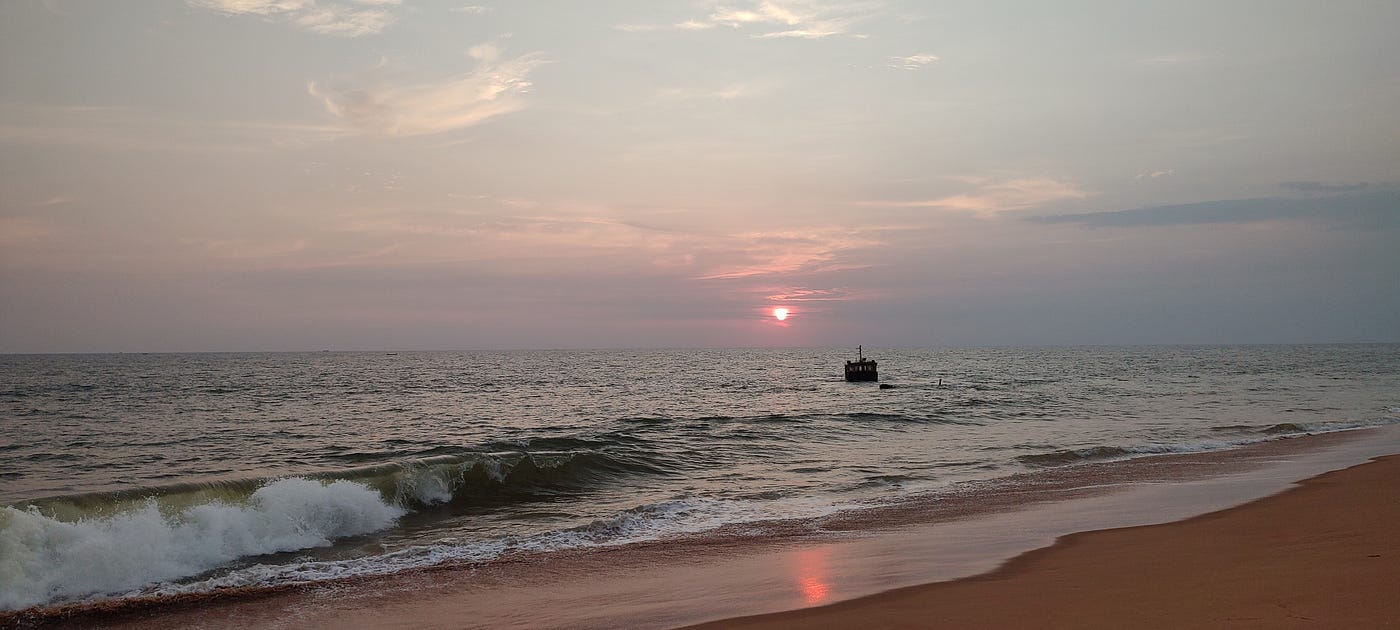
Sorrow — the kind that aches from humanity’s defeat — can be life-affirming. Yesterday, that redemptive pathos surfaced in the image of a marooned vessel. Most of it was submerged; only the cabin remained visible. The most touching sight was the orange light passing through its months-uncleaned windows — mossy green and sandy brown.
I often walk the beaches between Pallithura and Thumba. The vessel is beached between them. For months, I have passed by the barge that has run aground, its body mostly submerged, only the cabin visible above the waves. I walked from one beach to the other and back, until one evening — or was it morning, I cannot be sure — I truly saw it there. Marooned. I hadn’t understood it was stranded, and not merely capsized, until another evening, when I saw three earth-moving vehicles — one much larger than the other two — trying to extricate it. The smaller ones had dug into the sand around it or tried to get close by digging. Then the vessel, hitched to the larger machine by a four-inch-thick steel cable, was pulled. It did not budge. After days of effort, the work was abandoned. The vessel was left there, still tied by that same cable tethered to a tetrapod about a hundred feet from the sea. More tetrapods lie on the sand where even the high tide never reaches. Now people use them as benches to sit on, to watch sunsets.
It has been stranded there for months, and I have walked past it without much interest, unless there was something dramatic about it to catch my attention. Mostly it was the orange glow of the setting sun in its cabin windows, but sometimes it was the strong waves lapping against it. On those days, the deck was visible, and it seemed like the sea dragon, its tongue lashing and tail coiled around, was trying to pull the vessel in. Yet the grounded wreck would not budge.
Now, as I pass it again, the hulk, with its durable hull, deck, and cabin, feels like a rock — a solid part of the very landscape. It exudes a permanence that cannot be imagined in a human-made object. But how long before corrosion eats into the metal, and the foggy, blurry glass panes sink to the bottom, mostly unbroken, lingering until the sand particles trample on them and bury them, silica of sand and silica of glass mixing millimetre by millimetre of grind.
That will be a long, long time from today, and still I walk on the beach, feeling miserable about humans and their sufferings. And that is the scale of insignificance of human anguish. It is not vanity. It is not any sense of ascended magnificence, but the opposite: Yet, there is some grandeur in how humanity fathoms its own smallness, how even misery — this brief, crushing awareness — becomes the pulse of being alive.

Sorrow — the kind that aches from humanity’s defeat — can be life-affirming.
메타데이터
- post_id
- ddf94acc9264
- slug
- marooned-ddf94acc9264
- url
- https://medium.com/@2narendra.patil/marooned-ddf94acc9264
- canonical_url
- https://medium.com/@2narendra.patil/marooned-ddf94acc9264
- author_url
- https://medium.com/@2narendra.patil
- status
- ok
- fetched_at
- 2026-07-13 18:29:43