What Is Wrong with Quantum Mechanics?
Wavefunctions, black holes, and why a century-old theory may be showing its limits
What Is Wrong with Quantum Mechanics?
Wavefunctions, black holes, and why a century-old theory may be showing its limits
Quantum mechanics is often described as the most successful theory ever developed. Its predictions match experiments with astonishing precision. It underlies nearly every modern technology, from transistors and lasers to GPS systems and atomic clocks. Few scientific frameworks have earned such trust.
And yet, beneath this success lies a persistent unease.
The problem with quantum mechanics is not that it gives wrong answers. It almost always gives the right ones. The problem is that it does so while failing to describe a coherent picture of physical reality. At its core, quantum mechanics relies on mutually incompatible rules, undefined processes, and assumptions that quietly collapse when pushed beyond their comfort zone.
These weaknesses are often tolerated because they rarely matter in everyday laboratory physics. But when quantum mechanics is forced to confront gravity, spacetime, and extreme conditions, especially in black holes, the cracks become impossible to ignore.
This is not a minor technical issue. It is a sign that something fundamental does not add up.
The Schrödinger Equation: A Perfect Machine That Never Finishes the Job
At the heart of quantum mechanics lies the Schrödinger equation. It is elegant, deterministic, and mathematically precise. Given a system’s wavefunction at one moment in time, the equation tells you exactly how it will evolve at the next.
As long as the Schrödinger equation governs the dynamics, quantum mechanics is internally consistent. Superpositions evolve smoothly. Probabilities change predictably. Information is conserved. Nothing dramatic or mysterious occurs.
But there is a critical limitation.
The Schrödinger equation never produces definite outcomes. It does not select one result from many possibilities. Instead, it predicts ever-expanding superpositions-systems that are simultaneously in multiple states at once.
If the Schrödinger equation were taken as a complete description of reality, the universe would never settle into the concrete outcomes we actually observe. There would be no single measurement result, no definite events, but only an endlessly evolving cloud of possibilities.
And yet, we do observe definite outcomes.
This gap between mathematical evolution and physical experience is the first signal that quantum mechanics, as currently formulated, is incomplete.
Wavefunction Collapse: The Rule That Breaks the Theory
To bridge the gap between theory and observation, quantum mechanics introduces a second rule: **wavefunction collapse**.
According to this rule, when a measurement occurs, the wavefunction abruptly collapses into one definite state. This collapse is probabilistic, irreversible, and instantaneous.
The problem is not that collapse is strange. The problem is that collapse is not described by the Schrödinger equation.
Quantum mechanics therefore relies on two fundamentally different types of time evolution:
- Continuous, deterministic evolution governed by the Schrödinger equation,
- Sudden, random, non-deterministic collapse during measurement.
These two processes are mathematically incompatible. There is no equation describing when collapse happens, how it happens, or what physical mechanism causes it. Collapse is simply postulated, because without it, the theory cannot connect to observed reality.
This is not a philosophical discomfort. It is a structural contradiction built directly into the theory.

Schrödinger’s Cat: A Thought Experiment Meant as a Warning
Schrödinger’s cat is often presented as a playful illustration of quantum weirdness. In reality, it was intended as a critique.
Schrödinger designed the thought experiment to demonstrate that, if the Schrödinger equation is taken as universally valid, it leads to absurd conclusions at macroscopic scales. A cat entangled with a quantum decay process would remain in a superposition of “alive” and “dead” indefinitely, until a measurement occurs.
But quantum mechanics provides no physical definition of when or how such a measurement takes place.
- Is the measurement triggered when the atom decays?
- When the poison is released?
- When the cat’s biological processes are affected?
- When a detector clicks?
- When a human observer opens the box?
The theory does not say.
The cat is not the paradox. The transition is. Schrödinger’s point was that the need to invoke wavefunction collapse precisely when quantum behavior becomes inconvenient is not an explanation, but an admission of failure.
Schrödinger’s cat was never meant to suggest that cats are both alive and dead. It was meant to show that quantum mechanics cannot consistently describe the boundary between quantum possibility and classical reality.
Measurement: A Physical Process With No Physical Description
Measurement plays a central role in quantum mechanics and yet, it has no physical definition within the theory.
“Measurement” functions as a black box. It marks the moment when one set of rules stops applying and another abruptly takes over. But quantum mechanics does not specify what distinguishes a measurement from an ordinary interaction.
Is measurement defined by scale? Complexity? Irreversibility? Consciousness?
None of these criteria appear in the equations.
As a result, measurement occupies an uncomfortable position: It is both essential and undefined. The theory depends on it, but cannot describe it.
This violates a basic expectation of fundamental physics: That all physical processes should be governed by the same underlying laws.
Do We Really Need Quantum Gravity — Or Are We Asking the Wrong Question?
The standard narrative in modern physics holds that quantum mechanics and general relativity are fundamentally incompatible, and that this incompatibility demands a theory of quantum gravity. Yet this conclusion often glosses over a crucial detail: The two theories coexist remarkably well almost everywhere we test them.
In atomic physics, chemistry, and particle interactions, gravity is so weak that its quantization is irrelevant. In astrophysics and cosmology, classical gravity works extraordinarily well without quantum corrections. For nearly all known physical regimes, the theories simply do not collide. The exception is black holes. It is there — and only there — that the assumptions of quantum mechanics and general relativity are forced into direct confrontation.
Inside a black hole, general relativity predicts horizons and singularities where spacetime itself breaks down. Quantum mechanics, however, requires a global notion of time, unitary evolution, and well-defined quantum states evolving smoothly. None of these assumptions survive inside a black hole. There is no global time coordinate, no natural way to define spatial slices, and no meaningful way to write the Schrödinger equation. This is not a technical inconvenience to be fixed with better mathematics; it is a fundamental incompatibility between the conceptual foundations of the two theories.
Two Paradoxes, One Deeper Inconsistency
The problem deepens further with Hawking radiation. If black holes evaporate completely and emit purely thermal radiation, then information about what fell in appears to be destroyed, a direct violation of quantum unitarity.
Decades of increasingly sophisticated proposals have attempted to resolve this paradox while preserving both frameworks intact: Firewalls, complementarity, holography, and other constructions designed to save information without abandoning classical spacetime. But a pattern emerges. Rather than questioning the underlying assumptions, physics has repeatedly chosen to add conceptual machinery to protect them.
The same pattern appears in the measurement problem. Wavefunction collapse introduces nonlocal, acausal behavior that clashes with relativity, while relying on an external notion of time that black holes do not permit. In this sense, the black hole paradox and the measurement problem are not separate puzzles but two manifestations of the same underlying inconsistency. Both arise from treating quantum mechanics as complete while assuming spacetime is an empty background.
Yet quantum field theory already tells us this is false: The vacuum is not empty. It fluctuates, carries energy, and exhibits structure and correlations.
The more pressing question, then, may not be how to quantize gravity, but why gravity has not yet fully absorbed what quantum physics has already revealed about the physical nature of space itself.
A Coherent Vacuum as the Physical Foundation
If we take the problems seriously rather than treating them as isolated paradoxes to be patched over, then a different approach suggests itself. Instead of asking how to force quantum mechanics and gravity to coexist within an inherited framework, we can ask a simpler question: What if one of our most basic assumptions is wrong?
In particular, what if space is not empty at all, not even in principle? Quantum physics has already taught us that the vacuum is not a void, but an active, structured entity. Taking that fact seriously, rather than treating it as a technical detail, leads naturally to a different way of thinking about both quantum phenomena and gravity.
The Relativistic Coherent Vacuum Gravity Theory (rCVGT) begins precisely from this point. Rather than treating the vacuum as an empty background that merely hosts particles and fields, it treats the vacuum itself as a physically real, structured, and coherent medium.
In this view, the vacuum is not a passive stage but an active participant in physical processes. Particles are not fundamental point-like objects embedded in space; they are stable, localized excitations of vacuum coherence. What we interpret as spacetime curvature is not geometry acting on matter from the outside, but a manifestation of how the vacuum’s internal structure responds to energy, motion, and stress.
Quantum behavior, in turn, emerges from coherent interactions within this medium, rather than from abstract probability amplitudes evolving in an otherwise empty space. By shifting the role of the vacuum from background to substance, this perspective removes several long-standing tensions at once. It eliminates the need to treat quantum mechanics and gravity as fundamentally separate domains and reframes both as effective descriptions of deeper vacuum dynamics operating at different scales and coherence regimes.
*Instead of asking how to force quantum mechanics and gravity to coexist within an inherited framework, we can ask a simpler question: *What if one of our most basic assumptions is wrong?**
Measurement, Black Holes, and the End of Singularities
Within this framework, the measurement problem and the black hole problem are no longer distinct mysteries requiring separate fixes. There is no wavefunction collapse in rCVGT. Measurement is understood as a physical interaction that disrupts or reorganizes vacuum coherence, driving a system from one metastable configuration into another that is dynamically stable. This process is local, causal, irreversible, and fully physical.
The Schrödinger equation remains useful, but only as an effective approximation that applies when vacuum coherence is preserved; it naturally loses validity when coherence is broken by strong interactions with the environment. There is no sudden jump, no observer-dependent rule, and no violation of relativistic causality.

This infographic compares two ways of interpreting the same double-slit experiment. In the standard quantum view, measurement is said to cause an abrupt wavefunction collapse. In the coherent vacuum perspective, no collapse occurs; measurement is a local, physical interaction that reorganizes vacuum coherence into a stable outcome. The experimental results are identical, and only the underlying explanation differs.
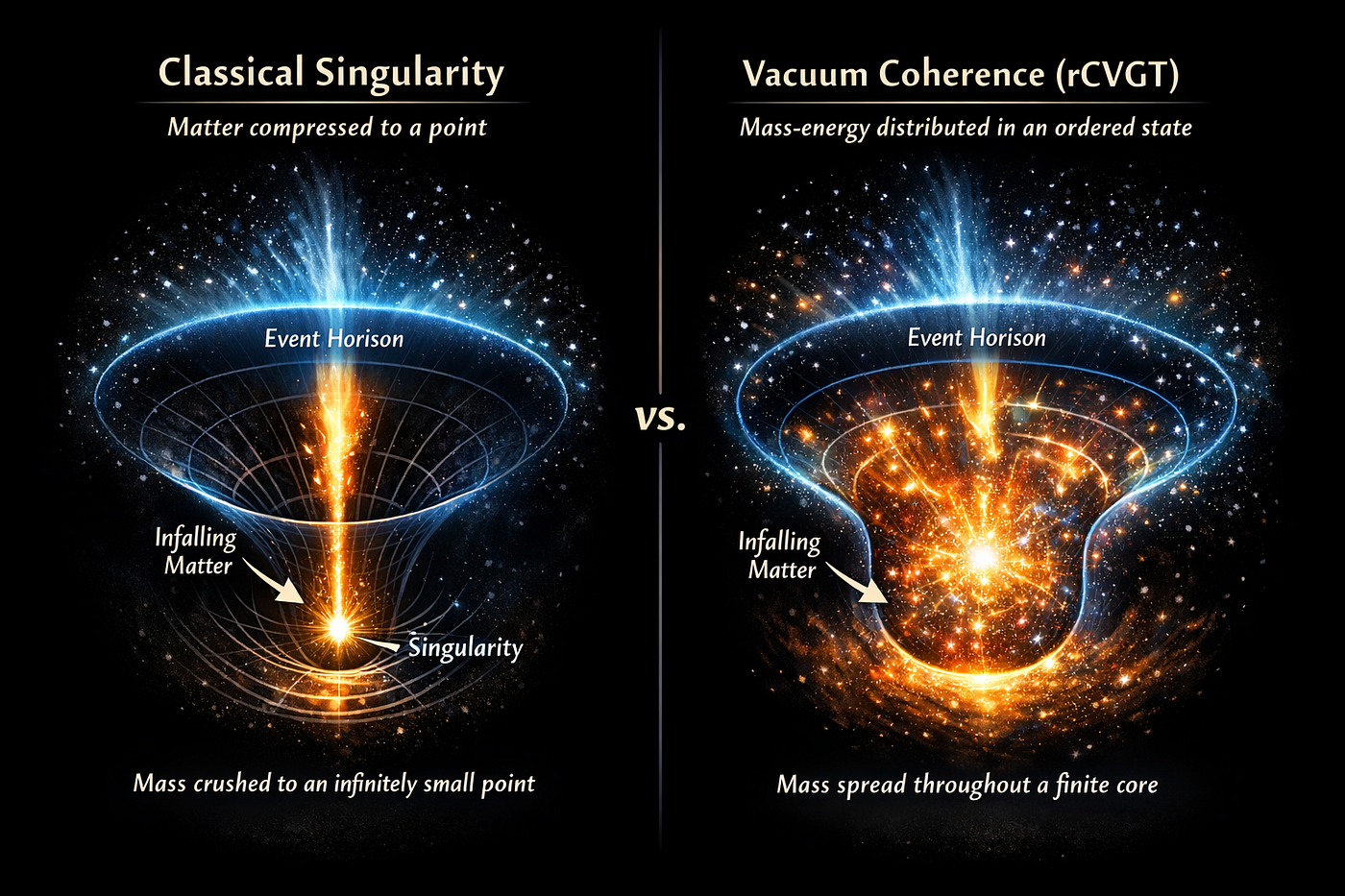
The same logic extends to black holes. In rCVGT, black holes do not contain singularities where physics ends and equations diverge. Extreme gravitational collapse corresponds instead to a saturated regime of vacuum coherence rather than infinite density. The interior of a black hole represents a new phase of vacuum structure, not a point of mathematical failure. Because the vacuum structure remains finite and dynamically coherent, quantum evolution does not terminate and information is not fundamentally destroyed. Hawking radiation reflects a gradual reconfiguration of vacuum coherence rather than a paradoxical loss of unitarity.
Time itself does not disappear inside black holes; it emerges relationally from gradients in vacuum coherence. In this light, the traditional quest for “quantum gravity” may be misdirected. Gravity need not be quantized as an independent interaction, and quantum mechanics appears as an effective, rather than complete, ontological description. Both emerge from deeper vacuum dynamics, suggesting that the apparent need for quantum gravity reflects a misidentification of the level at which quantization truly belongs.

In rCVGT, black holes are interpreted as coherence-saturated vacuum domains. While General Relativity describes the external spacetime geometry, rCVGT specifies the physical state of the vacuum in the strong-field regime. As collapse proceeds, the vacuum transitions toward maximal coherence (Q → 1), suppressed local time rate (τ → 0), and radially aligned vacuum flow. This replaces the classical singularity with a finite-density, structured vacuum core, while preserving the standard GR exterior and event-horizon behavior.
When a Theory Works Too Well
Quantum mechanics works astonishingly well and that success has been both its greatest strength and its quietest weakness. Its predictions are unrivaled in precision, its applications ubiquitous, its mathematical machinery indispensable. Precisely because it works so well, its internal contradictions have been tolerated, postponed, or reframed as matters of interpretation rather than signals of deeper trouble.
Yet those contradictions are real. Quantum mechanics predicts outcomes with extraordinary accuracy while offering no physical account of how definite outcomes arise. It relies on wavefunction collapse, yet refuses to describe collapse as a physical process. It assumes a global, external notion of time even where spacetime itself becomes dynamical or ceases to be well defined. These tensions are easy to ignore in everyday laboratory settings, but they become unavoidable at the boundaries of the theory — where quantum systems meet gravity, where measurement can no longer be idealized, and where spacetime itself is pushed to its limits.
Schrödinger’s cat and black holes are not curiosities or philosophical distractions. They are stress tests. The cat exposes the unresolved transition between quantum possibility and classical reality; black holes expose the incompatibility between quantum evolution and spacetime geometry. In both cases, the theory stops short of explaining what actually happens. The same unresolved assumptions resurface in different guises, pointing not to isolated paradoxes but to a common structural flaw.
What these limits suggest is not that quantum mechanics is wrong, but that it is incomplete. It is a powerful effective theory and one that describes how systems behave within a certain regime, but not a final account of what reality is made of. When the theory is asked to explain measurement, time, or extreme gravitational collapse, it reveals the scaffolding it was built upon: Assumptions about empty space, external time, and abstract probability that no longer hold.
When those starting assumptions are revisited, and when space is treated not as an empty backdrop but as a physically structured medium, when coherence replaces collapse, and when time is understood as emergent rather than fundamental, then the paradoxes begin to dissolve. Not because they were forcefully resolved within the old framework, but because they were never fundamental to begin with. They were artifacts of asking the right questions within the wrong conceptual starting point.
In this sense, the deepest lesson of quantum mechanics may not lie in its strangeness, but in its limits. A theory can work extraordinarily well and still be pointing beyond itself. And sometimes, progress does not come from adding more mechanisms or quantizing ever more aggressively, but from recognizing when a successful framework has become a blind spot, and daring to ask what reality looks like when we let go of the assumptions that once made it work.
Note: The conceptual framework discussed here is part of the Relativistic Coherent Vacuum Gravity Theory (rCVGT). If these ideas are used or developed further, proper citation is appreciated.
메타데이터
- post_id
- e0f2c96cd4ad
- slug
- what-is-wrong-with-quantum-mechanics-e0f2c96cd4ad
- url
- https://medium.com/the-idea-of-reality/what-is-wrong-with-quantum-mechanics-e0f2c96cd4ad
- canonical_url
- https://medium.com/the-idea-of-reality/what-is-wrong-with-quantum-mechanics-e0f2c96cd4ad
- author_url
- https://medium.com/@steen_m_n
- status
- ok
- fetched_at
- 2026-07-11 11:40:08