AI Can Generate Answers Instantly. So Why Does Everything Feel Less Certain?
We automated information retrieval, not understanding and backend teams are starting to feel the cost.
AI Can Generate Answers Instantly. So Why Does Everything Feel Less Certain?
We automated information retrieval, not understanding and backend teams are starting to feel the cost.
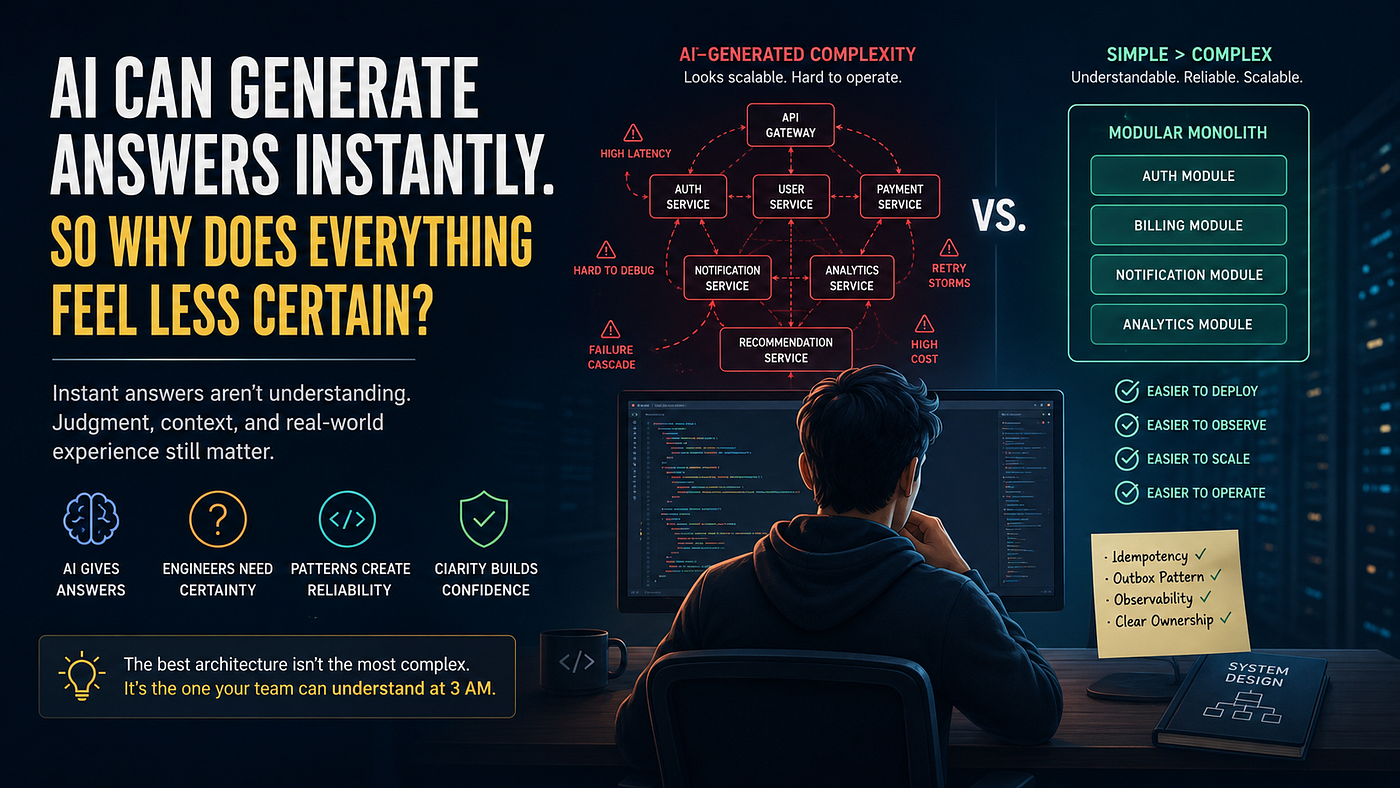
AI can generate answers instantly, but engineering teams feel more uncertain than ever. Here’s what that means for backend architecture, system design, and developer productivity.
The Strange Thing Happening Inside Engineering Teams
We have more answers than any generation of developers in history.
And somehow, fewer people trust their own judgment.
That’s the weird part nobody talks about.
A junior engineer can now generate a Kubernetes deployment, a Redis caching strategy, a FastAPI service layer, and a CI/CD pipeline in under five minutes. AI can explain event sourcing, write SQL migrations, and summarize distributed systems papers faster than most humans can read them.
So why do so many teams still feel stuck?
Why do incidents still drag on for hours?
Why do architecture meetings feel more confused than before?
Why are senior engineers quietly becoming more valuable while “knowledge” itself becomes cheaper every month?
Because instant answers changed something deeper than productivity.
They changed certainty.
And software engineering was never really about answers in the first place.
It was about knowing which answers survive reality.
The Industry Accidentally Optimized for Speed Over Understanding
For years, the industry treated information access as the bottleneck.
That assumption shaped everything.
Documentation. Stack Overflow. Framework abstractions. Cloud platforms. Internal tooling. Now AI.
The entire ecosystem evolved around one idea:
“If developers can access answers faster, they’ll build better systems.”
Reasonable assumption. Wrong conclusion.
Because most production failures never happen from missing information.
They happen from missing context.
And context is the one thing AI still struggles to truly own.
An AI assistant can explain idempotency in seconds.
But it doesn’t know your payment retries are routed through three legacy services, one Kafka consumer occasionally duplicates events under load, and half the team still assumes PostgreSQL transactions magically protect cross-service consistency.
That’s where real engineering lives.
Not in definitions.
In collisions.
The Real Cost of Infinite Answers
The hidden problem with AI-generated knowledge is that it compresses effort, but effort used to create understanding.
Older engineers remember this clearly.
You didn’t just copy a solution. You fought your way toward it.
You broke staging environments. You read obscure GitHub issues at 2 AM. You misunderstood TCP retries. You learned why distributed locks fail the hard way.
Pain created mental models.
Today, many developers can generate sophisticated-looking architectures before they’ve developed intuition about failure modes.
That changes team dynamics in subtle ways.
You start seeing systems that look correct from a distance but collapse under pressure.
Like this:
Client
  ↓
API Gateway
  ↓
Auth Service
  ↓
User Service
  ↓
Notification Service
  ↓
Analytics Service
  ↓
Recommendation Service
Looks impressive.
Until latency spikes.
Then debugging becomes archaeology.
The Most Dangerous Architecture in 2026
The most dangerous backend architecture today is not the monolith.
It’s the AI-generated distributed system nobody fully understands.
That system usually has:
- too many services
- shallow abstractions
- duplicated observability
- vague ownership
- retry storms
- inconsistent contracts
- generated boilerplate nobody reviews carefully
The architecture feels modern because the diagrams look modern.
But complexity does not become sophistication just because YAML generated it faster.
One of the biggest myths in system design is this:
“If something scales at Netflix scale, it must be good architecture.”
No.
It’s good architecture for Netflix-scale problems.
Most teams are nowhere near that scale.
Yet AI tools frequently generate infrastructure patterns optimized for hyperscale systems instead of operational clarity.
That tradeoff matters more than people think.
Microservices vs Monolith Was Never the Real Debate
The industry framed this conversation incorrectly for years.
The real debate was never:
- monolith vs microservices
It was:
- coordination cost vs deployment independence
That’s a completely different discussion.
A modular monolith often outperforms microservices for growing teams because it reduces cognitive fragmentation.
Example:
┌──────────────────────┐
│ Modular Monolith     │
├──────────────────────┤
│ Auth Module          │
│ Billing Module       │
│ Notification Module  │
│ Analytics Module     │
└──────────────────────┘
Single deployment. Shared observability. Shared transactions. Lower operational overhead.
Now compare that to premature microservices:
┌──────────┐   ┌──────────┐
│ Auth API │→  │ Billing  │
└──────────┘   └──────────┘
      ↓               ↓
┌──────────┐   ┌──────────┐
│ Notify   │→  │ Analytics│
└──────────┘   └──────────┘
Looks scalable.
Actually increases:
- network failure surfaces
- deployment coordination
- debugging complexity
- monitoring burden
- incident resolution time
AI accelerates this mistake because it makes distributed architecture feel deceptively easy.
Generating services is easy.
Operating them is not.
Developer Productivity Is Quietly Changing Shape
There’s another shift happening beneath the surface.
AI massively increases local productivity.
But many companies accidentally reduce system productivity.
That distinction matters.
A developer can now ship isolated features faster than ever.
But organizations still struggle with:
- integration failures
- architecture drift
- inconsistent conventions
- unclear service ownership
- duplicated logic
- unreliable deployments
In other words:
AI improves code generation faster than teams improve coordination.
And coordination has always been the expensive part of software engineering.
That’s why senior backend engineers are still incredibly valuable.
Not because they type faster.
Because they reduce uncertainty.
The Backend Patterns That Actually Matter Now
Ironically, the AI era is making foundational engineering principles more important — not less.
The teams succeeding right now are focusing heavily on boring reliability patterns.
Not flashy architecture diagrams.
1. Idempotency
Because retries happen. Always.
Especially in distributed systems.
A practical FastAPI payment example:
from fastapi import FastAPI, Header, HTTPException
from sqlalchemy.orm import Session

app = FastAPI()

processed_requests = {}

@app.post("/payments")
async def create_payment(
    amount: float,
    idempotency_key: str = Header(...)
):
    if idempotency_key in processed_requests:
        return processed_requests[idempotency_key]

    payment_result = {
        "status": "success",
        "amount": amount
    }

    processed_requests[idempotency_key] = payment_result

    return payment_result
Simple idea. Massive operational impact.
Most production reliability comes from patterns like this — not revolutionary frameworks.
2. The Outbox Pattern
AI often generates architectures that assume distributed consistency “just works.”
Reality says otherwise.
The outbox pattern exists because databases and message brokers fail independently.
Example flow:
Transaction
 ├── Save Order
 ├── Save Outbox Event
 └── Commit

Background Worker
 └── Publish Event to Kafka
This pattern survives crashes. That’s why experienced teams trust it.
Not because it’s elegant. Because it’s survivable.
3. Observability Over Guessing
Modern backend architecture is increasingly about visibility.
Logs are not enough anymore.
You need:
- distributed tracing
- structured logs
- metrics correlation
- request lineage
- latency visibility
The hardest incidents today are rarely caused by missing code.
They’re caused by invisible interactions.
AI can generate services quickly.
But if nobody can trace failures across them, you’ve only accelerated confusion.
Why Teams Historically Made These Mistakes
Most architectural mistakes come from fear.
Not incompetence.
Teams fear:
- future scale
- migration pain
- technical debt
- being seen as “behind”
- rebuilding later
So they overcompensate early.
That’s how startups with 12 users end up discussing service meshes.
And AI unintentionally amplifies this because generated solutions often bias toward “complete” architectures.
The generated system feels safer because it looks sophisticated.
But sophisticated systems fail in sophisticated ways.
And every abstraction eventually becomes someone’s debugging problem.
A Real Production Lesson Most Engineers Eventually Learn
The best backend systems often feel slightly boring.
That’s not a criticism.
It’s maturity.
The strongest systems usually have:
- predictable deployment pipelines
- minimal hidden behavior
- obvious ownership
- stable interfaces
- simple rollback strategies
- low operational surprise
Engineers eventually realize something important:
Reliability is a feature users notice only when it disappears.
And AI cannot magically generate operational wisdom from syntax patterns alone.
When Simplicity Becomes the Wrong Choice
Of course, simplicity is not always correct.
This is where nuance matters.
There are legitimate reasons to adopt complexity.
Microservices make sense when:
- teams scale independently
- deployment velocity becomes blocked
- domains become operationally isolated
- scaling characteristics differ dramatically
- compliance boundaries require separation
Event-driven systems make sense when:
- asynchronous workflows dominate
- throughput requirements explode
- loose coupling matters operationally
Advanced observability matters when:
- systems become geographically distributed
- latency debugging becomes business-critical
- failures cascade across dependencies
The problem is not complexity itself.
The problem is complexity without operational necessity.
That distinction separates experienced system design from architecture theater.
What Modern Backend Teams Are Actually Doing
Interestingly, many mature engineering organizations are quietly moving toward pragmatism again.
Not maximalism.
You see trends like:
- modular monoliths returning
- platform engineering replacing endless microservices sprawl
- stronger observability investments
- internal developer tooling
- simpler deployment paths
- fewer infrastructure layers
- explicit ownership boundaries
The industry is slowly rediscovering an old truth:
The best architecture is usually the one your team can still understand during an outage.
Not the one that wins conference applause.
AI Didn’t Remove Engineering Judgment. It Increased Its Importance.
This is the part many people misunderstand.
AI absolutely improves developer productivity.
Massively.
It removes repetitive work. Accelerates prototyping. Speeds up debugging. Reduces boilerplate fatigue.
That’s real.
But when answer generation becomes infinite, judgment becomes the scarce resource.
And judgment is built from:
- production failures
- operational tradeoffs
- debugging pain
- architectural restraint
- understanding consequences
Not autocomplete.
That’s why senior engineers are not disappearing.
They’re becoming navigation systems.
The Real Shift Happening Right Now
We are entering an era where:
- coding is cheaper
- architecture is easier to fake
- complexity scales faster
- operational clarity matters more than ever
And ironically, the engineers who thrive won’t necessarily be the ones generating the most code.
They’ll be the ones creating the least confusion.
Because software engineering was never fundamentally about producing answers.
It was about building systems that remain understandable after reality attacks them.
And reality is still undefeated.
메타데이터
- post_id
- e3b17abc51d7
- slug
- ai-can-generate-answers-instantly-so-why-does-everything-feel-less-certain-e3b17abc51d7
- url
- https://medium.com/@hadiyolworld007/ai-can-generate-answers-instantly-so-why-does-everything-feel-less-certain-e3b17abc51d7
- canonical_url
- https://medium.com/@hadiyolworld007/ai-can-generate-answers-instantly-so-why-does-everything-feel-less-certain-e3b17abc51d7
- author_url
- https://medium.com/@hadiyolworld007
- status
- ok
- fetched_at
- 2026-06-17 12:55:42