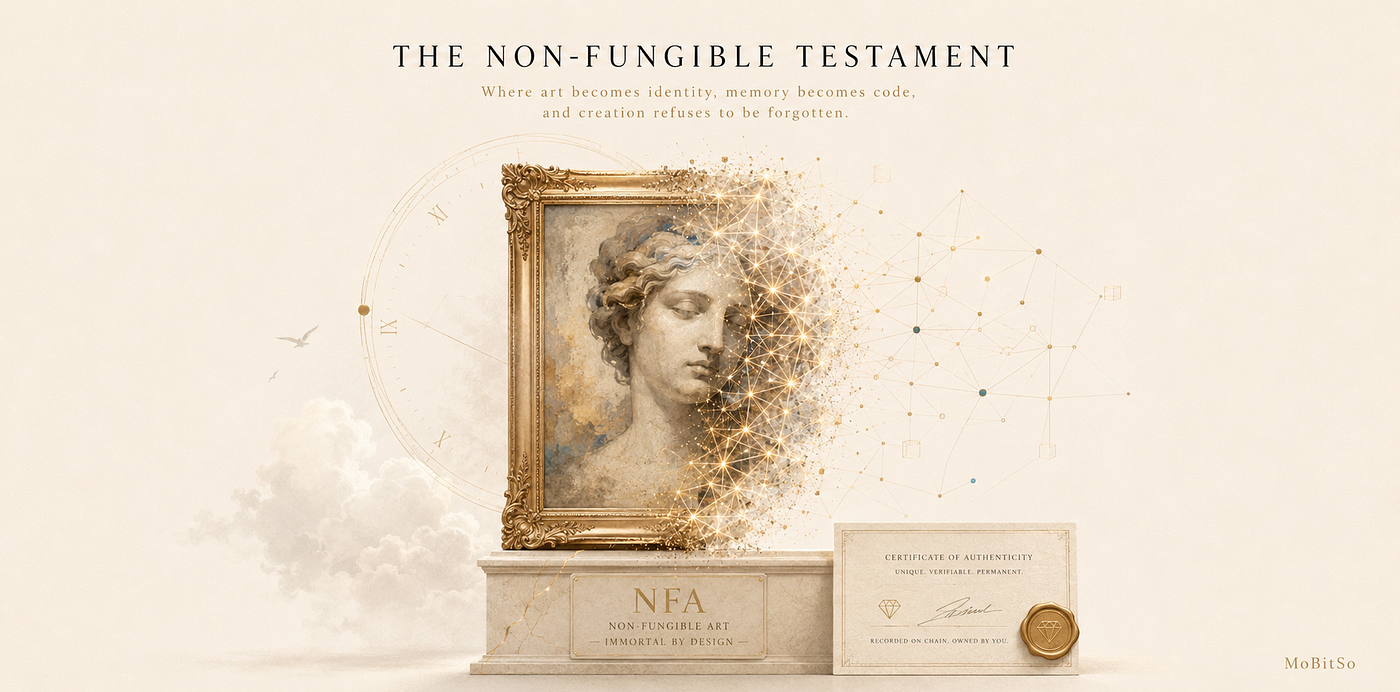
The Non-Fungible Testament
Where art becomes identity, memory becomes code, and creation refuses to be forgotten.
The Non-Fungible Testament
Where art becomes identity, memory becomes code, and creation refuses to be forgotten.
This article is an invitation to look beyond the surface of NFTs, beyond the noise of markets, prices, and trends. It is a journey into the deeper meaning of non-fungible art: art as identity, art as memory, art as a timestamped act of creation that refuses to vanish. The moment an object refuses to be replaced, it becomes art. That is the old rule. Real art has always been a slow revolution against interchangeability. The artist whispers: it can be only once, only here.
That whisper was kept safe for centuries by walls, frames, museums, vaults, declarations of authenticity and the fragile faith of human memory. Then a civilization came into being where numbers race faster than breath, where the copy precedes the original, and where the world shakes with the weight of infinite duplication. But in such a landscape the artist was faced with an old enemy in a new guise: the loss of the unrepeatable.
NFTs were never meant to be just collectibles. That’s a later simplification, an accountant’s error. Their source is deeper. An NFT is the first digital artifact that acts the way a painting acts: it will not be replaced. It is the revolt of the one in an infinite universe.
Uniqueness is not a metaphor on the blockchain. It’s a mathematical imperative. An agreed-upon line of code becomes a signature no museum could fake. No empire could crush. No authority could overwrite. In this world the certificate is the artwork, the artwork is the certificate and the chain becomes the new cathedral wall upon which hangs creation.
The artist of the NFT age is not just a sculptor of matter. They chisel time. They tether their work to a chain of blocks that may outlive governments, markets, institutions and maybe even languages. Immortality, once the domain of gods and stone, is now the domain of pixels and ideas. NFTs are not a passing fad. It is the moment when digital art claimed its right to exist, without apology.
It’s a statement that imagination deserves scarcity, even in a world drowning in abundance. It is the understanding that value does not come from atoms or pigments alone but from meaning, intention and the courage of the creator. Art is not just the thing on the wall. Art can’t be replaced.
NFTs gave digital artists a civilization to stand upon. Not a platform, not an industry, but a civilization. A map of ownership without permission. A museum without walls. A signature without a master. In the great sea of code, One mark can still say, I am the first. I am the only one.
When it verifies this singularity, the chain then becomes a kind of cosmic notary. The block height is the birth certificate; The hash is the bloodline; The wallet is the silent witness to the creation event. The NFT is thus not just a product, a collectible or an investment. It is an ontology; a new definition of being for the digital world.
To talk about NFTs is to talk about authorship as such. For centuries authorship existed in a fragile ritual of trust: a gallery’s certificate, a curator’s whisper, a collector’s faith, a professor’s appraisal. The artist’s authority was often borrowed from somebody else’s stamp. One stray document, one contested provenance and the artwork can vanish into limbo.
The blockchain broke this ritual and rebuilt it from scratch. We trust an algorithm instead of a signature. “We trust consensus, not an umpire.” We believe in the honesty of mathematics, rather than the honesty of the archive. Every artwork of the old world had the ghost of a question: is it real? In the blockchain world, reality is a function of verification. The chain doesn’t require belief. It runs a computation.
This changes the art itself. When an artist is minting an NFT, he is creating not an object, but a trajectory. The artist’s work does not end when he or she is finished. And it begins. Each transfer is a line in its biography. Each signature is a new layer in time. Each block freezes the artwork in flight, a fossil of intent. A painting can be lost in a private vault for a hundred years, an NFT is a pulse that can always be tracked. It acquires something paintings never had: the right never to be lost.
This makes the NFT not just non-fungible, but non-forgettable. In an age of the scrollable, disposable, replicable, and buried-under-new-content-every-hour culture, the NFT restores to digital creation a strange dignity: the dignity of persistence. It rejects the default destiny of digital life: oblivion by overload.
But the real change is political. NFTs rewires the relation between creator and the world. In traditional art, the artist often leaves his work to the discretion of gatekeepers who decide what is seen, what is preserved, what is sold or celebrated. The blockchain removes the gate, and leaves just the keeper: the artist herself. A painter no longer has to wait for the approval of an institution. No musician bows to a label anymore. No longer does a writer wait for a publisher’s nod. Blockchains offer the artist a sovereign channel. NFTs give the art a sovereign existence.
This is the reason why early critics missed the phenomenon. They judged NFTs by the images they brought with them; cats, punks, apes, generative grids. But the picture was never the revolution. The revolution was the record. The NFT is a new type of thing: part artwork, part timestamp, part identity, part proof, part memory, part inheritance. It is the smallest conceptual unit of digital sovereignty.
The NFT is the child of the same cosmic furnace that created Bitcoin. They are both children of the blockchain, that austere architecture where time is etched into blocks and truth is no longer a matter of negotiation. If Bitcoin is the first crownless currency, then the NFT is the first museumless artwork. They have the same immune system: decentralization. They have the same blood stream. Consensus. They have the same immortality, replication over thousands of nodes.
Bitcoin taught the world that value can exist beyond borders. NFTs show the world that meaning can exist outside institutions. In Bitcoin each satoshi carries a cryptographic history written in the ledger. Each NFT has a cryptographic identity in every token that can neither be stripped, swapped or diluted. One preserves the economic truth; the other preserves the creative truth.
Bitcoin gave us digital scarcity. NFTs took that idea into digital identity. Money is the absence of identity. Identity without scarcity is white noise. Only by merging the two in the ledger does art regain its sovereignty in the digital age.
And this brings us to the deeper concept of NFA, Non-Fungible Art. NFA begins where NFT ends. NFTs are tokens, claims. NFAs are complete identities in themselves. The token isn’t separate from the artwork. The artwork is not just a file somewhere else. Nothing is going out. The meaning, the memory, the cryptographic truth are combined into one existence.
This is the essence of NFA: the art doesn’t need curators, archives, signatures or institutions to tell its story. It speaks for itself. For the first time in history an artwork can have perfect memory. It knows where it is from. It feels like when it was made. It’s familiar with the concept that made it. It knows the block that sealed its being in time. No empire can erase this memory; no institution can reassign its authorship.”
NFA turns art from an object into a continuing state, from a possession into a persistent identity, from a fragile artifact into a cryptographic being with a life span beyond human institutions. Bitcoin gave people the power of money. NFA offers people sovereignty of meaning.
In the old world, works of art were about institutions: museums, auction houses, galleries, universities. These were the suns; upon their light art was founded. The NFA reverses the pattern. The art turns towards the sun. The chain is their heaven. Institutions are satellites, optional, not necessary.
This is more than decentralisation. It’s a new deal between people and permanence. People start to see art not as decoration, but as anchors of identity. The artwork you hold is not just a thing you have, it is a message you keep, a message guarded by thousands of miners, validators and nodes who are strangers to you, but who preserve your importance through cryptographic fidelity.
NFA brings art into two worlds at once: the physical and the cryptographic. A work of art is a body of one thing: pigment, canvas, metal, wood, clay. When the material body dies, too often the meaning dies with it. But an NFA has two bodies. A body of matter and a body of code. The physical form may break, fade or disappear, but the encoded identity remains. It is like every artwork has a backup soul, which is kept in a distributed nervous system, stretching across continents.
This is the future of cultural memory. Art works can be inherited by families, whose stories can’t be changed. There are no fragile institutions to save histories of communities. An artist can put their philosophy into objects that last longer than they do. NFA is a means for people to store emotional truth with the same permanence Bitcoin gives to economic truth.
This is where the difference between NFT and NFA matters. NFTs create ownership, NFAs create presence. NFTs say “This digital object is owned by someone. NFAs say, “This artwork exists in a form that is inseparable from its history.” One is a certificate, the other a consciousness. One can be exchanged for a card, the other creates meaning like a monument.
In this sense, NFA introduces a new form of immortality into human life: not the immortality of ego, name or myth, but the immortality of intention. What you produce, what you love, what you want to preserve can now live on inside a memory system that defies human failure, political revision, and physical entropy.
NFT is not the death of art. It is the beginning of a new material that artists use to shape the future. Its medium is not canvas, stone or pigment. Its medium is time trustless.
This is only the beginning of a larger conversation.
In future articles, we will explore more about NFTs, Non Fungible Art, Bitcoin, blockchain, digital identity, and the future of creative ownership.
If this article gave you a new way to think about art and technology, please share it, like it, and subscribe for more reflections on the new digital culture being built around us.
The story is not finished. In many ways, it has only just been minted.
메타데이터
- post_id
- e3c5ad222bfa
- slug
- the-non-fungible-testament-e3c5ad222bfa
- url
- https://medium.com/coinmonks/the-non-fungible-testament-e3c5ad222bfa
- canonical_url
- https://medium.com/coinmonks/the-non-fungible-testament-e3c5ad222bfa
- author_url
- https://medium.com/@MoBitSo21
- status
- ok
- fetched_at
- 2026-06-11 05:11:55